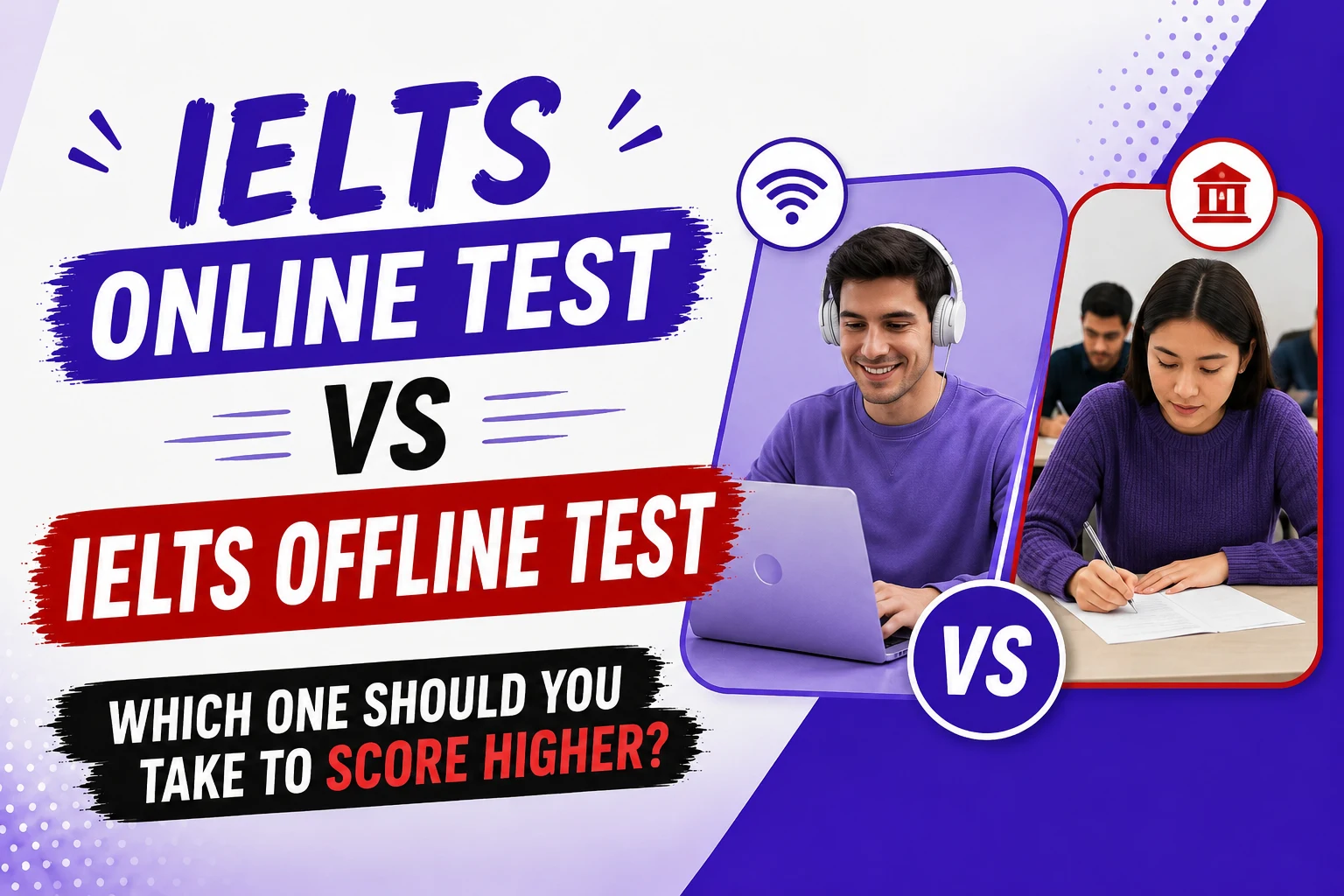
Choosing between the IELTS online test and the IELTS offline test feels like a small decision but it can genuinely affect your score. The two formats test the same skills, but they feel very different on exam day. Pick the wrong one and you’re fighting the format instead of showing your English ability.
This guide breaks down every difference between the two, tells you who performs better in each, and helps you make a confident decision before you book your test.
Table of Contents
- What Is the IELTS Online Test?
- What Is the IELTS Offline Test?
- Key Differences: Online vs Offline IELTS
- IELTS Computer Based Test vs Paper Based Test: Which Is Faster to Score?
- Who Should Choose the IELTS Online Test?
- Who Should Choose the IELTS Offline Test?
- Does the Format Affect Your Score?
- Tips to Prepare for Each Format
- FAQ
What Is the IELTS Online Test?
The IELTS online test officially called the computer-delivered IELTS is taken at an authorized test center on a computer. You read passages on screen, type your Writing answers, and click answers for Listening and Reading sections. The Speaking test is still done face-to-face with a human examiner.
This format launched globally in 2018 and is now available in over 100 countries. The test content and scoring criteria are exactly the same as the paper version IELTS confirms this officially. Only the delivery method changes.
What Is the IELTS Offline Test?
The IELTS offline test also called the IELTS paper-based test or IELTS paper test is the original format. You receive printed question booklets, write your answers by hand, and shade answer sheets with a pencil for Listening and Reading. Writing responses go directly on paper.
The paper test has been running since 1989 and is the format most test-takers grew up practicing with. It remains widely available and is still the only option in some smaller test centers.
Key Differences: IELTS Online Test vs IELTS Offline Test
| Feature | IELTS Online Test (Computer-Delivered) | IELTS Offline Test (Paper-Based) |
|---|---|---|
| Writing method | Typing on keyboard | Handwriting with pencil |
| Reading annotation | Highlight tool on screen | Underline/circle on paper |
| Results turnaround | 3–5 days | 13–15 days |
| Word count check | Automatic counter visible | You count manually |
| Editing answers | Easy to cut, paste, rearrange | You cross out and rewrite |
| Test availability | Multiple slots per week | Fewer sessions per month |
| Speaking test | Face-to-face (same as paper) | Face-to-face (same as online) |
| Score validity | 2 years | 2 years |
| Accepted by institutions | All institutions that accept IELTS | All institutions that accept IELTS |
The Speaking module is identical in both formats same examiner, same criteria, same scoring.
IELTS Computer Based Test vs Paper Based Test: Which Is Faster to Score?
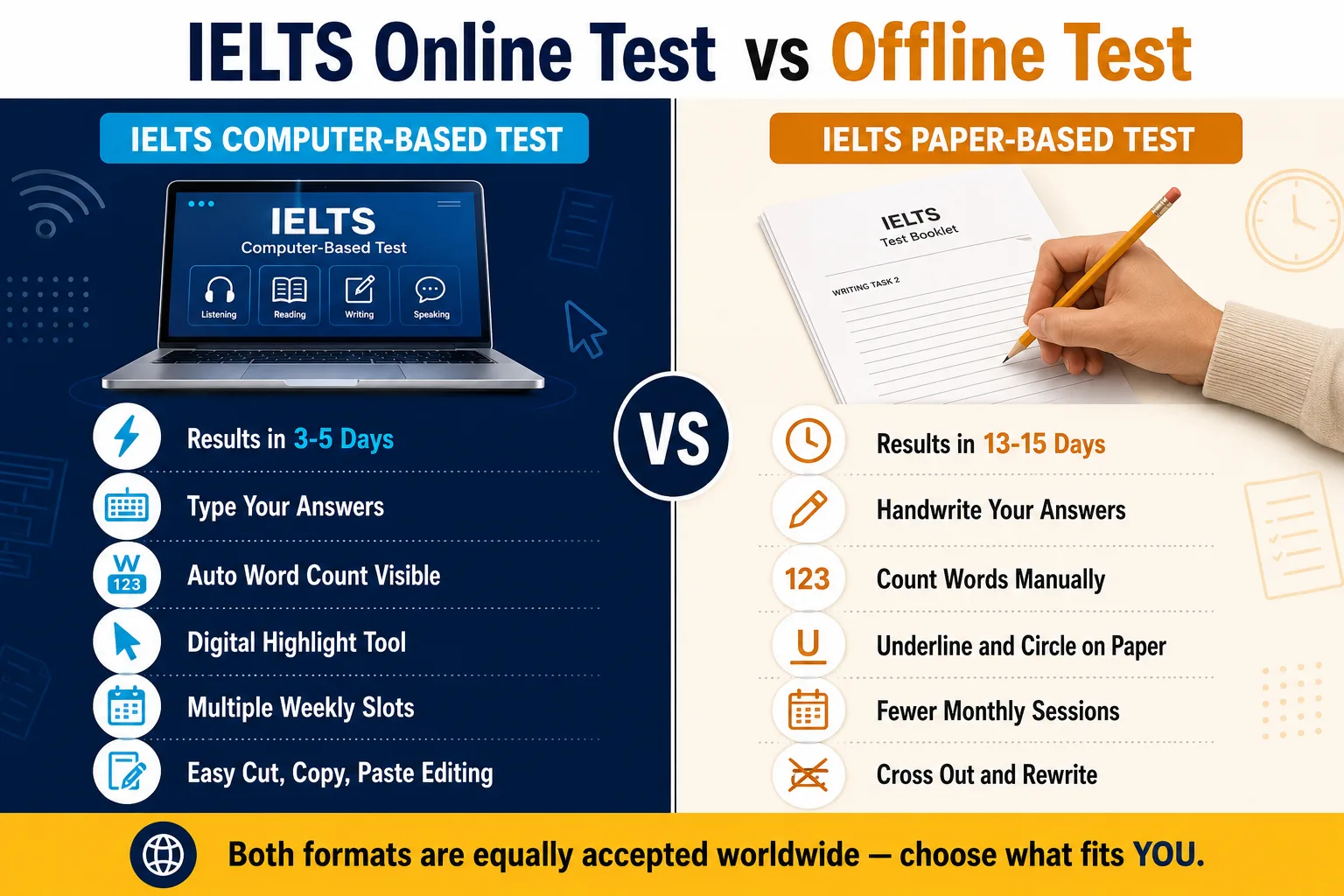
This is one area where the IELTS computer based test wins clearly. Results come back in 3–5 business days. The IELTS paper based test takes 13–15 days.
If you have an urgent university deadline or visa application, this difference matters a lot. Many test-takers now pick the computer-delivered IELTS simply because of faster results not because the format suits them better.
Speed aside, both formats carry equal weight with universities, immigration authorities, and employers worldwide.
Who Should Choose the IELTS Online Test?
The computer-delivered IELTS suits you if:
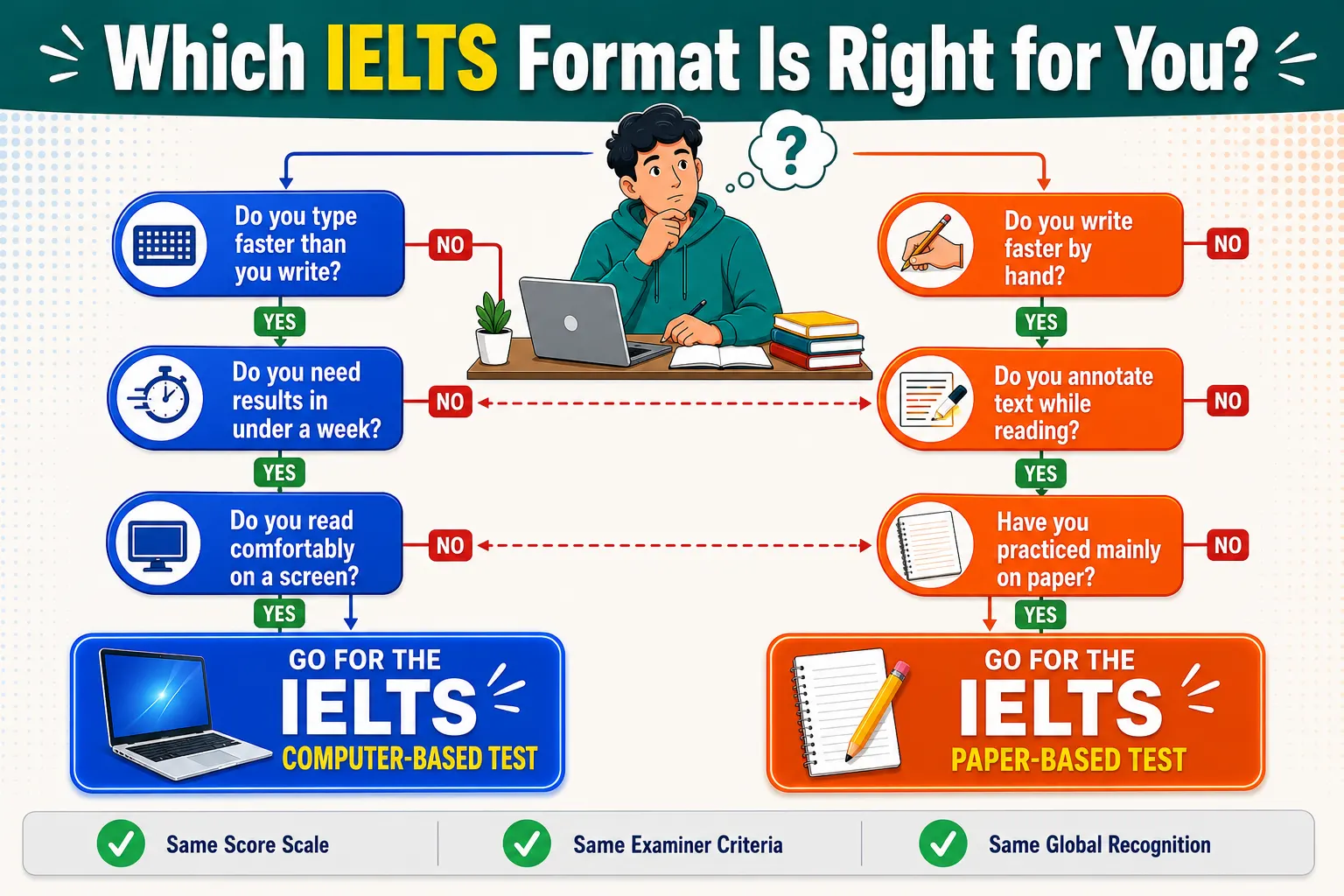
- You type faster than you write. If you use a keyboard daily for work or study, typing your Writing answers will feel natural. Many test-takers report writing 30–40% more words on the computer test simply because typing is faster for them.
- You want the built-in word counter. The screen shows your word count in real time. No more anxiously counting every word in Task 1 and Task 2 you always know where you stand.
- You need results quickly. A 3–5 day turnaround is a game-changer when deadlines are tight.
- You prefer editing on the fly. On the computer, you can move sentences, delete paragraphs, and restructure arguments without messy cross-outs. This helps test-takers who think and revise as they write.
- You read comfortably on screen. If you read news, books, or documents digitally every day, the screen format will feel comfortable rather than tiring.
Who Should Choose the IELTS Offline Test?
The IELTS paper test is the better pick if:
- Your handwriting is fast and clear. Some people genuinely write faster by hand. If you fill notebooks easily, paper may actually help your Writing score by keeping your rhythm going.
- You find screens tiring over long periods. The full test is nearly three hours. If digital eye strain affects your concentration, paper is easier on your focus.
- You annotate heavily while reading. Many strong readers underline key ideas, circle answers, and write margin notes. On the computer screen, the highlight tool exists but feels different paper gives you more physical control.
- You struggle with typing accuracy. Frequent typos or unfamiliarity with keyboard shortcuts can slow you down and add stress. On paper, your handwritten corrections are less disruptive.
- You have practiced mainly on paper. If all your mock tests and preparation materials are paper-based, switching formats on exam day adds unnecessary risk.
Does the Format Affect Your Score?
Research says: not significantly when you choose the right format for yourself.
A 2019 Cambridge Assessment study compared results across both formats and found no statistically significant difference in average band scores. The IELTS paper test and computer-delivered IELTS are designed to be equivalent.
But and this is the key insight most articles miss the research assumes test-takers are comfortable with their chosen format. A strong typist who takes the paper test, or a hand-writer who takes the computer test, can underperform simply due to format discomfort. The format itself is neutral. Your fit with the format is not.
So choose based on your habits, not on any myth that one version is “easier.”
Tips to Prepare for Each Format
Preparing for the IELTS Computer Based Test
- Practice typing timed essays. Set a 40-minute timer and type your Task 2 response without looking at the clock every minute. Build the muscle memory of sustained typing.
- Use the IELTS computer practice test on the official website. The British Council and IDP both offer free sample computer-delivered tests at their official portals use them. The interface is almost identical to exam day.
- Practise with the highlight and strikethrough tools. These are available during the Listening and Reading sections. Learning to use them quickly saves time.
- Build your typing speed if it’s below 40 words per minute. Free tools like TypingClub or Keybr can raise your speed noticeably in 2–3 weeks.
Preparing for the IELTS Paper Based Test
- Write by hand daily. Your handwriting speed and stamina drop if you only type. Start writing 200-word paragraphs by hand every day from at least 3 weeks before your exam.
- Use official IELTS Cambridge practice books. Books 1–18 in the Cambridge IELTS series use the real paper format and are the gold standard for paper test preparation.
- Count words consistently. Develop a fast counting system counting in groups of 10 takes less time than counting individually. Under-word penalties in Task 1 (under 150 words) and Task 2 (under 250 words) reduce your score automatically.
- Practice transferring answers in the Listening section. Paper test-takers get 10 extra minutes at the end of Listening to transfer answers to the answer sheet. Practise doing this accurately under time pressure errors here are avoidable mistakes.
FAQ
Is the IELTS computer based test easier than the paper test?
No. The questions, marking criteria, and band score calculations are identical in both formats. The British Council and IDP both confirm this. What differs is the delivery method screen versus paper. Some test-takers find one more comfortable than the other, which can indirectly affect performance.
Can I switch between IELTS online and offline test formats between attempts?
Yes. You can take the IELTS paper test in one session and the computer-delivered IELTS in the next. Many test-takers try both to find which suits them better. There is no restriction on switching formats between registrations.
Which format do UK universities and Australian immigration accept?
Both formats carry equal recognition. Every institution that accepts IELTS including UKVI-approved organizations, Australian Department of Home Affairs, and Canadian immigration accepts scores from both the computer-delivered IELTS and the paper-based IELTS without distinction.
How long does the IELTS computer based test take?
The total test time is approximately 2 hours and 45 minutes identical to the paper format. Listening is around 30 minutes, Reading is 60 minutes, and Writing is 60 minutes. Speaking is scheduled separately and lasts 11–15 minutes.
What happens if I make a mistake on the IELTS paper test?
You can cross out the wrong answer neatly and write the correct one beside it. Examiners accept clear corrections. For the answer sheet in Listening and Reading, erase the incorrect bubble fully and fill in the correct one. Messy or partially erased answers can sometimes be misread by automated scanners.
Which One Should You Choose?
The IELTS online test works best for people who type comfortably, want fast results, and like the flexibility of editing written responses on screen. The IELTS offline test works best for people who write quickly by hand, prefer annotating on paper, or have built their entire preparation around printed materials.
Neither the IELTS computer based test nor the IELTS paper based test gives you a scoring advantage on its own. The advantage comes from choosing the format that matches how you naturally work and then preparing specifically for that format.
Book a free practice session in your chosen format before exam day. Walk in knowing exactly what to expect. That preparation alone puts you ahead of most test-takers.
Leave a Reply