Most IELTS candidates run out of time. They read every word, answer carefully, and still find themselves guessing on the last five questions because the clock ran out.
Sound familiar?
The IELTS Reading section gives you 60 minutes for 40 questions across three long passages. That works out to roughly 90 seconds per question. Without the right ielts reading tips and tricks, you are spending your time the wrong way — reading instead of answering.
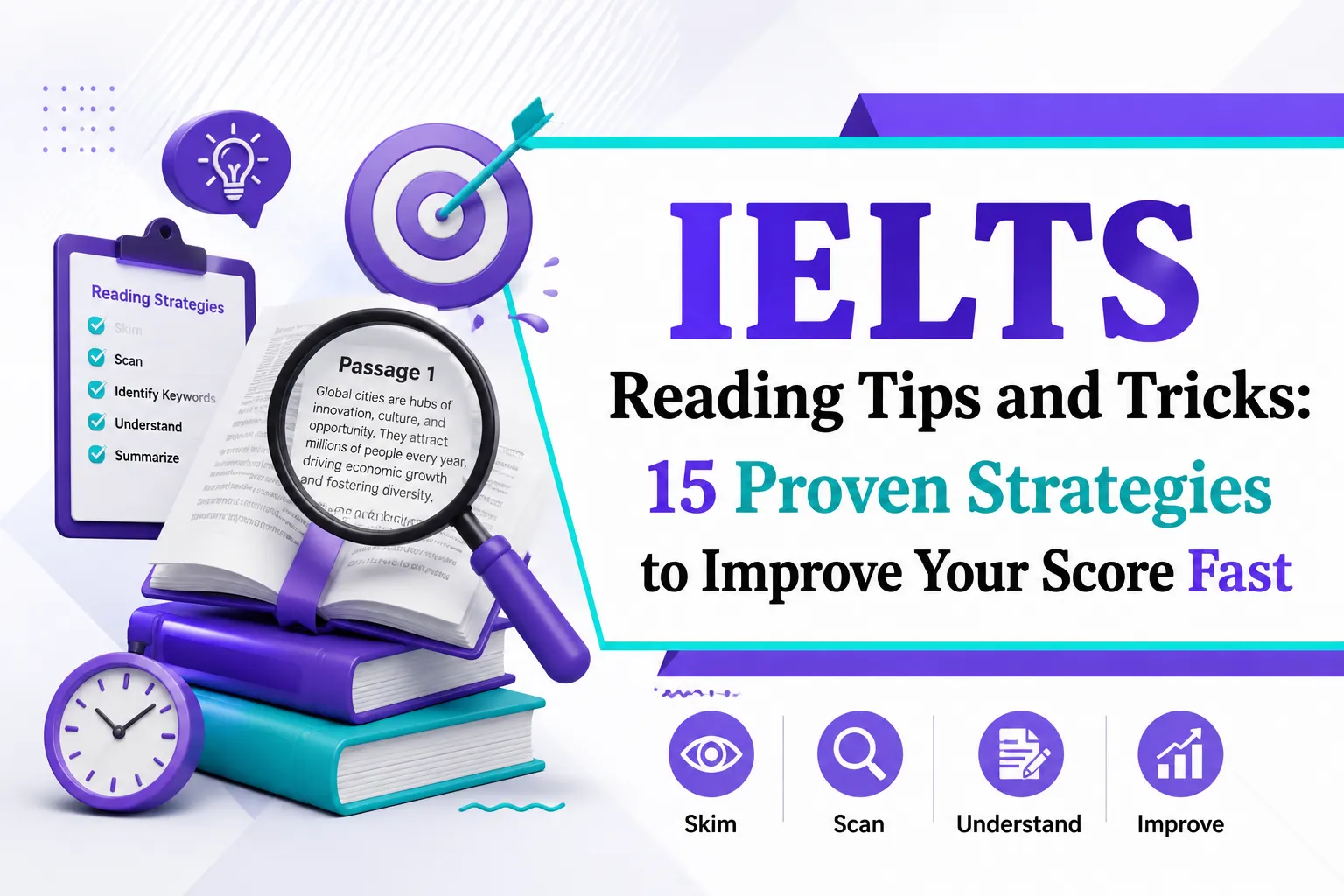
This guide gives you 15 strategies that experienced test-takers and IELTS trainers actually use. Not theory. Not generic advice. Specific techniques you can practise today and see results in your next mock test.
Understand the IELTS Reading Format First
Before any strategy works, you need to know exactly what you are dealing with.
The Academic IELTS Reading test has three passages, each progressively harder. Passage 1 is usually descriptive or factual. Passage 2 is more analytical. Passage 3 is the most complex — often an academic essay with abstract arguments.
The General Training test uses shorter texts in Passages 1 and 2, with only Passage 3 matching Academic difficulty.
Question types you will face include:
- True / False / Not Given and Yes / No / Not Given
- Matching headings to paragraphs
- Matching information to sections
- Sentence completion and summary completion
- Multiple choice (single and multiple answers)
- Short answer questions
- Matching features and matching sentence endings
Each question type needs a slightly different approach. The 15 tips below cover them all.
Tip 1: Read the Questions Before the Passage
This is the single most effective ielts reading tips and tricks technique, and most students skip it.
Before you read a single word of the passage, read all the questions for that section. Underline the key nouns and names. Now when you read, your brain is not processing the text generally — it is hunting for specific information it already knows to look for.
This turns passive reading into active searching. You will find answers faster and stay focused throughout the passage.
Tip 2: Skim for Structure, Not Meaning
Skimming does not mean reading quickly. It means reading selectively.
When you first look at a passage, read only the first sentence of each paragraph. That sentence almost always tells you what the paragraph is about. In about 60–90 seconds, you will have a rough map of the entire passage — where each topic lives, and where to return when a question points you to that topic.
Do not try to understand the passage fully at this stage. That comes later, one paragraph at a time, when a question directs you there.
Tip 3: Scan for Keywords, Not Sentences
Once you know what a question is asking, go back to the passage and scan — not read — for the keyword or a synonym of it.
Move your eyes quickly down the column of text. You are looking for a name, a number, a capitalised word, or a specific noun from the question. When you spot it, stop and read only the two or three sentences around it. That is almost always where the answer lives.
This technique alone can save you 10 minutes on a full test.
Tip 4: Never Read Every Word
Reading every word is the habit that destroys scores. The passages in IELTS Academic are between 700 and 1,000 words each. Reading all three fully takes 25–35 minutes just for reading — before you answer a single question.
Train yourself to trust your scanning ability. You do not need to understand everything. You need to find specific answers to specific questions. That is a completely different skill, and it is one you can practise deliberately.
Tip 5: Use the Passage Map Technique
As you skim the passage, write a one- or two-word note next to each paragraph in your test booklet. Something like: “para A — history of solar panels,” “para B — cost comparison,” “para C — government policy.”
This takes about 90 seconds and saves far more time later. When a question asks about government policy, you know immediately which paragraph to scan. Without a map, you are searching blindly through 900 words every time.
Tip 6: Tackle True / False / Not Given Strategically
This question type trips up more candidates than any other. The difference between False and Not Given confuses almost everyone at first.
Here is the rule:
- True: the passage directly confirms the statement.
- False: the passage directly contradicts the statement.
- Not Given: the passage does not mention the idea at all — neither confirming nor contradicting it.
The key word is “directly.” If you find yourself inferring, guessing, or using outside knowledge — the answer is almost always Not Given. IELTS does not test what you know. It tests what the passage says.
Work through the statements in order. The answers usually follow the order of the passage, which makes scanning faster.
Tip 7: Crack Matching Headings with Topic Sentences
Matching headings to paragraphs is one of the most time-consuming question types if you approach it wrong.
The right approach: read only the first sentence and last sentence of each paragraph. The first sentence introduces the topic. The last sentence often reinforces or summarises it. Those two sentences, together, almost always point you to the correct heading.
Avoid trying to match the heading to the whole paragraph — you will get lost in detail. Match it to the paragraph’s main idea, which those two sentences give you.
Tip 8: Handle Sentence Completion with Grammar Logic
In sentence completion questions, the answer must fit grammatically into the gap. Use this to your advantage.
If the gap follows “a” or “an,” the answer is a singular noun. If it follows a verb, you need a noun phrase or complement. If the instruction says “use no more than two words,” a three-word answer is automatically wrong no matter how well it fits.
Always check the word limit. Students lose easy marks by adding one extra word.
Tip 9: Manage Your Time with the 20-Minute Rule
Spend no more than 20 minutes on each passage. Set this boundary firmly.
If you hit 20 minutes and are not done with Passage 1, make your best guess on remaining questions and move on. You do not want to arrive at Passage 3 — the hardest one — with only 10 minutes left.
In IELTS, an unanswered question and a wrong answer both give you zero marks. There is no penalty for guessing. So always put something, even if you are not sure.
Tip 10: Build Your Vocab for IELTS Reading
Vocabulary is the foundation everything else builds on. Passages use academic and formal language, and the questions often paraphrase the passage using different words.
Focus your vocab for IELTS preparation on:
- Academic word list (AWL) words that appear across many subjects — words like “demonstrate,” “indicate,” “alternative,” “significant,” “contrast,” and “justify”
- Topic-specific vocabulary in areas that appear frequently in IELTS — environment, technology, education, health, and social science
- Synonym groups — learn words in clusters rather than in isolation. If you know “demonstrate” means the same as “show,” “illustrate,” and “evidence,” you will recognise paraphrasing instantly
Strong vocabulary also helps your ielts speaking topics answers and writing — building it benefits your entire test, not just reading.
Tip 11: Watch for Paraphrasing Traps
IELTS test writers are very good at paraphrasing. The passage might say “the study revealed a significant drop in temperatures,” and the question says “researchers found temperatures fell sharply.” Same meaning, completely different words.
The trap works in both directions. Sometimes a question uses almost the same words as the passage — but the meaning is subtly different, making it False or Not Given. Do not assume that matching words means a correct answer.
Always ask: does this statement mean the same thing as what the passage says? Not just: do these words look similar?
Tip 12: Use Elimination on Multiple Choice
Multiple choice questions in IELTS are designed to distract you with plausible-sounding wrong answers. Each wrong option usually contains something that is mentioned in the passage — but twisted slightly, overstated, or taken out of context.
Work by elimination. Cross out any option that is clearly wrong, partially wrong, or uses stronger language than the passage supports (words like “always,” “never,” “all,” and “completely” are usually traps). You will often narrow it to two options quickly, making your final choice much easier.
Tip 13: Do Not Leave Any Answer Blank
There is no negative marking in IELTS. A blank answer gives you zero. A guess gives you a chance.
For True / False / Not Given, if you have no idea, write “Not Given” — it statistically comes up most often when test-takers are genuinely unsure, because the absence of information is harder to detect than a direct contradiction.
For other question types, eliminate what you can and pick from what remains. Even a random guess from two options gives you a 50% chance of a correct mark.
Tip 14: Practise with Real Cambridge Tests Only
This one saves you from wasting months of preparation.
Only Cambridge IELTS Official Practice Tests accurately replicate the real exam — the passage length, vocabulary level, question distribution, and timing. Third-party books and online practice tests vary wildly in quality and can build bad habits.
Use Cambridge IELTS books 1 through 18 (available in most bookshops and online). Do each test under timed conditions — 60 minutes, no pausing. Then review every wrong answer carefully before moving to the next test.
Quality of practice matters far more than quantity. Two properly reviewed Cambridge tests beat ten rushed ones every time.
Tip 15: Review Mistakes the Right Way
Most students check their score, feel good or bad about it, and move on. That is wasted practice.
Every wrong answer is a lesson if you analyse it properly. For each mistake, ask:
- Did I misread the question or misunderstand the passage?
- Was this a vocabulary problem — a word I did not know?
- Did I fall for a paraphrasing trap?
- Did I run out of time and guess?
Each cause has a different fix. Vocabulary problems need more vocab study. Paraphrasing traps need more awareness of how IELTS rephrases ideas. Time problems need timed practice with stricter self-discipline.
Keep a mistake log. After five or six tests, patterns will emerge. Fix the pattern, not the individual question.
How to Improve IELTS Reading Score: The 4-Week Plan
If you have four weeks before your exam, here is how to structure your preparation using these ielts reading tips and tricks:
Week 1 — Foundation: Do one Cambridge test without timing. Focus on understanding every question type and applying Tips 1–5. Do not worry about your score yet.
Week 2 — Technique: Do two timed tests. Apply Tips 6–11 consciously. Review every mistake with the question from Tip 15.
Week 3 — Speed: Do three timed tests. Enforce the 20-minute rule. Focus on scanning speed and vocabulary recognition.
Week 4 — Refinement: Do two full timed tests. Identify your weakest question type and spend extra time drilling only that type with past papers.
Most students who follow this plan improve by one full band within four weeks.
FAQ: IELTS Reading Tips and Tricks
How many questions do you need to get right for a band 7 in IELTS Reading?
For Academic IELTS, you need approximately 30 correct answers out of 40 for a band 7. For General Training, the threshold is slightly higher — around 34 correct — because the passages are generally more accessible. These numbers can shift slightly between test versions due to score scaling.
Should you read the passage or the questions first in IELTS Reading?
Always read the questions first. Knowing what to look for before you read the passage makes scanning far more targeted and saves significant time. This applies to all question types except matching headings, where skimming the paragraph first is more effective.
How long should you spend on each IELTS Reading passage?
Aim for 20 minutes per passage. This gives you a small buffer at the end to review flagged questions. Most high-scorers spend 16–18 minutes on Passage 1 and 2, leaving a little more time for the harder Passage 3.
What is the difference between True / False / Not Given and Yes / No / Not Given?
The question types work identically — the difference is only in what they test. True / False / Not Given applies to factual statements about things in the real world. Yes / No / Not Given applies to the writer’s opinions or claims. The strategy for answering both is the same: only mark something True or Yes if the passage directly states it.
Does vocabulary really affect IELTS Reading scores?
Yes, significantly. A strong vocab for IELTS means you understand paraphrasing, recognise synonyms quickly, and spend less time decoding sentences. Candidates who score band 8 or above typically have a wide reading vocabulary built through months of regular reading in English — academic articles, quality newspapers, and non-fiction books are all good sources.
Final Thoughts
The IELTS Reading section rewards strategy more than intelligence. You do not need to understand every passage fully. You need to find specific answers quickly, avoid common traps, and manage your time with discipline.
Apply these ielts reading tips and tricks one by one in your practice sessions. Do not try to change everything at once. Master two or three techniques per week, test them under timed conditions, and build from there.
Your score will follow.
Leave a Reply