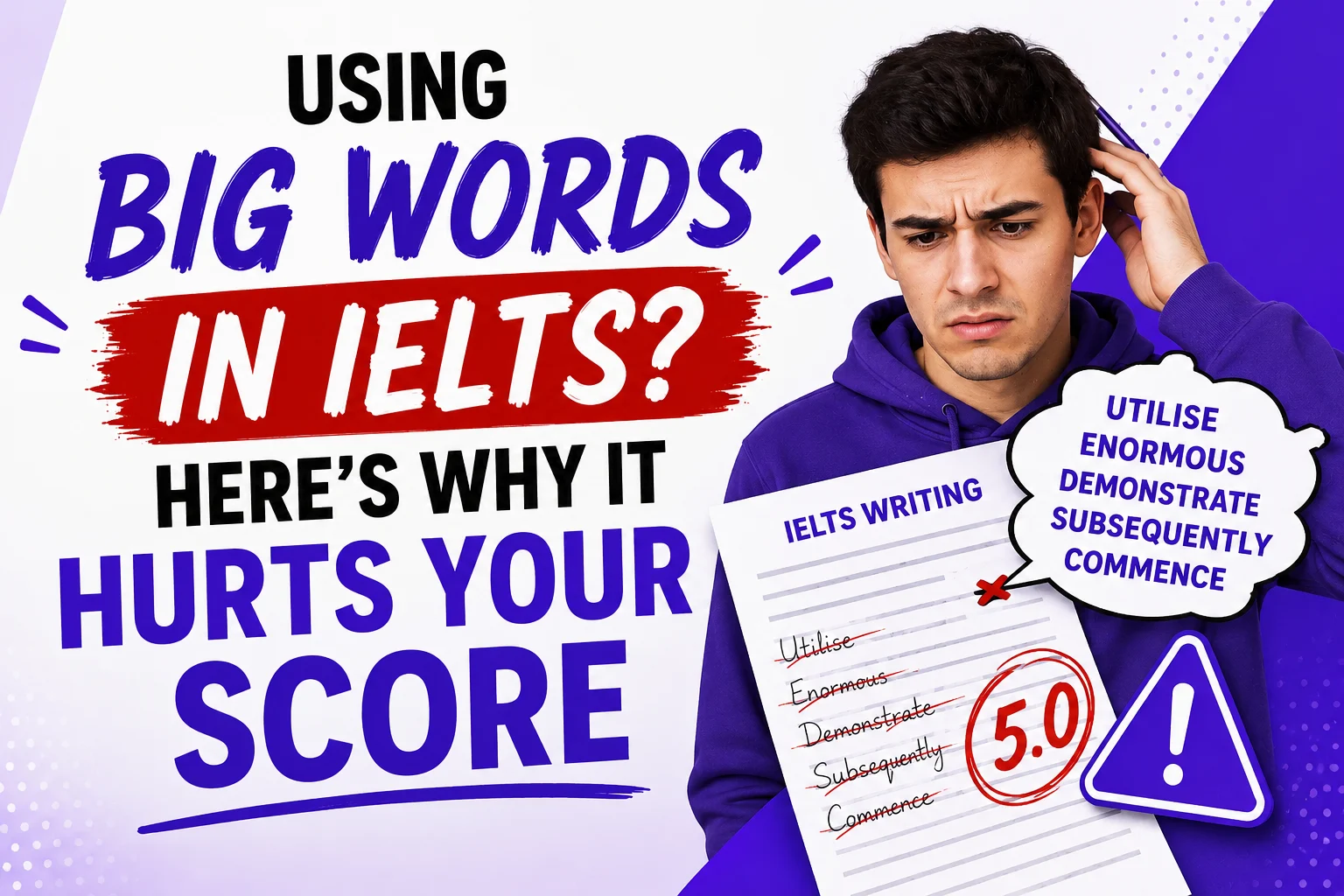
Many students believe that loading their answers with rare, complex words in IELTS will impress the examiner. It sounds logical bigger words must mean a bigger vocabulary score, right? Wrong. This is one of the most common mistakes that pulls scores down, especially for beginners and intermediate learners.
The truth is, how you use words in IELTS matters far more than which words you choose. This article breaks down why oversized vocabulary backfires, what examiners actually look for, and how to build the kind of vocabulary that genuinely raises your band score.
Table of Contents
- What Examiners Really Look for in IELTS Vocabulary
- Why Using Big Words Hurts Your Score
- The Right Way to Use Vocabulary Words for IELTS
- Vocabulary for IELTS Speaking: Special Rules
- What to Learn Instead of Rare Words
- Building Your IELTS Vocabulary List the Smart Way
- FAQ
What Examiners Really Look for in IELTS Vocabulary
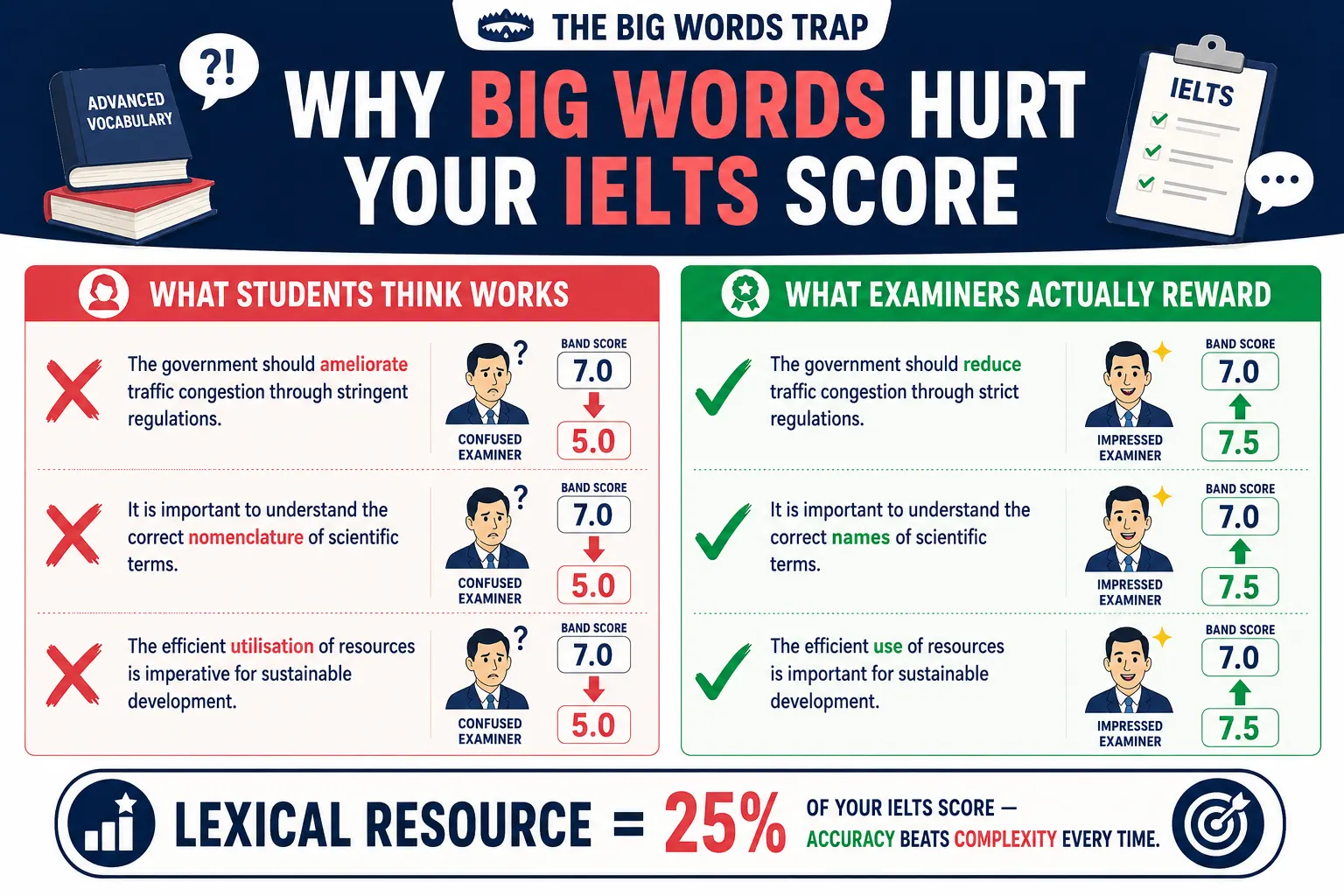
The IELTS Writing and Speaking tests both use a criterion called Lexical Resource. This accounts for 25% of your total Writing score and 25% of your Speaking score.
Lexical Resource does NOT mean “uses the hardest words possible.” According to the official IELTS band descriptors, a Band 7 candidate uses “a sufficient range of vocabulary to allow some flexibility and precision” not a dictionary of academic jargon.
Examiners look for three specific things:
- Range: Can you use different words to express the same idea? Can you avoid repeating the same word over and over?
- Accuracy: Are you using words in the right context, with the right grammar, and with the correct collocations (words that naturally go together)?
- Appropriacy: Do your word choices suit the task, the tone, and the topic?
A student who writes “the utilisation of excessive nomenclature” instead of “using too many big words” is not showing skill. They are showing confusion.
Why Big Words Hurt Your Score
1. Wrong Context = Automatic Penalty
Every advanced word has rules about where it fits. “Ameliorate” means to improve, but you cannot say “the weather ameliorated my mood” the way you would say “the walk improved my mood.” If you use a fancy word in the wrong context, the examiner marks it as an error. One mistake like this can drop your Lexical Resource score by half a band.
2. Unnatural Collocations Signal Memorisation
When students study an IELTS vocabulary list and paste words into their writing, the sentences often sound strange. “Make a deep influence” instead of “have a profound influence” is a collocation error. Examiners are trained to spot these. They do not reward memorised vocabulary they penalise its misuse.
3. It Disrupts Coherence and Cohesion
Big, unfamiliar words slow the reader down. In IELTS Writing, another 25% of your score comes from Coherence and Cohesion how clearly your ideas flow. If your word choices make the text awkward or hard to follow, you lose marks in two categories at once.
4. In Speaking, It Sounds Rehearsed
For vocabulary for IELTS speaking, using memorised academic words in a spoken answer is easy to detect. Examiners hear hundreds of candidates. They can tell the difference between someone who genuinely knows a word and someone who rehearsed it. Forced vocabulary in speaking also causes unnatural pausing, mispronunciation, and a robotic tone all of which hurt your Fluency and Coherence score.
The Right Way to Use Vocabulary Words for IELTS
The goal is not to sound academic. The goal is to communicate clearly and precisely, with enough variety to show you have range.
Here is what that looks like in practice:
- Use a mix of simple and mid-level words, not exclusively high-level ones. A sentence like “City planners must address the rising cost of public transport” is clear, accurate, and natural. It does not need to become “Municipal administrators must mitigate the escalating expenditure of public transit.”
- Focus on topic-specific vocabulary rather than general academic vocabulary. If the topic is environment, words like “carbon emissions,” “renewable energy,” and “biodiversity” are far more useful than generic academic terms.
- Pair new words with correct collocations. Do not just learn “deplete” learn “deplete natural resources.” Do not just learn “tackle” learn “tackle a problem.”
- Use synonyms purposefully, not randomly. Replacing “said” with “elucidated” in every sentence is not variety it is noise.
Vocabulary for IELTS Speaking: Special Rules
Speaking has different expectations from Writing. The language should sound like a confident, educated person talking not reading from a textbook.
For vocab for IELTS, here is what works in the speaking test:
- Idiomatic expressions used correctly show natural range. Saying “it’s a double-edged sword” or “there’s a fine line between the two” sounds genuinely fluent.
- Descriptive, precise language beats rare words every time. “The streets were completely gridlocked” is better than “vehicular congestion rendered thoroughfares impassable.”
- Paraphrasing the question using different words shows lexical flexibility without forcing big vocabulary. If the examiner asks about “environmental problems,” you can naturally say “issues affecting the natural world” in your answer.
- Self-correction is fine. If you use a word and then correct yourself to a more accurate one, examiners see that as a positive sign of awareness.
What to Learn Instead of Rare Words
Shifting your focus away from obscure words will actually get you a higher score faster. Here is what to build instead:
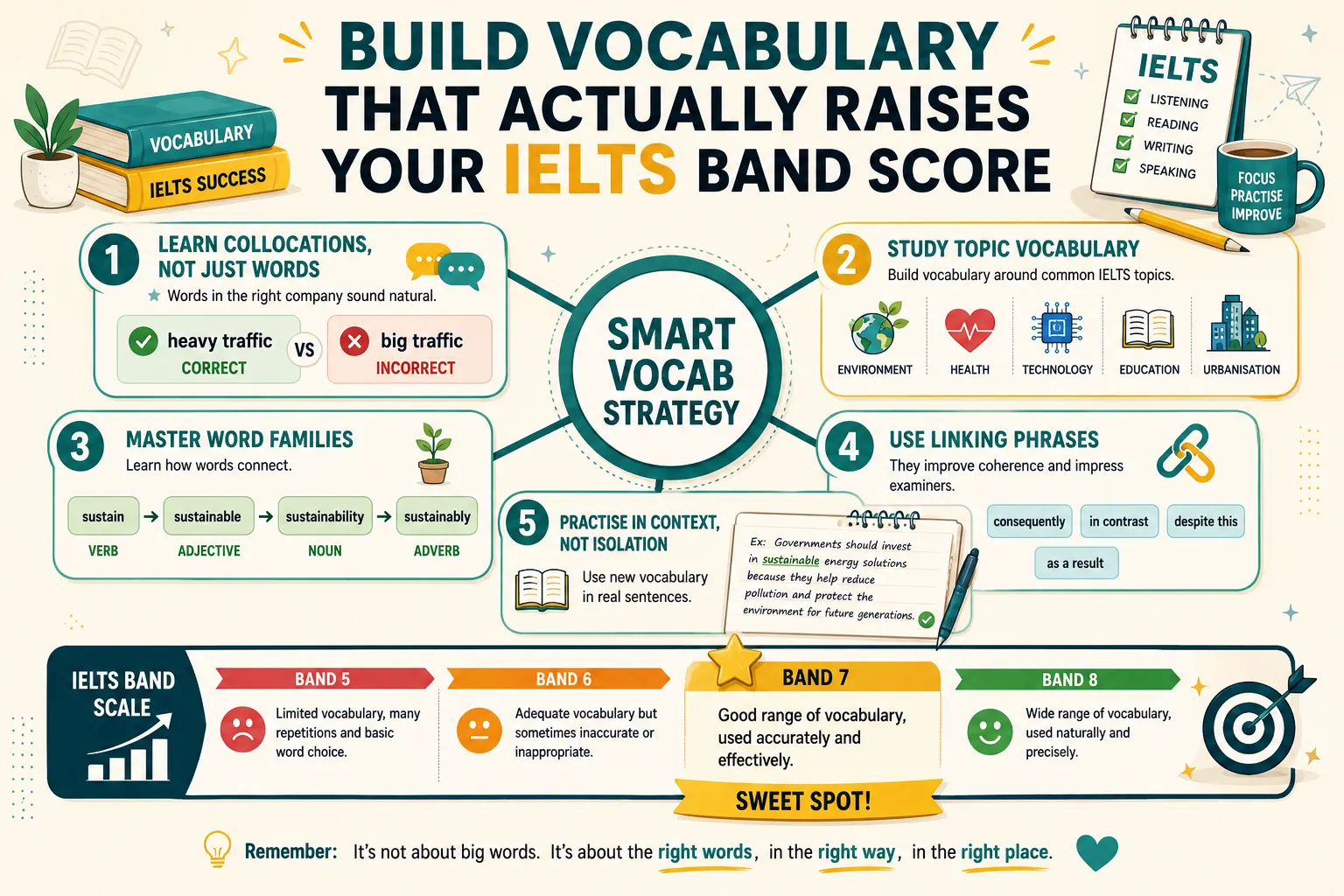
Collocations: These are word pairs that naturally go together. “Heavy traffic,” not “big traffic.” “Make a decision,” not “do a decision.” A solid grasp of collocations is one of the strongest markers of a Band 7+ candidate.
Topic vocabulary: Pick 8-10 essential words per common IELTS topic (health, environment, technology, education, urbanisation) and learn them deeply meaning, spelling, pronunciation, collocations, and example sentences.
Linking phrases: Words like “consequently,” “in contrast,” “as a result,” and “despite this” add sophistication without the risk of misusing rare vocabulary. They also directly boost your Coherence and Cohesion score.
Academic word families: Instead of memorising one rare synonym, learn a word in multiple forms. “Sustain → sustainable → sustainability → sustainably” gives you four usable tools from one root.
Building Your IELTS Vocabulary List the Smart Way
A smarter IELTS vocabulary list does not look like a thesaurus. It looks like a learning system.
Follow this process:
- Study from IELTS-specific sources: Cambridge IELTS books, the British Council vocabulary pages, and the Academic Word List (AWL) are built around actual test content. Avoid generic “hard English words” lists they are not designed for IELTS.
- Learn words in sentences, not isolation: “Substantial” is useless if you only know it means “big.” Learn it as “a substantial increase in urban population” so you know how it behaves in context.
- Practise using words in writing tasks: Write one practice paragraph using five new words each week. Check your collocations on a resource like the Longman Collocations Dictionary or the COCA corpus.
- Record yourself using new words in speaking: If a word sounds odd when you say it aloud, you are not ready to use it in the test. Fluency matters.
- Review regularly: Spaced repetition (reviewing words at increasing intervals) helps words move from short-term to long-term memory. Apps like Anki make this straightforward.
A Quick Word on Band Score Expectations
Many students target Band 7 but study vocabulary as if they need Band 9. Here is a reality check:
- Band 5: Uses basic vocabulary with limited range. Errors are frequent.
- Band 6: Uses an adequate vocabulary, some errors in word choice and collocation.
- Band 7: Uses vocabulary with some flexibility and precision. Less common lexical items attempted with occasional errors.
- Band 8: Uses a wide vocabulary fluently and flexibly. Rare minor errors.
Notice that Band 7 says “less common lexical items attempted” not mastered, and “occasional errors” are acceptable. You do not need perfect rare vocabulary to hit Band 7. You need accurate, flexible use of a solid mid-range vocabulary. That is a very achievable target.
Words in IELTS: The Real Strategy
The most successful IELTS candidates are not the ones who memorised the longest word list. They are the ones who used words in IELTS correctly, precisely, and naturally.
Go back to the basics. Build topic vocabulary, master collocations, and practise in context. Use advanced words only when you are genuinely confident in how they work. One accurate mid-level word is worth five misused complex ones.
Your score will reflect your real command of the language not the size of your thesaurus.
FAQ
Q1: Will using synonyms always improve my IELTS vocabulary score?
Only if the synonyms are accurate and natural. Using “commence” instead of “start” is fine, but using it in every sentence sounds forced. Variety must feel organic. If a synonym does not fit the context perfectly, stick with the simpler word.
Q2: How many new vocabulary words for IELTS should I learn per week?
Quality beats quantity here. Learning 10 words deeply with their collocations, example sentences, and word families is far more useful than memorising 50 words in isolation. Most IELTS teachers recommend 8 to 15 words per week at a deep learning level.
Q3: Is there a specific IELTS vocabulary list I should study from?
Yes. The Academic Word List (AWL), developed by Averil Coxhead, covers the most common academic words across university-level texts. Pair it with topic-specific vocabulary from Cambridge IELTS practice books and you have a very strong foundation.
Q4: Does vocab for IELTS speaking differ from writing vocabulary?
It does. Speaking rewards natural, idiomatic language over formal academic terms. In writing, more formal vocabulary is appropriate but it still must be accurate. The key difference is tone: speaking should sound conversational and confident, not like a written essay.
Q5: Can I use phrasal verbs in IELTS Writing?
In IELTS Writing Task 1 and Task 2, it is better to avoid informal phrasal verbs like “go up” (use “increase”) or “bring about” (use “cause”). However, some neutral phrasal verbs are acceptable. In IELTS Speaking, phrasal verbs are completely appropriate and actually add to your score if used naturally.
Leave a Reply