
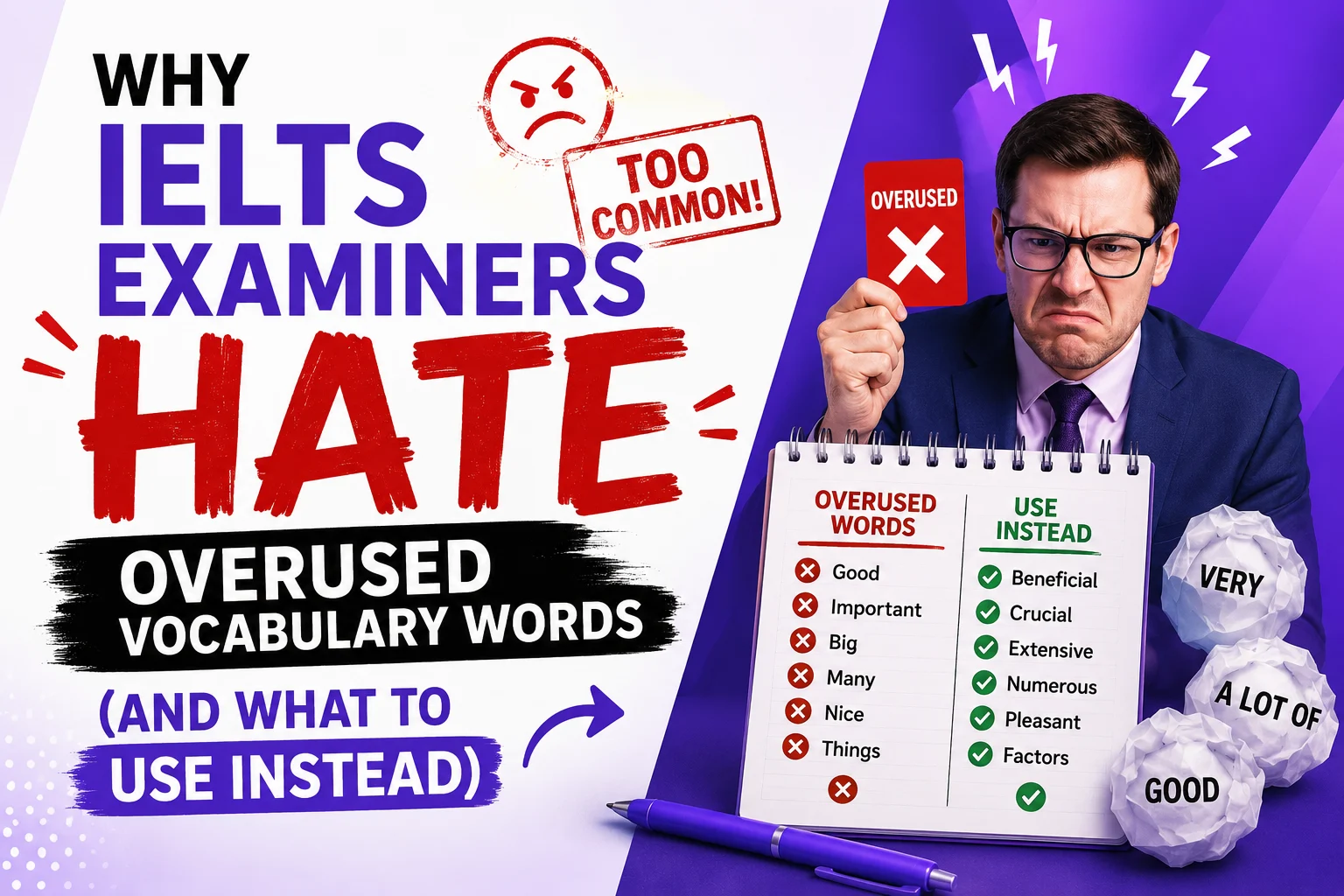
You spent weeks memorizing “advanced” vocabulary words for your IELTS exam. You used them everywhere in Task 2 essays, in your Speaking test, in every sentence you could fit them into. Then your score came back lower than expected. What went wrong?
The problem is overused vocabulary. IELTS examiners read hundreds of scripts every week, and they spot clichéd vocabulary words within seconds. Using the same worn-out phrases that every test-taker uses does not signal a strong command of English it signals the opposite.
This article tells you exactly which vocabulary words trigger examiner frustration, why they hurt your score, and what you should write instead.
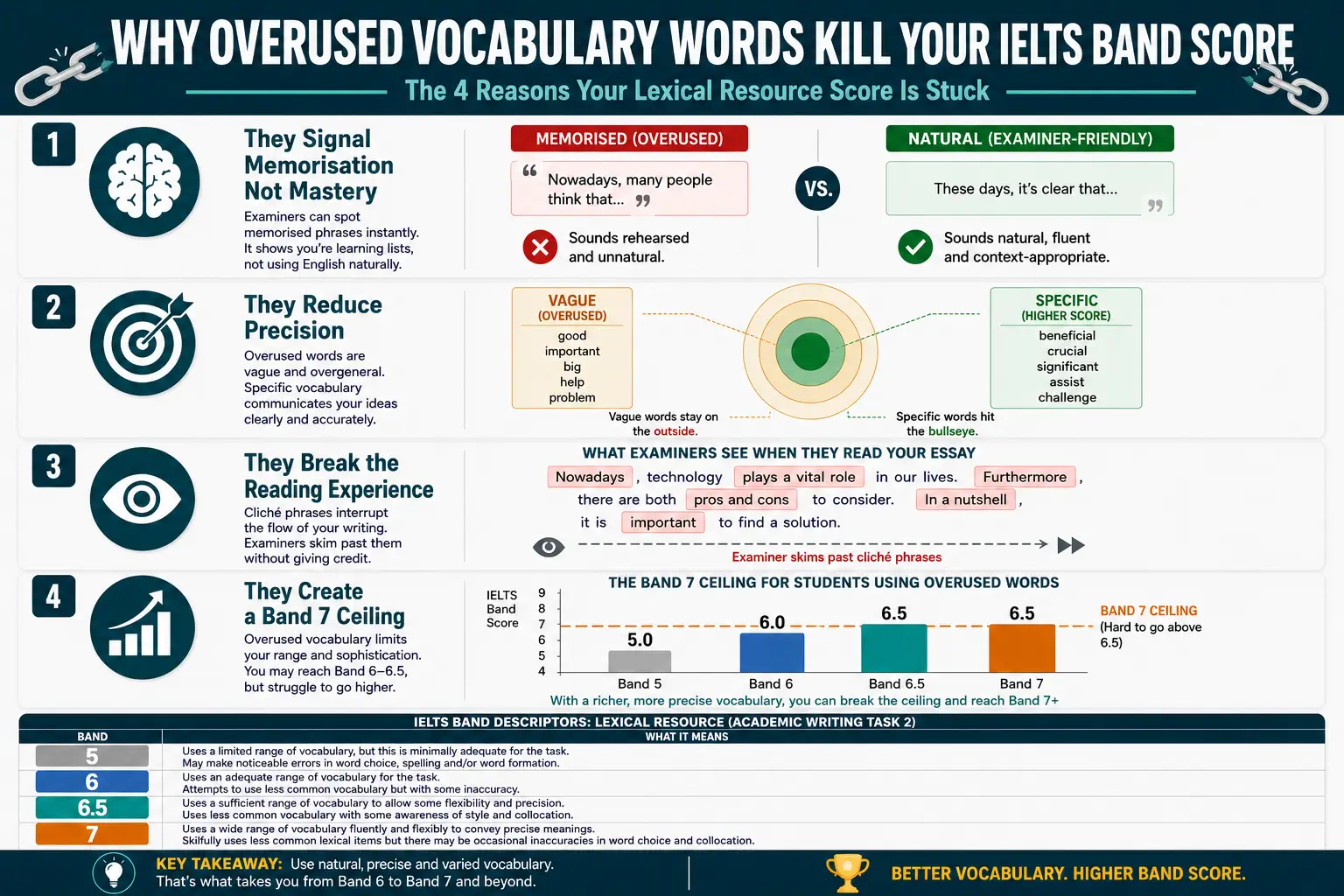
Table of Contents
- What the IELTS Marking Criteria Actually Says
- The Most Overused Vocabulary Words in IELTS Writing
- Why Examiners Penalize These Words
- IELTS Examiner Pet Peeves in Speaking
- How to Replace Common IELTS Words Effectively
- The Right Way to Build a Strong Vocabulary for IELTS
- Frequently Asked Questions
1. What the IELTS Marking Criteria Actually Says
IELTS Writing is scored on four criteria, each worth 25% of your band score:
- Task Achievement – Did you answer the question fully?
- Coherence and Cohesion – Is your writing logically organized?
- Lexical Resource – Do you use a wide, accurate range of vocabulary words?
- Grammatical Range and Accuracy – Do you use varied and correct grammar?
Lexical Resource directly measures your vocabulary. The official IELTS band descriptors say that a Band 7 candidate uses “a sufficient range of vocabulary to allow some flexibility and precision.” A Band 5 candidate shows “noticeable repetition of vocabulary.”
Here is what many students miss: using the same overused vocabulary words that appear in every student’s essay is a form of repetition even if you only write each word once.
Examiners are trained to assess range and precision. When you use vague, overused words, you show neither.
2. The Most Overused Vocabulary Words in IELTS Writing
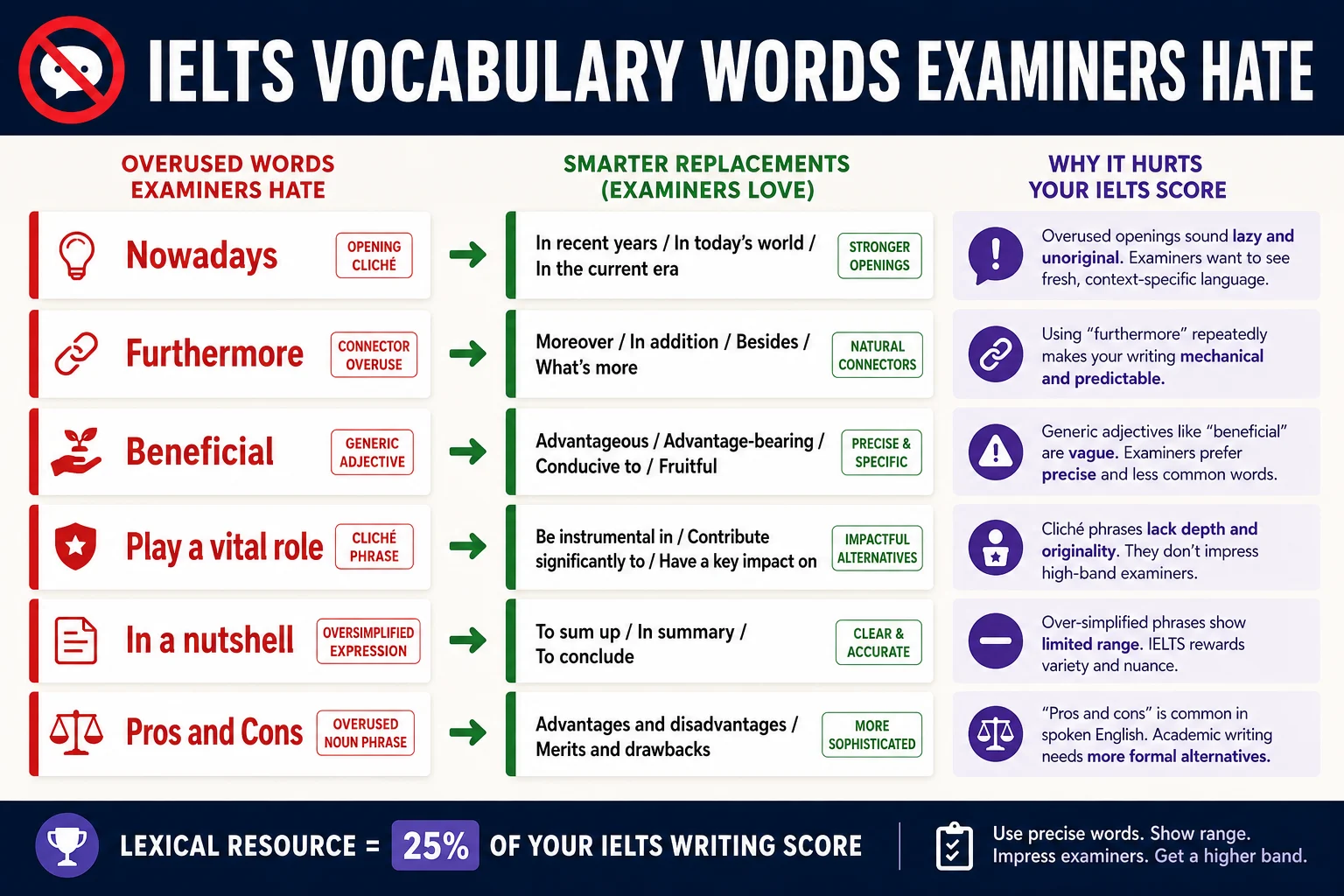
These are the words and phrases that appear most frequently in IELTS scripts and that examiners flag as clichés.
“Nowadays”
Almost every IELTS essay begins with “Nowadays, technology has changed the world.” Examiners have read this opening thousands of times. It adds no meaning and signals a formulaic approach.
Better options: “Over the past decade,” / “In recent years,” / “Since the rise of digital communication,”
“Furthermore” and “Moreover”
These linking words appear so frequently that they have lost impact. Students drop them between any two sentences, even when the connection is weak.
Better options: Use “This also means that,” / “Beyond this,” / “On top of that,” or restructure the sentence so no connector is needed.
“Beneficial” and “Detrimental”
Students learn these words as “advanced” synonyms for good and bad. But because every student learns the same list, these words have become the new basic vocabulary.
Better options: Be specific. Instead of “social media is beneficial,” write “social media helps isolated individuals maintain friendships across long distances.”
“Play a Vital Role”
This phrase appears in nearly every IELTS essay on education, government, or technology. Examiners have seen it so many times it registers as filler.
Better options: Say what the subject actually does. “Governments fund public schools” is stronger than “Governments play a vital role in education.”
“In a Nutshell”
This is one of the most common IELTS overused vocabulary phrases in conclusions. It sounds informal and adds nothing.
Better options: Simply state your conclusion directly. You do not need a signposting phrase at all.
“Pros and Cons”
This phrase is informal and vague. It belongs in casual conversation, not in an academic IELTS essay.
Better options: “Advantages and disadvantages,” / “Benefits and drawbacks,” or better yet, state the specific arguments directly.
“It Goes Without Saying”
If something goes without saying, why are you saying it? This phrase wastes words and frustrates examiners.
Better options: Delete the phrase entirely and state the point directly.
3. Why Examiners Penalize These Words
Overused Words Signal Memorization, Not Mastery
IELTS examiners know what vocabulary lists look like. When a candidate uses the same ten “impressive” vocabulary words that appear on every prep website, it signals rote memorization rather than real language ability.
Real language ability means choosing the right word for the right context — not inserting a word because it looks academic.
They Reduce Precision
Strong vocabulary is precise. When you write “technology has a beneficial impact on society,” you have said almost nothing. Which technology? What kind of impact? On which part of society?
Vague vocabulary words force the examiner to do the work of figuring out what you mean. That is the opposite of what strong writing does.
They Break the Reading Experience
Examiners read quickly. Familiar, overused phrases trigger a kind of mental auto-pilot where the reader stops engaging with the actual meaning. Your argument stops landing because the language stops registering.
Fresh, specific language keeps the examiner engaged and demonstrates that you are thinking — not just reproducing a template.
The Band 7+ Ceiling
Research from IELTS preparation experts and published examiner reports consistently shows that candidates who rely on common IELTS words rarely break past Band 6.5 in Lexical Resource. The band descriptors explicitly reward “less common vocabulary” and penalize “inappropriate word choice.”
4. IELTS Examiner Pet Peeves in Speaking
The Speaking test has its own set of vocabulary words that examiners hate hearing repeatedly.
“To be honest with you” — This filler phrase appears before almost every answer, regardless of whether the answer involves honesty at all. It wastes time and adds no meaning.
“In my humble opinion” — Examiners want you to state your opinion confidently. Excessive hedging sounds unnatural.
“As we all know” — This phrase assumes shared knowledge and can sound condescending. State the information directly instead.
Repetition of the examiner’s exact question words — Saying “Well, the question is asking about technology, and technology is…” just to buy thinking time is fine occasionally, but doing it after every question is a clear signal that your vocabulary range is limited.
A strong Speaking score comes from using vocabulary words naturally, varying your expressions, and recovering confidently when you cannot find a word. It does not come from filling space with memorized phrases.
5. How to Replace Common IELTS Words Effectively
Avoiding overused vocabulary is not about memorizing a new list of rare words. It is about developing flexibility. Here is a practical framework.
Step 1: Identify the Function of the Word
Before choosing a word, ask what job it needs to do. Is it connecting two ideas? Describing an effect? Signaling contrast? Knowing the function helps you choose precisely.
Step 2: Be More Specific
The fastest upgrade you can make is to replace a vague word with a specific one. Study these examples:
| Overused Word/Phrase | Specific Replacement |
|---|---|
| “Beneficial” | “Reduces commute time by up to 40%” |
| “A lot of people” | “The majority of urban workers” |
| “Bad for society” | “Increases income inequality” |
| “In conclusion” | State the final point directly |
| “Furthermore” | “This creates a second problem:” |
Step 3: Use Context Clues from the Prompt
Every IELTS task gives you vocabulary to work with. The prompt itself contains words and phrases you can adapt, vary, and respond to directly. Using language from the question in a varied way shows you have understood it deeply.
Step 4: Practice Paraphrasing Every Day
Take a sentence from a news article. Rewrite it three different ways without repeating any word from the original. This builds the habit of reaching for alternatives naturally, rather than defaulting to memorized phrases.
6. The Right Way to Build a Strong Vocabulary for IELTS
Read Widely, Not Just IELTS Practice Tests
IELTS topics cover education, environment, technology, health, and society. Read articles from publications like The Guardian, BBC, or Scientific American on these topics. Note how professional writers express common ideas with specific, varied language.
Learn Words in Collocations
Do not memorize isolated vocabulary words. Learn how words sit together. For example:
- Not just “increase” but “a sharp increase,” “a gradual increase,” “to increase dramatically”
- Not just “government” but “the government allocates,” “government-funded,” “government intervention”
Collocations sound natural. Random impressive words jammed into sentences do not.
Keep a Vocabulary Journal with Contexts
Write down new words with the sentence you found them in, a paraphrase of the meaning, and two or three example sentences you create yourself. Passive vocabulary (words you recognize) does not help your score. Active vocabulary (words you can produce accurately) does.
Test Yourself Under Time Pressure
Real IELTS conditions include time pressure. Practice writing full Task 2 essays in 40 minutes without looking at notes. The vocabulary words you use under pressure are the ones actually available to you. This tells you exactly what you need to work on.
Frequently Asked Questions
Is it wrong to use “Furthermore” or “Moreover” at all in IELTS?
No, these words are not forbidden. The problem is overuse and inappropriate use. If you use “furthermore” once in an essay where it accurately signals an addition to a previous point, that is fine. Using it three times in a row, or using it to connect unrelated ideas, is what hurts your score.
What band score does vocabulary affect the most?
Lexical Resource is one of the four marking criteria, each worth 25% of your total Writing or Speaking score. But good vocabulary also improves Task Achievement and Coherence scores, because precise language makes your argument clearer and better organized. So in practice, vocabulary improvements can lift your overall score more than 25%.
How many vocabulary words do I need to know for IELTS Band 7?
There is no official number, but research on English proficiency suggests that a working vocabulary of 8,000 to 10,000 word families supports upper-intermediate to advanced reading and writing. For IELTS Band 7+, you need enough range to discuss complex topics with precision and to avoid repeating yourself — which is more a matter of flexibility than sheer size.
Do IELTS examiners have a list of banned words?
No official banned word list exists. However, examiners are trained to assess lexical range and appropriacy. Using consistently vague, informal, or repetitive vocabulary words will lower your Lexical Resource band descriptor score regardless of which specific words you use.
Should I memorize “advanced” vocabulary lists before my exam?
Memorizing lists can help you build passive vocabulary, but it rarely translates into exam performance on its own. The most effective approach is learning words in context through reading, practicing them in timed writing, and focusing on precision rather than impressiveness. An accurate, specific common word beats a misused rare one every time.
The Bottom Line on Vocabulary Words in IELTS
IELTS examiners are not looking for a collection of impressive vocabulary words. They are looking for evidence that you can use English flexibly, precisely, and naturally. The overused IELTS vocabulary that fills most student essays does the opposite — it signals a template, not a mind.
Stop learning vocabulary lists as isolated words. Start learning how language works in context. Read widely on IELTS topics, practice paraphrasing daily, and focus on being specific rather than sounding academic. When you avoid clichés in IELTS writing and speak with genuine precision, your vocabulary words will start working for you — not against you.
That is what pushes scores past Band 7.

Mr. Sanjay Smart has taught IELTS for the last 30 years and has helped more than 15,000 students clear the IELTS and study abroad. He is also the creator of SMART IELTS, an AI-driven IELTS preparation portal, for which he has lent his content creation, UX Design and Prompt Engineering skills.
Leave a Reply