
You studied. You practiced. You even listened to the audio twice. But you still got the wrong answer.
If that sounds familiar, you are not alone. Most test-takers who struggle with IELTS listening answers are not struggling because they cannot understand English. They are losing marks because of a very deliberate trick built into every IELTS test: the distractor.
Examiners design the listening section to mislead you. Understanding how that works is the single biggest step you can take toward a higher band score.
What Is a Distractor in IELTS Listening?
A distractor is a word, phrase, or piece of information in the audio that sounds like the answer but is not the correct one. The examiner puts it there on purpose.
Here is a simple example. The question asks: What day does the meeting take place?
The speaker says: “We originally planned it for Wednesday, but we have now moved it to Thursday.”
The answer is Thursday. But test-takers who are not listening carefully write Wednesday because it was the first date they heard.
That is a distractor. The audio gives you the wrong answer first, then corrects it. If you stop listening at the first mention, you lose the mark.
According to Cambridge IELTS guidelines, the listening test is specifically designed to assess whether candidates can follow a conversation under natural conditions, where information changes and speakers correct themselves.
The 5 Most Common IELTS Listening Traps
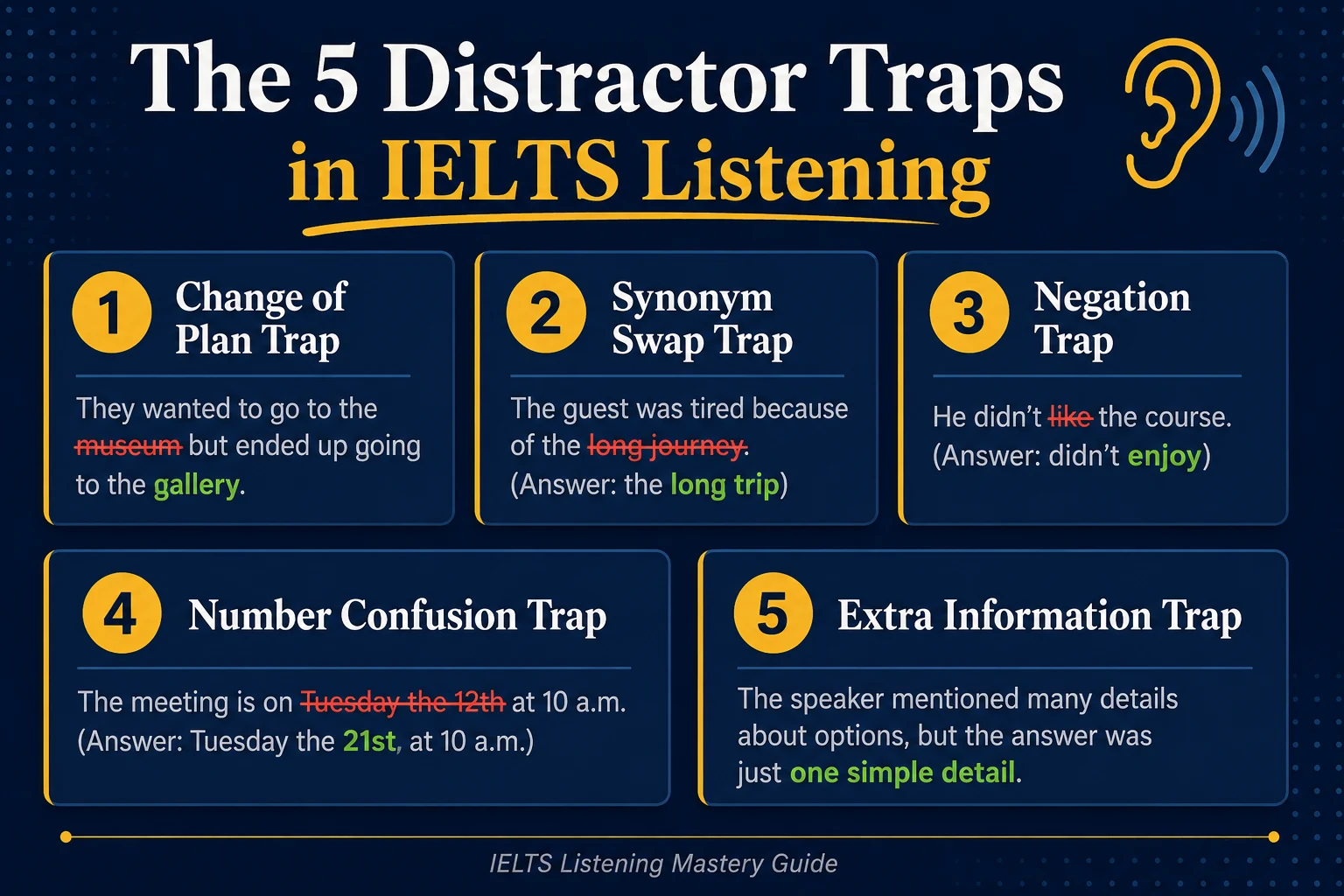
1. The Change of Plan Trap
Speakers often change their minds during a conversation. One person suggests something, then the other person disagrees, and they agree on something different.
- Someone says the price is £45, then corrects it to £54.
- A hotel room is available on Saturday, but the guest books Sunday instead.
- A speaker mentions three possible answers before settling on one.
The correct IELTS listening answer is always the final decision, not the first suggestion.
2. The Synonym Swap Trap
The audio never uses the exact words from the question. Examiners use synonyms and paraphrases on purpose.
If the question says “transportation,” the speaker will say “bus” or “train.” If the question asks about “cost,” the speaker will say “price,” “fee,” or “charge.”
Test-takers who listen only for exact words from the question will miss answers that were spoken clearly. This is one of the most common IELTS listening mistakes at all levels.
3. The Negation Trap
Listen carefully for words like not, never, no longer, except, apart from, rather than, and unless. These completely flip the meaning of a sentence.
“All the rooms are available except the corner suite” if you miss the word except, you choose the wrong option entirely.
4. The Number Confusion Trap
Numbers are a classic battleground. Examiners know that 13 and 30 sound similar, as do 15 and 50, and 16 and 60. They use these pairs deliberately.
Beyond similar-sounding numbers, the audio often mentions one number first and then corrects it: “That comes to eighty dollars… sorry, eighteen.”
Always stay alert until the speaker finishes the sentence. Never write down a number the moment you hear it.
5. The Extra Information Trap
Sometimes the speaker gives more information than you need. You hear several names, several dates, or several locations. Only one of them answers the question.
Test-takers who panic write down everything they hear and then cannot decide. The solution is to read the question carefully before the audio starts, so you know exactly what type of information you are listening for.
Why You Get Wrong Answers in IELTS Listening
Understanding why I get wrong answers in IELTS listening is not about blaming your English skills. The root causes are almost always habits and strategy, not ability.
You Are Not Reading Ahead
You have 30 to 45 seconds before each section begins. Most students sit and wait. High scorers use that time to read every question, underline key words, and predict what kind of answer they need: a name, a number, a place, a price?
Reading ahead means you are never surprised. You know what is coming.
You Are Listening for Words, Not Meaning
The IELTS test is not a dictation exercise. The audio will rarely give you the exact word in the question. You need to listen for the idea, not the phrase.
If you train yourself to match sounds rather than meanings, distractors will fool you every single time.
You Lose Focus After Getting One Answer Wrong
This is a common spiral. You miss an answer, you start worrying about it, and then you miss the next two because your attention drifted. The audio does not stop for you.
Treat each question as a fresh start. A missed answer is gone. The next one is still winnable.
You Do Not Check Your Answers Properly
At the end of each section, you get 30 seconds to check your answers. Most students spend that time staring blankly. Instead, use it to verify spelling, check whether your answer grammatically fits the sentence, and confirm you have not left anything blank.
How to Train Your Ear to Catch Distractors
Training for IELTS listening distractors requires deliberate practice, not just playing audio and hoping you absorb it.
Shadow Authentic Conversations
Find BBC Radio interviews, TED Talks, or real podcast conversations where speakers change their minds, correct themselves, and interrupt each other. Listen once, then listen again and write down every time the speaker changes or corrects information.
This builds the habit of tracking meaning across a whole conversation, not just catching individual words.
Practice with a Transcript
Listen to a section, write your answers, then read the full transcript. Mark every distractor: where was the wrong information given? Where did the speaker correct themselves? How did the wording differ from the question?
Doing this exercise ten times will permanently change how you listen.
Predict Before You Listen
Before each section, look at the questions and predict: what kind of word am I listening for? A person’s name will sound different from a number. A location will sound different from a reason. Knowing the shape of the answer helps you filter out noise.
Band 6 to Band 7: What Actually Changes?
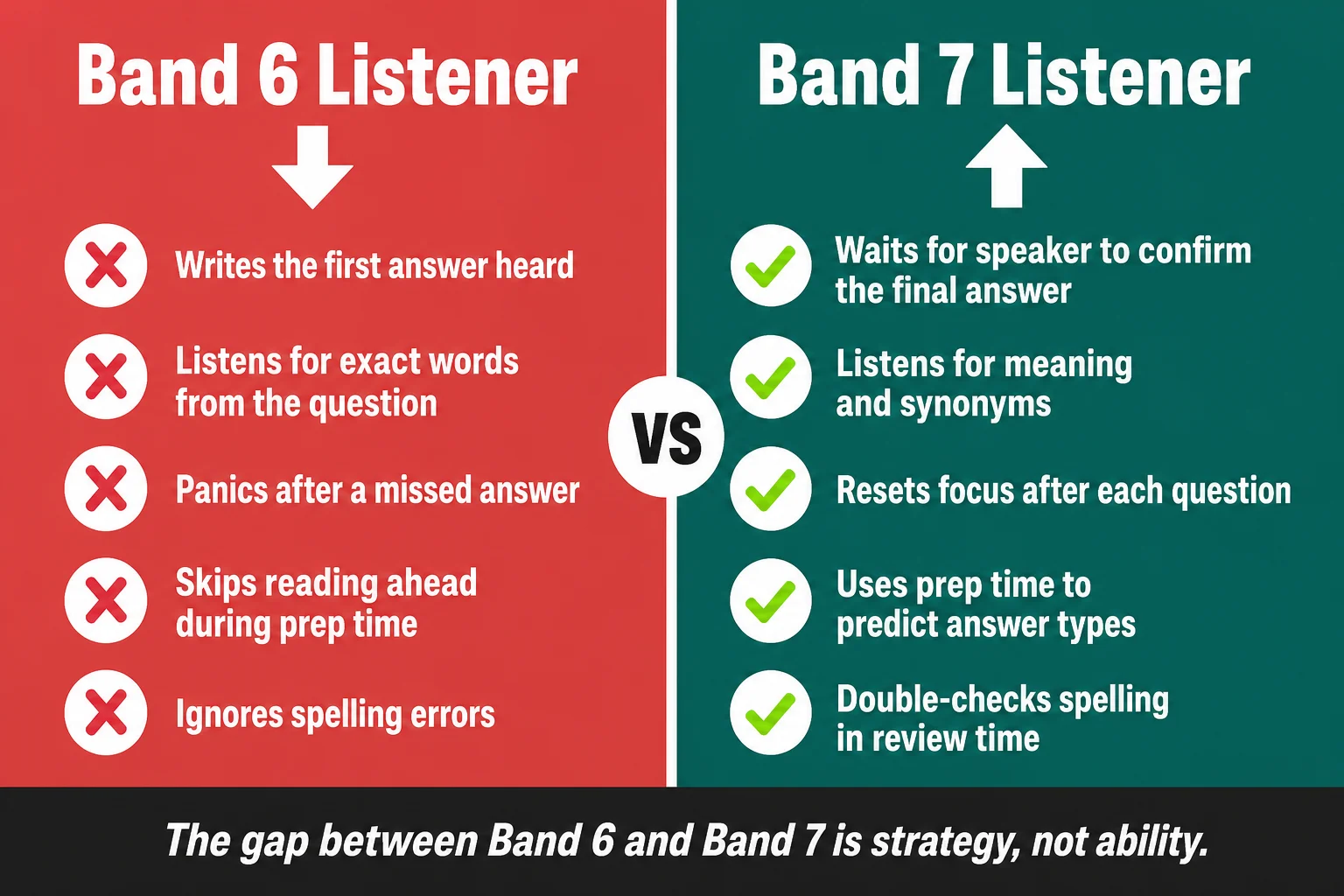
Moving from Band 6 to Band 7 in listening means getting roughly 4 to 6 more answers correct out of 40. That sounds small. In practice, it means eliminating a specific category of mistakes.
Band 6 listeners typically:
- Fall for the first piece of information they hear without waiting for corrections.
- Miss answers because they were still writing the previous one.
- Lose focus during Section 3 or 4, which use more complex academic language.
Band 7 listeners have developed two key habits. First, they trust the process: they know the first answer they hear might be wrong, so they hold it loosely until it is confirmed. Second, they manage their attention actively: when they lose focus for a moment, they quickly scan ahead to find where the audio is in the question list.
The band 6 to band 7 listening jump also comes from spelling. A correctly identified answer spelled wrong scores zero. Practice spelling common IELTS vocabulary out loud, especially words like accommodation, necessary, guarantee, and environment.
Practice Strategies That Work
Here are the strategies that consistent Band 7+ scorers use:
Do timed, exam-condition practice. Sit down, play the audio once only, answer under real conditions. Listening to audio twice in practice will hurt you when the real test plays each section only once.
Review every wrong answer forensically. Do not just note that you got it wrong. Find exactly where in the audio the correct answer was spoken, what distractor appeared before it, and what mistake you made. Keep a log of your errors for two weeks. Patterns will emerge.
Improve your vocabulary for paraphrasing. Build lists of synonym pairs that commonly appear in IELTS: buy/purchase, start/commence, help/assist, show/demonstrate. The more synonym pairs you know, the better you will spot when the audio is paraphrasing the question.
Focus extra time on Sections 3 and 4. These are academic discussions and monologues. They are harder, and most Band 6 candidates drop the most marks here. Practising academic listening with university lecture recordings helps considerably.
Do not write in full sentences. Your answers need to be short: a word, a number, a name. Writing more than necessary means you miss what comes next.
FAQ
Why do I understand the audio but still get the wrong IELTS listening answer?
Understanding the audio is only half the task. The IELTS listening section tests whether you can track changing information and distinguish correct answers from deliberate distractors. You may understand every word and still choose the wrong one if you pick the first piece of information rather than the final confirmed answer.
How many distractors appear in a typical IELTS listening test?
There is no fixed number, but research into Cambridge IELTS practice tests shows that roughly 30 to 40 percent of questions involve at least one distractor either a change of plan, a correction, or a synonym switch. That means in a 40-question test, up to 16 answers could involve some form of misdirection.
Do IELTS listening distractors appear in every section?
Yes, but they are more common in Sections 2, 3, and 4. Section 1, the everyday conversation, does include distractors but they tend to be simpler — usually just a number correction or a change of date. Sections 3 and 4 use more complex paraphrasing and opinion changes.
What is the fastest way to improve IELTS listening from Band 6 to Band 7?
The fastest gains come from two things: reading questions before the audio plays so you know what to listen for, and reviewing every wrong answer to identify exactly which type of distractor caught you. Most students find they repeat the same two or three mistake types. Fixing those specific patterns often adds 3 to 5 marks.
Should I guess if I miss an IELTS listening answer?
Always write something. There is no negative marking in IELTS, so a guess costs you nothing. If you miss an answer entirely, write the most logical option based on the context you heard. A blank is always zero; a guess is sometimes correct.
Final Thoughts
Missing IELTS listening answers is rarely about your English level. The test is engineered with distractors, synonyms, corrections, and traps that catch even fluent speakers off guard.
The difference between Band 6 and Band 7 is not a sudden leap in language ability. It is a shift in strategy: reading ahead, listening for meaning over exact words, staying calm after a missed answer, and knowing that the first thing you hear might not be the right answer.
Start identifying distractor types in your practice sessions. Review your mistakes forensically. Give yourself exam conditions every time you practice. Those habits, built consistently over four to six weeks, are what move the needle.
The examiner has set the trap. Now you know where it is.
Leave a Reply