
Most test-takers lose marks in the IELTS Listening section not because they have poor English but because they don’t know how the test works. Learning the right IELTS listening tips and tricks can push your score from a Band 5.5 to a Band 7 or above without needing months of extra study.
This guide gives you 12 battle-tested strategies, explains why each one works, and tells you exactly when to use them during the test.
How the IELTS Listening Test Actually Works
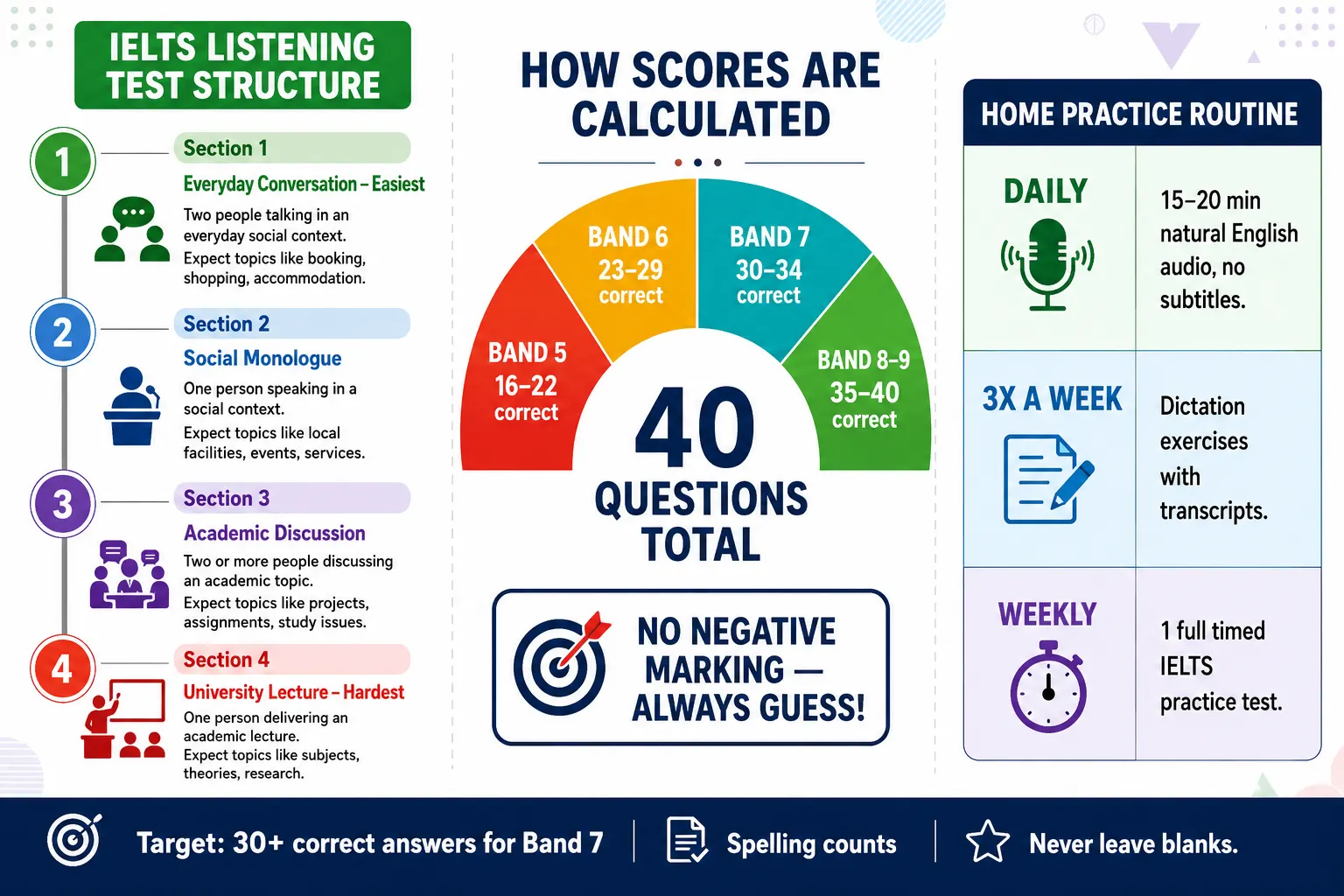
The IELTS Listening test runs for about 30 minutes, plus 10 minutes to transfer your answers to the answer sheet (paper-based test only). You listen to four recordings and answer 40 questions in total.
Here’s the structure:
- Section 1: A conversation between two people in an everyday social context (e.g., booking a hotel room)
- Section 2: A monologue in a social context (e.g., a tour guide explaining a local area)
- Section 3: A conversation in an academic or training setting (e.g., students discussing an assignment)
- Section 4: A university-style lecture or talk on an academic topic
The recordings go from easiest to hardest. Section 4 is the toughest it plays once, has no pauses, and uses complex academic language.
Each correct answer = 1 mark. Your raw score out of 40 maps to a Band score. To hit Band 7, you need roughly 30 correct answers. Band 8 needs about 35.
Why Most People Lose Marks
Test-takers usually fail in one of three ways:
- They miss words because they’re still writing the previous answer while the recording moves on
- They don’t read the questions before the audio starts, so they don’t know what to listen for
- They spell words wrong or write an answer the question doesn’t ask for
The good news? All three mistakes are completely preventable. That’s exactly what these IELTS listening strategies are built to fix.
The 12 IELTS Listening Tips and Tricks
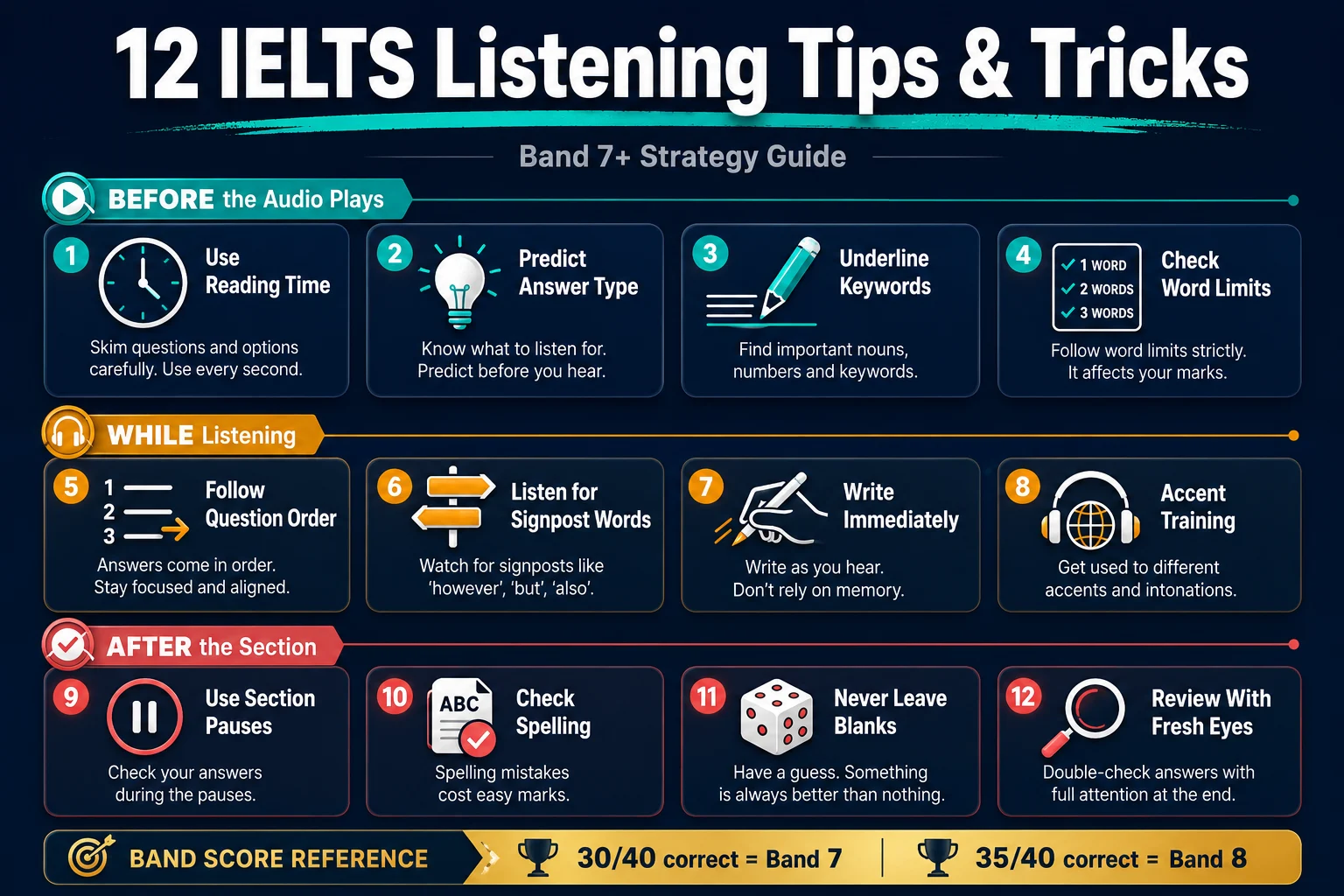
Tips 1–4: Before the Audio Plays
Tip 1: Use Every Second of Reading Time
Before each section, the recording gives you time to read the questions. This is not optional preparation it’s a strategic weapon.
Scan the questions quickly and ask yourself: What kind of information am I listening for? A name? A number? A date? A reason? When you already know the answer type, your brain tunes into the audio instead of trying to process and understand at the same time.
Most test-takers read slowly and panic. Read fast, get the gist, and start predicting.
Tip 2: Predict the Answer Type Before You Hear It
After scanning the questions, try to guess what kind of word fits the blank. Look at the grammar around the gap. If the sentence reads “The appointment is on ___,” you know you need a day or date. If it says “Contact ___ for more details,” you need a name.
This trick alone can save you 3–5 marks per test. Your brain pre-activates the right “listening mode,” which makes it far less likely you’ll miss the answer when it comes.
Tip 3: Underline Keywords in Each Question
Draw a line under the most specific word in each question a number, a proper noun, a topic word. These are your audio triggers. When you hear something close to that word in the recording, that’s your signal: the answer is coming right now.
For example, if the question mentions “parking permit,” the moment you hear those words spoken, sharpen your focus immediately. The answer almost always follows within one or two sentences.
Tip 4: Notice the Word Limit on Fill-in-the-Blank Questions
The test often says “write NO MORE THAN TWO WORDS.” Students regularly write three and lose the mark even when the information is correct.
Count your words before moving on. If the limit is two and your answer reads “a small hotel,” you have exactly two words. If it reads “a small budget hotel,” you’re over the limit and the answer is wrong, regardless of accuracy.
Tips 5–8: While Listening
Tip 5: Follow the Questions in Order, Don’t Jump Ahead
The answers always appear in the same order as the questions. If you’re on Question 5 and you miss it, don’t go back. Accept the loss, move to Question 6, and stay in sync with the recording.
Test-takers who go back to fill in a missed answer almost always miss the next answer too. One missed question costs you 1 mark. Losing your place costs you 3 or 4.
Tip 6: Listen for Signpost Words to Catch Key Information
Speakers use certain words to flag important information. Train yourself to react when you hear:
- Contrast signals: “however,” “but,” “although,” “on the other hand” the answer often follows a contrast
- Correction signals: “actually,” “I mean,” “sorry, I said…” the speaker is changing the answer they just gave
- Emphasis signals: “the main reason,” “most importantly,” “above all” this is almost always what the test is asking about
These phrases are the audio equivalent of bold text in a book. They tell you: pay attention right now.
Tip 7: Write Your Answers Immediately, Don’t Wait
As soon as you hear the answer, write it down. Even if it’s messy or abbreviated. Don’t wait for the sentence to finish, because the next question’s answer may be just seconds away.
Write a shorthand note first, then check spelling after the section ends (you get a short pause between sections). Waiting for “the perfect moment” to write is how answers disappear.
Tip 8: Don’t Let an Unfamiliar Accent Throw You Off
IELTS uses speakers with British, Australian, American, and occasionally Canadian accents. If you’ve only practiced with one accent, unfamiliar pronunciations can shake your confidence mid-test.
The solution: practice with varied English audio every week. BBC Radio, Australian news podcasts, and American documentary narrations all help. It doesn’t take long to become comfortable 20 minutes a day for three weeks makes a significant difference.
Tips 9–12: After the Section Ends
Tip 9: Use the Pause Between Sections Wisely
Between each section, there’s a brief pause. Most people sit there and breathe. High scorers use that time to read the questions for the next section and underline keywords before the audio starts again.
It’s the same preparation strategy from Tip 1 but now you’re doing it mid-test, not just at the beginning.
Tip 10: Check Spelling During Transfer Time (Paper Test)
On the paper-based test, you get 10 minutes at the end to transfer your answers to the answer sheet. This isn’t bonus time to relax. It’s your final quality check.
Go through every answer and ask: Is it spelled correctly? Does it fit the word limit? Did I write what the question actually asked for, not just what I heard? Students lose marks here on completely correct information just because of a spelling error.
Common tricky spellings in IELTS: accommodation, necessary, Wednesday, February, receipt. Know them cold.
Tip 11: Never Leave a Blank Answer
There is no negative marking in IELTS. A blank gives you zero. A guess gives you a chance. If you have no idea, write something plausible a common noun, a number that fits the context, or the last word you remember hearing near that question.
Even a random guess on 3 questions can occasionally net you 1 extra mark, and that mark could be the difference between a 6.5 and a 7.
Tip 12: Review Your Answers With Fresh Eyes
After transferring answers (or during your final review on the computer-based test), read each answer as if you’re seeing it for the first time. Ask yourself: does this actually make sense in context?
If you wrote “the library open at 7 am” instead of “the library opens at 7 am,” you may have heard correctly but written something grammatically inconsistent with the question. Small errors like this cost real marks.
IELTS Listening Strategies for Specific Question Types
Multiple Choice Questions
These are trickier than they look. The recording often mentions all three options, but only one is the actual answer. Speakers frequently correct themselves or change their mind, which means the last thing they say about a topic is usually what counts.
Don’t choose an answer just because you heard the word. Listen for which option the speaker confirms, agrees with, or comes back to.
Map and Diagram Labelling
Study the map or diagram carefully during reading time. Get familiar with the layout which direction is north, what’s already labelled, where the blank spaces are. When the speaker says “turn left,” “opposite the entrance,” or “just past the stairs,” you need to picture the layout instantly.
Practice this question type with physical maps. Draw them yourself after listening. Spatial memory improves fast with deliberate repetition.
Short Answer Questions
The word limit is everything here. Write exactly what you hear no extra words, no paraphrasing. The marking is strict: the answer either matches or it doesn’t.
If the question asks “Where does the speaker suggest meeting?” and the answer is “the café near the station,” write that. Don’t simplify it to “café” if two words are allowed, because you may drop important detail.
How to Improve IELTS Listening at Home
Building your listening score for IELTS outside of practice tests comes down to consistency. Here’s a practical weekly routine:
Daily (15–20 minutes): Listen to natural English audio such as podcasts, TED Talks, BBC World Service broadcasts, or Australian news. Don’t use subtitles. Try to write down key words after each segment. Many effective IELTS listening tips and tricks focus on building this habit because it improves your ability to identify important information in real time.
Three times a week: Do a dictation exercise. Play 30 seconds of audio, pause it, and write what you heard word-for-word. Check against the transcript. This trains your ear for connected speech and weak forms of words (e.g., “gonna,” “wanna,” “kinda” in informal speech). Among the most practical IELTS listening tips and tricks, dictation helps learners become more accurate at recognizing spoken English under exam conditions.
Once a week: Complete one full IELTS Listening practice test under exam conditions. Time it. Don’t pause the recording. Score it and analyze every wrong answer—not just what the right answer was, but why you missed it. This is one of the most valuable IELTS listening tips and tricks because it helps you identify recurring mistakes and avoid losing the same marks in future tests.
This three-level approach targets different listening sub-skills: general comprehension, sound-to-text accuracy, and test-specific performance. All three matter for your IELTS listening band score.
FAQ
How many mistakes can I make to get a Band 7 in IELTS Listening?
Can I write my answers in capital letters?
Yes. IELTS accepts answers in all capital letters, all lowercase, or standard sentence case. Capitalization will not affect your mark. Spelling must be correct regardless of the case you choose.
Is the computer-based IELTS Listening test easier than the paper version?
The content is identical same recordings, same question types, same marking. The main difference is that on the computer-based test, you type directly into the answer boxes during the test, so there’s no separate transfer time at the end. Some people find typing faster; others prefer handwriting. Choose the format that matches how you practice.
What’s the best way to practice for IELTS Listening Section 4?
Section 4 is a continuous academic monologue with no pause. The best way to prepare is to listen to university lectures and academic podcasts regularly. YouTube channels from institutions like MIT OpenCourseWare, Oxford, and Cambridge all have free lecture recordings. Practice taking notes while listening don’t just absorb passively.
Should I guess if I don’t know the answer?
Always. IELTS has no penalty for wrong answers, so a blank is strictly worse than a guess. If you missed an answer, write the most plausible word you heard near that question. Even guessing a category of word (a name, a number, a place) gives you a chance where a blank gives you none.
About the Author – Mr. Sanjay Smart
Mr. Sanjay Smart is one of the most experienced IELTS trainers in the industry, with over 30 years of teaching experience and a proven track record of helping more than 15,000 students successfully clear the IELTS exam and pursue their study-abroad goals. He is the creator of SMART IELTS, an AI-driven IELTS preparation platform that combines expert teaching methods with modern technology to make IELTS preparation more effective and accessible. Drawing on his expertise in IELTS training, content creation, UX design, and prompt engineering, Sanjay continues to develop innovative learning solutions that help students achieve higher band scores with confidence.

Mr. Sanjay Smart has taught IELTS for the last 30 years and has helped more than 15,000 students clear the IELTS and study abroad. He is also the creator of SMART IELTS, an AI-driven IELTS preparation portal, for which he has lent his content creation, UX Design and Prompt Engineering skills.
Leave a Reply