
IELTS Writing Task 2 is the essay section of the IELTS Writing test — and it’s the part that most test-takers worry about. You get a prompt, a point of view to argue, and exactly 40 minutes to write a well-structured, logically developed essay of at least 250 words.
The good news? Task 2 follows predictable patterns. The question types, the essay structures, and even the vocabulary examiners reward — all of it is learnable. This guide walks you through everything: what Task 2 actually tests, the five question types you’ll face, how to build a strong essay from scratch, and what separates a Band 6 response from a Band 7.
No fluff. No sample essays that leave you wondering how they were built. Just the actual method.
Table of Contents
- What Is IELTS Writing Task 2?
- Academic vs. General IELTS Writing Task 2
- The 5 Question Types Explained
- The 4-Paragraph Essay Structure That Works
- How to Write a Strong Introduction
- How to Write Body Paragraphs That Score High
- How to Write Your Conclusion
- What Examiners Grade You On
- Common IELTS Writing Task 2 Topics
- Mistakes That Drop Your Band Score
- Vocabulary and Phrases That Help
- How to Practice Effectively
- FAQ
What Is IELTS Writing Task 2?
IELTS Writing Task 2 is an essay question. It carries two-thirds of your total Writing band score, which makes it significantly more important than Task 1.
You must write a minimum of 250 words. Most strong responses land between 270 and 320 words. Going much longer than 320 words rarely improves your score and eats into your Task 1 time.
The prompt always presents a statement, an issue, or two opposing views. Your job is to respond with a clear, well-supported argument. You’re expected to show logical thinking, use evidence or examples, and write in formal academic English.
One thing beginners get wrong immediately: Task 2 is not a creative writing exercise. Examiners aren’t looking for impressive stories. They want a clear position, structured paragraphs, and specific support for every claim you make.
Academic vs. General IELTS Writing Task 2
Both the Academic and General Training IELTS include a Task 2 essay. The format is identical — same word count, same timing, same four assessment criteria.
Writing Task 2 Academic IELTS and IELTS General Writing Task 2 use the same question types and the same scoring rubric. The only practical difference is that Academic test-takers tend to face slightly more complex or abstract topics, while General Training prompts often involve everyday social or workplace issues.
If you’re preparing for General Training, don’t assume the essay is easier. The band descriptors are the same. Examiners apply the same standards to both versions.
The 5 Question Types Explained
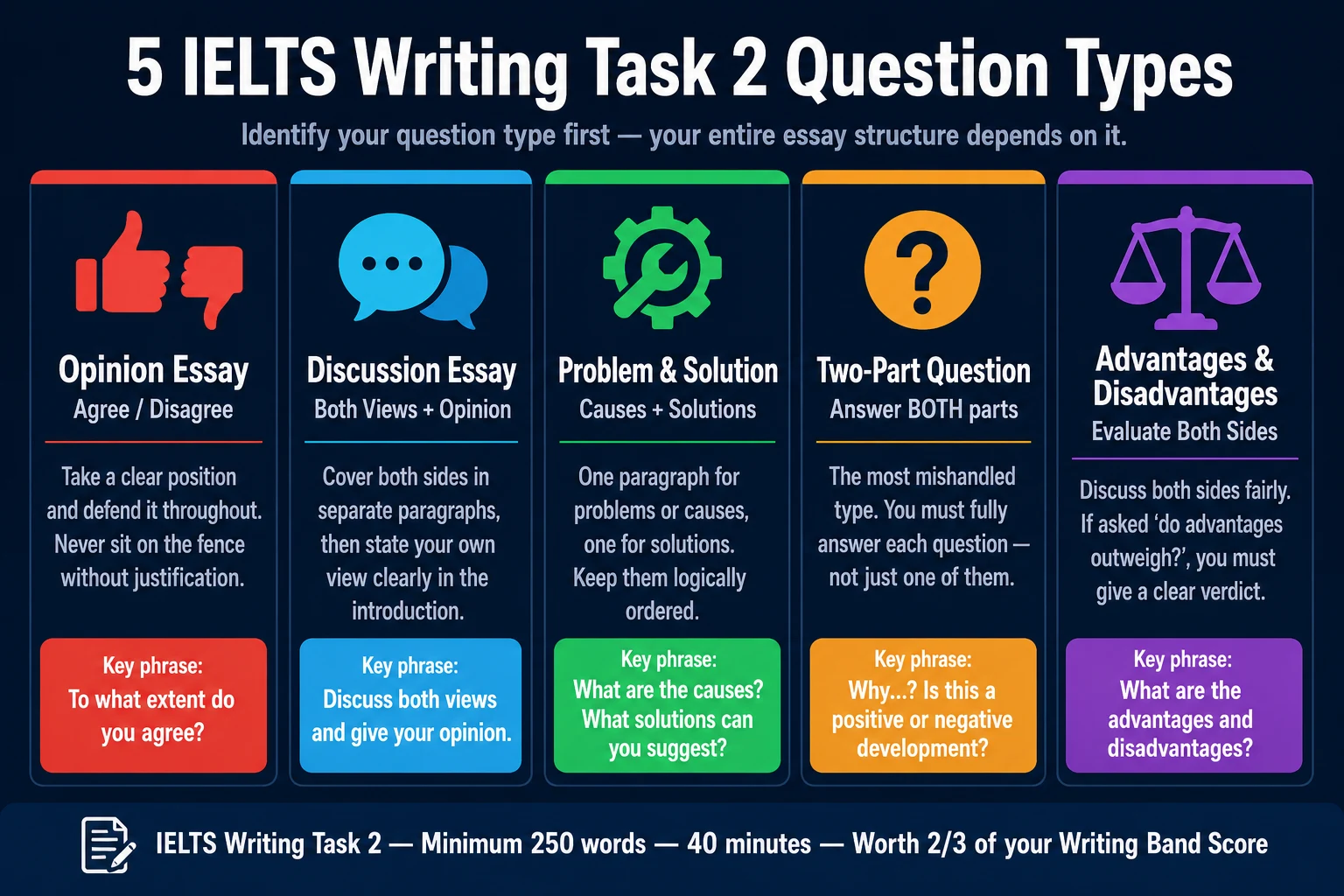
Every IELTS Writing Task 2 question falls into one of five types. Recognizing the type before you write is the single most useful thing you can do, because each type needs a slightly different approach.
1. Opinion (Agree/Disagree)
The prompt makes a statement and asks: “To what extent do you agree or disagree?”
Your job is to take a clear position — fully agree, fully disagree, or partially agree — and defend it throughout the entire essay. Sitting on the fence without justification costs you points.
Example prompt: “Social media does more harm than good. To what extent do you agree or disagree?”
2. Discussion (Discuss Both Views)
The prompt presents two opposing views and asks you to discuss both before giving your own opinion.
Cover both sides fairly in separate body paragraphs. Then state your own view clearly — usually in the introduction and reinforced in the conclusion.
Example prompt: “Some people think children should learn to be competitive. Others believe cooperation is more valuable. Discuss both views and give your own opinion.”
3. Problem and Solution
The prompt identifies a problem and asks you to explain its causes, effects, or solutions — sometimes all three.
Structure matters a lot here. One paragraph for causes or problems, one paragraph for solutions, written in a logical order.
Example prompt: “Traffic congestion in cities is increasing. What are the causes of this problem? What solutions can you suggest?”
4. Two-Part Question
The prompt asks two separate but related questions. You must answer both.
This is the question type most beginners mishandle. They answer one question well and barely touch the other, which immediately drops their Task Achievement score.
Example prompt: “Why do some people choose to live alone? Is this a positive or negative development?”
5. Advantages and Disadvantages
The prompt describes a trend or development and asks you to evaluate it.
Sometimes it asks “Do the advantages outweigh the disadvantages?” — which requires a clear conclusion. Other times it simply asks you to discuss both sides without declaring a winner.
Example prompt: “Many companies now allow employees to work from home. What are the advantages and disadvantages of this trend?”
The 4-Paragraph Essay Structure That Works
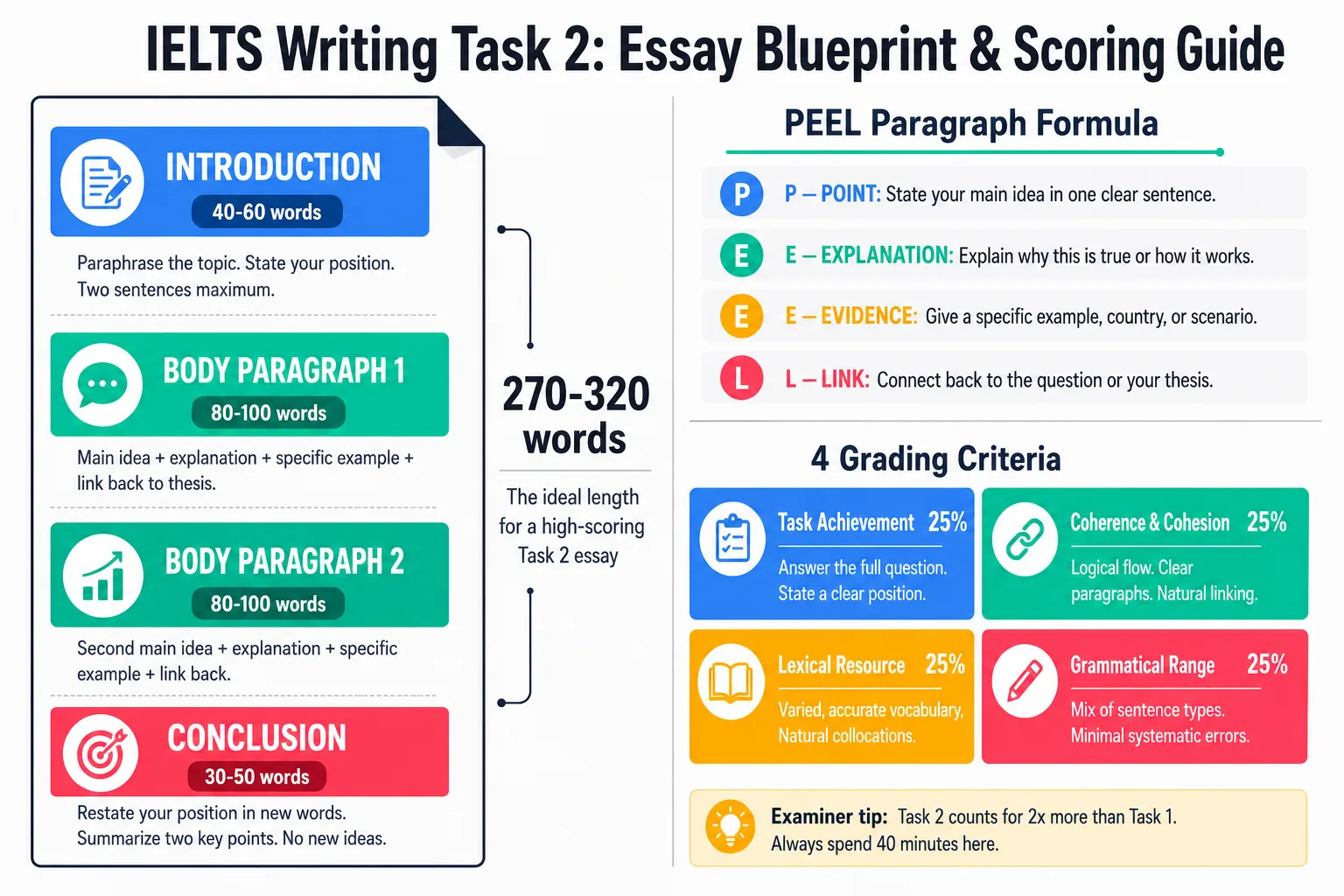
You don’t need five paragraphs. You don’t need six. The most reliable structure for IELTS Writing Task 2 is four paragraphs, written consistently and well.
Paragraph 1: Introduction (40-60 words) State the topic and your position. Don’t write a long background story. Two sentences work perfectly: one to introduce the topic, one to state your thesis.
Paragraph 2: First Body Paragraph (80-100 words) Present your first main idea. Support it with a reason and a specific example. End with a sentence that links back to the thesis.
Paragraph 3: Second Body Paragraph (80-100 words) Present your second main idea. Same structure: idea, reason, example, link back.
Paragraph 4: Conclusion (30-50 words) Restate your position in different words. Summarize the two main points without introducing new information. One or two sentences is enough.
That’s 250-310 words total. Clean, structured, scoreable.
How to Write a Strong Introduction
The introduction does two things: it shows the examiner you understand the prompt, and it tells them where your essay is going.
Step 1: Write a general statement about the topic. Don’t copy the prompt. Paraphrase it. Change the vocabulary and sentence structure.
Prompt says: “Many people believe governments should spend more money on public transport.” Your opening: “Public investment in transport infrastructure has become a widely debated policy question in many countries.”
Step 2: Write your thesis statement. State your position clearly. Be direct. “This essay will discuss…” is a weak thesis. Tell them what you actually think.
Weak: “This essay will discuss the advantages and disadvantages of this issue.” Strong: “While increased transport funding offers real benefits for urban mobility, the financial burden on governments makes targeted private investment a more practical solution.”
Two sentences. Forty to sixty words. Done.
How to Write Body Paragraphs That Score High
Weak body paragraphs state an idea and stop. Strong body paragraphs develop an idea through three distinct moves.
The PEEL structure works well:
- Point: State your main idea clearly in one sentence.
- Explanation: Explain why this is true or how it works.
- Evidence: Give a specific example, fact, or scenario.
- Link: Connect back to the question or your thesis.
Here’s the difference in practice:
Weak paragraph: “Public transport is good for the environment. Many people use buses and trains. This reduces pollution.”
Strong paragraph: “Expanding public transport networks significantly reduces carbon emissions by shifting commuters away from private vehicles. When cities invest in reliable, affordable rail systems, people have a genuine alternative to driving, which directly lowers traffic volume and exhaust output. Cities like Zurich and Singapore demonstrate that well-funded transit systems can achieve both high ridership and measurable air quality improvements. This shows that public investment in transport is one of the most direct tools governments have for reducing urban pollution.”
Notice the difference: the strong paragraph has a reason, a realistic mechanism, a named example, and a closing link. It reads like a thought, not a list.
How to Write Your Conclusion
The conclusion is short. Two sentences. No new ideas.
Sentence 1: Restate your thesis in different words. Sentence 2: Briefly summarize your two supporting points.
Example: “Overall, while longer prison sentences may satisfy public demand for justice, they do not address the root causes of crime. A combination of social investment and rehabilitation programs offers a more evidence-based path to reducing reoffending.”
That’s it. Don’t introduce a new argument. Don’t ask a rhetorical question. Don’t write three sentences when two will do.
What Examiners Grade You On
IELTS Writing Task 2 uses four criteria, each worth 25% of your Task 2 band score.
Task Achievement Did you answer the question fully? If the prompt asks for two things, did you address both? Is your position clear and consistent? Ignoring any part of the prompt automatically limits your score to Band 5 in this category.
Coherence and Cohesion Does your essay flow logically? Do your paragraphs have clear topic sentences? Do you use linking words without overdoing them? Repeating “Furthermore” and “Moreover” in every sentence is not good cohesion — it’s mechanical, and examiners notice.
Lexical Resource Do you use a range of vocabulary accurately? Can you express the same idea in different words? Do you use collocations naturally, like “raise awareness” rather than “increase awareness” or “make awareness”?
Grammatical Range and Accuracy Do you write a mix of simple and complex sentences? Do you make repeated grammar errors? Occasional mistakes are acceptable. Systematic errors — wrong tense consistently, subject-verb agreement problems throughout — pull your score down.
Common IELTS Writing Task 2 Topics
Certain themes appear again and again across IELTS Writing Task 2 topics. Preparing ideas and vocabulary for each one gives you a massive advantage on test day.
Education covers topics like private vs. public schooling, university tuition fees, the value of arts subjects, online learning, and teaching methods.
Environment includes climate change, renewable energy, individual vs. government responsibility, plastic pollution, and urban green spaces.
Technology spans social media’s effects, artificial intelligence in the workplace, screen time for children, privacy and surveillance, and digital inequality.
Health addresses obesity, mental health awareness, the role of governments in promoting healthy lifestyles, alternative medicine, and healthcare funding.
Society and Culture covers immigration, gender equality, ageing populations, rural-urban migration, and the preservation of local languages.
Crime and Punishment includes rehabilitation vs. punishment, youth crime, the effectiveness of the death penalty, and community service as an alternative to prison.
You don’t need new ideas for every topic. Build three or four strong, flexible arguments per theme, then adapt them to whatever specific prompt you face.
Mistakes That Drop Your Band Score
These errors are extremely common in beginner and intermediate essays. Each one has a direct negative effect on at least one of the four criteria.
Not answering the question asked Read the prompt twice before writing. If it says “to what extent do you agree,” you need to state a position — not just discuss pros and cons vaguely. If it asks two questions, answer both.
Writing an introduction that’s too long Some test-takers write five or six sentences of background before reaching the thesis. This wastes words and delays the point. Two sentences and move on.
Making claims without any support “Education is very important for society” tells the examiner nothing. Why? How? For whom? Every point needs at least one layer of explanation or example behind it.
Overusing linking words mechanically Starting every sentence with “Furthermore,” “In addition,” or “Moreover” signals that you’ve memorized phrases, not that you can build a real argument. Use linking devices when they genuinely connect ideas, not as decoration.
Changing your position mid-essay Agree in your introduction, then switch to disagreeing in your conclusion — and you’ve just lost Task Achievement points. Decide your position before you write and stick with it.
Memorizing and inserting off-topic examples Examiners can spot a memorized template response immediately. If your example doesn’t connect logically to the prompt, it hurts your score rather than helping it.
Vocabulary and Phrases That Help
Build a practical toolkit you can use across most IELTS Writing Task 2 topics.
Introducing your position:
- This essay argues that…
- While both sides have merit, the stronger case lies with…
- The evidence suggests that…
Adding a point:
- A further consideration is that…
- This is compounded by the fact that…
- Beyond this, it is worth examining…
Giving an example:
- This is evident in countries such as…
- A clear illustration of this is…
- Research conducted in [country/field] suggests that…
Conceding a point before countering it:
- Opponents of this view argue that… However…
- While it is true that… this does not necessarily mean…
- Admittedly… yet the broader picture shows…
Concluding:
- Taking these factors into account…
- On balance, the evidence points toward…
- The most reasonable position, given these arguments, is that…
Avoid memorizing full sentences. Learn the patterns and fill them with your own ideas for each prompt.
How to Practice Effectively
Studying sample essays is useful. Writing your own essays is more useful. Here’s how to get the most out of your practice sessions.
Timed practice from day one. Write under exam conditions — 40 minutes, no dictionary, no pausing. You build exam stamina this way, not just writing skill.
Analyze question types before writing. Before every practice essay, identify the question type. Write it at the top of your page. This habit stops you from misreading prompts on test day.
Review your own essays critically. After writing, reread your essay and ask: Did I answer both parts of the question? Is my thesis clear? Does each body paragraph have a point, explanation, and example? Does my conclusion restate my position?
Study model essays for structure, not content. When you read a high-scoring essay, note how the introduction is built, how body paragraphs are organized, and how the conclusion wraps up not which ideas were used.
Write on a variety of topics. Don’t practice only your strongest topic. Examiners can tell when a test-taker is comfortable and when they’re struggling. Practicing weak topics builds real flexibility.
FAQ
How many words should I write for IELTS Writing Task 2?
Write at least 250 words. Most examiners recommend aiming for 270 to 320 words. Going under 250 incurs a penalty. Going much over 320 doesn’t improve your score and risks making your writing feel padded or repetitive.
What is the difference between Task 1 and Task 2 in IELTS Writing?
Task 1 asks you to describe a visual (Academic) or write a letter (General Training). Task 2 asks you to write an essay in response to a statement or question. Task 2 carries twice the weight of Task 1 in your Writing band score.
Can I use “I” in IELTS Writing Task 2?
Yes. Opinion essays specifically require you to state your view, and using “I believe” or “I would argue” is perfectly appropriate. Avoid overusing it — two or three instances across the essay is enough.
What topics come up most in IELTS Writing Task 2?
The most frequently tested themes are education, environment, technology, health, crime and punishment, and society. Preparing arguments and relevant vocabulary for each of these themes before your test significantly reduces the chance of being caught unprepared.
How is IELTS Writing Task 2 scored?
Examiners score Task 2 on four criteria: Task Achievement, Coherence and Cohesion, Lexical Resource, and Grammatical Range and Accuracy. Each criterion contributes 25% to your Task 2 band score. Task 2 itself counts for two-thirds of your total Writing band score, so a strong essay has a much bigger impact on your final result than most test-takers realize.
Leave a Reply