
So you’ve taken IELTS more than once. You study hard. But the score keeps coming back the same — Band 6.
Sound familiar? You’re not alone. Thousands of IELTS students stuck at Band 6 hit this exact wall. And in most cases, grammar is the reason they can’t break through.
This article shows you exactly which grammar mistakes pull your score down — and how to fix each one. No vague advice. Just clear, simple explanations with real examples.
Table of Contents
- Why Grammar Decides Your Band Score
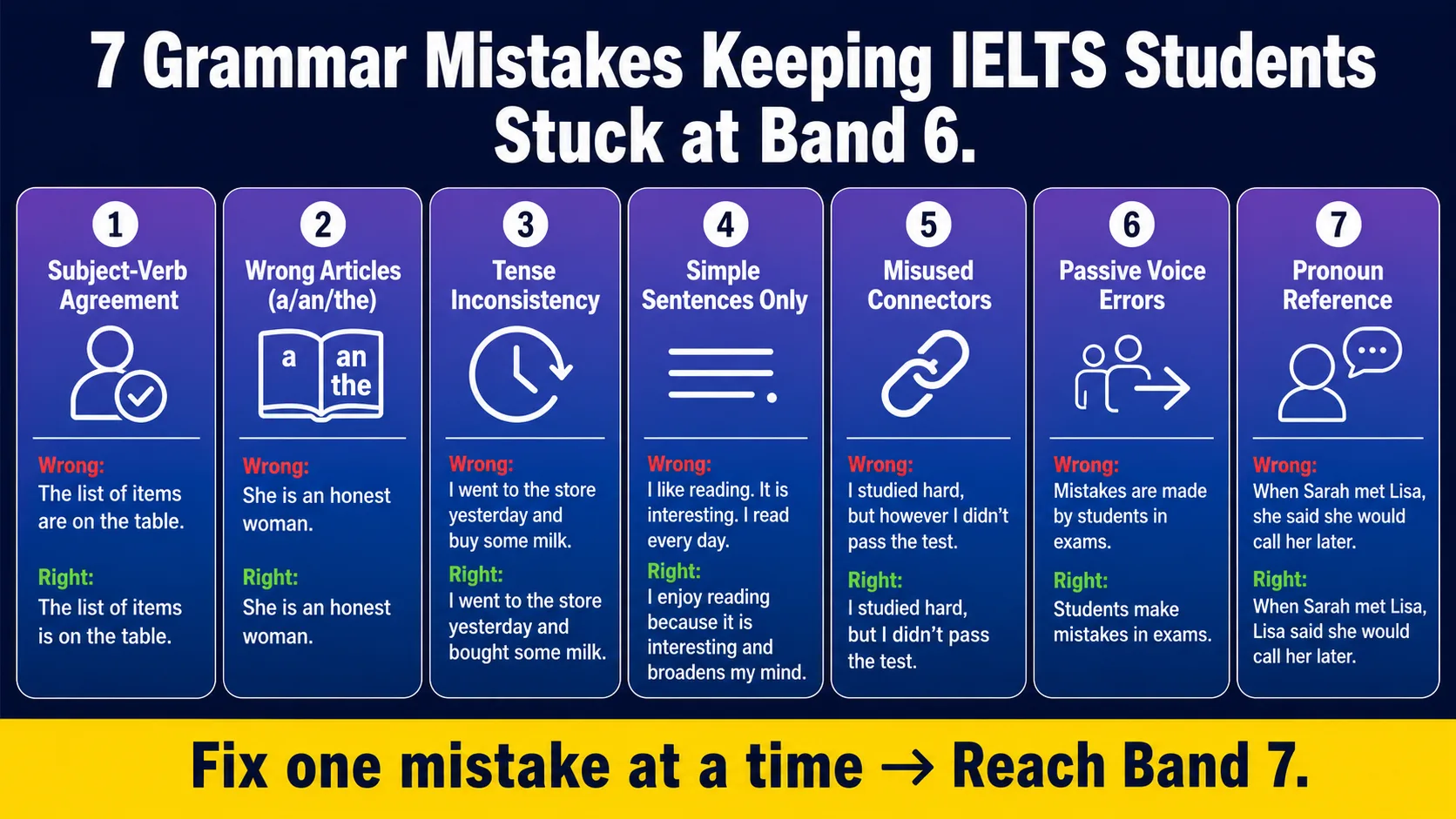
- Mistake 1: Subject-Verb Agreement Errors
- Mistake 2: Wrong or Missing Articles (a, an, the)
- Mistake 3: Tense Inconsistency
- Mistake 4: Overusing Simple Sentences
- Mistake 5: Misusing Connectors and Linking Words
- Mistake 6: Passive Voice Done Wrong
- Mistake 7: Pronoun Reference Errors
- The One Grammar Habit That Separates Band 6 from Band 7
- FAQ
Why Grammar Decides Your Band Score
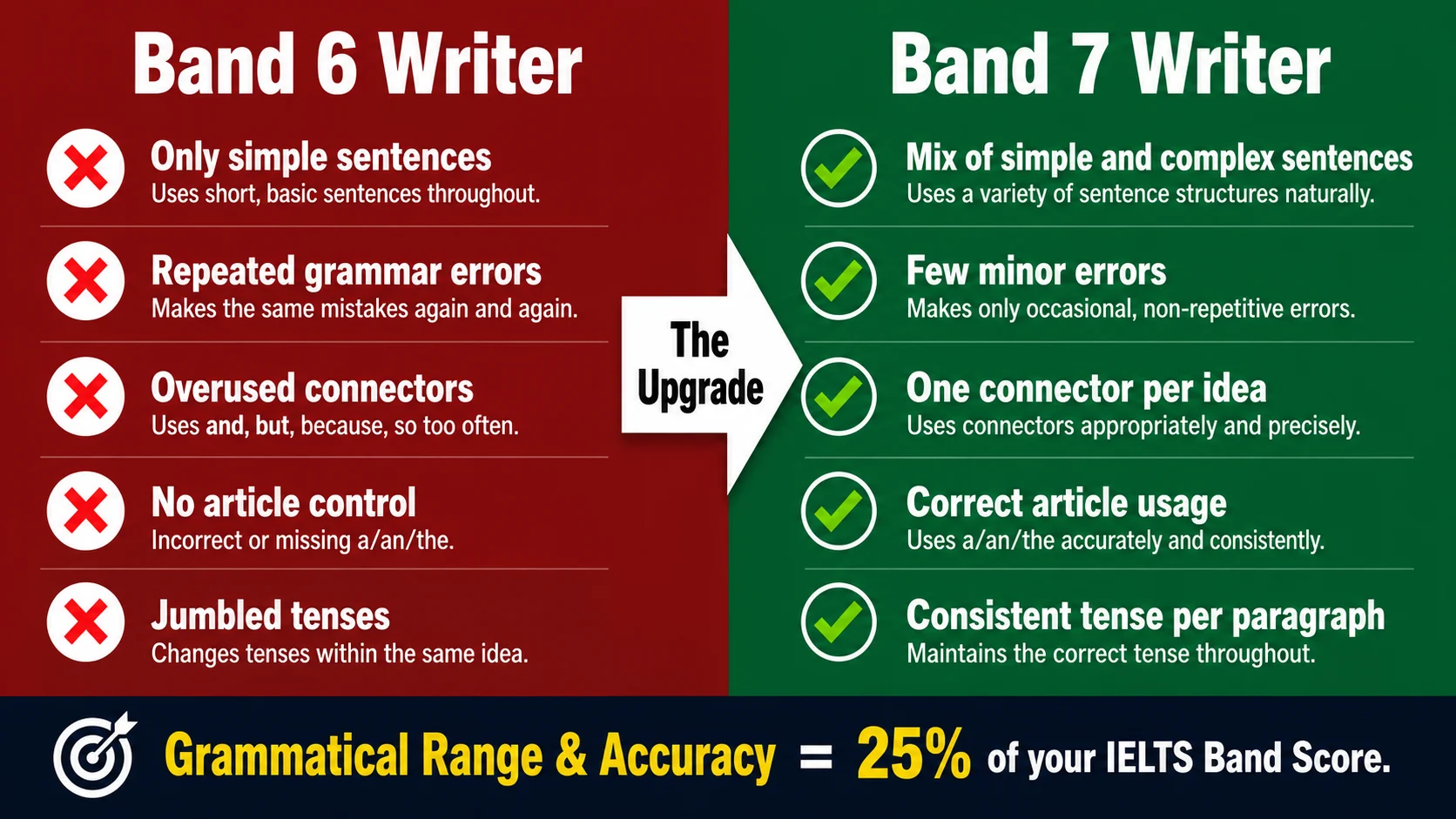
 The IELTS examiner scores your grammar under a category called Grammatical Range and Accuracy. This counts for 25% of your total Writing score and a big part of your Speaking score.
To reach Band 7, you need to show a mix of simple and complex sentences with few errors. Band 6 students usually write long sentences — but those sentences have consistent, repeated mistakes.
The examiner notices patterns. One mistake once is fine. The same mistake five times? That holds you back.
Mistake 1: Subject-Verb Agreement Errors
This is one of the most common IELTS writing errors for beginners.
What it means: The subject and verb in a sentence must match. Singular subjects take singular verbs. Plural subjects take plural verbs.
Wrong: “The number of students have increased.” Right: “The number of students has increased.”
The word number is singular, so the verb must be has, not have.
Another tricky one:
Wrong: “Each of the participants were tested.” Right: “Each of the participants was tested.”
Each is always singular. Always.
How to fix it: Before you submit, underline every subject in your sentences. Then check the verb next to it. Do they match?
Mistake 2: Wrong or Missing Articles (a, an, the)
Article errors are the #1 grammar problem for students from Hindi, Urdu, Chinese, or other languages that don’t use articles.
IELTS examiners see this mistake constantly. It signals a lack of grammatical control — even if everything else looks fine.
Wrong: “Government should take action.” Right: “The government should take action.”
Wrong: “She is doctor.” Right: “She is a doctor.”
The basic rules:
- Use a/an the first time you mention something general: a problem, an idea
- Use the when both you and the reader know exactly what you’re talking about: the problem we discussed, the main cause
- Use no article for general plural nouns: Governments should act (not The governments)
How to fix it: Read your sentences out loud. If an article sounds missing, it probably is.
Mistake 3: Tense Inconsistency
Jumping between past and present tense mid-paragraph confuses the reader. It also signals that the writer has lost control of the writing.
Wrong: “In 2010, the city builds a new railway. Many people used it and travel became easier.”
Right: “In 2010, the city built a new railway. Many people used it, and travel became easier.”
In IELTS Writing Task 2, most essays use present tense for arguments and past tense for historical examples. Pick a tense for each section and stay with it.
How to fix it: After writing, go through your essay and highlight every verb. Check that the tense is consistent within each paragraph.
Mistake 4: Overusing Simple Sentences
Short sentences are clear. But writing only short sentences keeps you at Band 5 or 6.
The examiner wants to see grammatical range — meaning you can use different sentence types correctly.
Band 6 writing: “Social media is popular. Many people use it every day. It has some disadvantages.”
Band 7 writing: “Although social media is widely used, it comes with significant disadvantages that many people overlook.”
The second version shows a subordinate clause, a contrast, and more precise vocabulary — all in one sentence.
Structures to practice:
- Relative clauses: “The policy, which was introduced in 2015, has been effective.”
- Conditional sentences: “If the government invests in education, crime rates will fall.”
- Concession clauses: “Although costs are high, the long-term benefits outweigh them.”
Mistake 5: Misusing Connectors and Linking Words
Students at Band 6 know words like however, furthermore, and therefore. The problem is they use them in the wrong places — or overuse them.
Wrong: “I like coffee. However, it is hot.” (However shows contrast between unexpected ideas — not just two related facts.)
Wrong: “Furthermore, moreover, in addition, also, the government should act.” (Stacking connectors one after another is a sign of overuse — examiners deduct marks for this.)
Right: Use one connector per idea transition. Choose the one that fits the logic.
Common connectors and when to use them:
| Connector | Use it when… |
|---|---|
| However / Nevertheless | Introducing a contrasting point |
| Therefore / As a result | Showing a cause-and-effect link |
| Furthermore / In addition | Adding a supporting idea |
| Although / Even though | Showing contrast within one sentence |
| For instance / For example | Giving a specific example |
Mistake 6: Passive Voice Done Wrong
Passive voice is not wrong in IELTS. In fact, using it correctly can raise your score. But many students either overuse it or form it incorrectly.
Incorrectly formed passive: “The report was write by the team.” ❌ “The report was written by the team.” ✓
The passive is was/were + past participle. Using the base form (write instead of written) is a clear error.
Overuse problem: “The data was collected. The results were analyzed. A conclusion was reached.”
This sounds robotic. Mix active and passive for variety.
Good balance: “Researchers collected the data and analyzed the results. A clear conclusion was reached based on the findings.”
Mistake 7: Pronoun Reference Errors
A pronoun reference error happens when it’s unclear what or who the pronoun refers to.
Unclear: “The manager told the employee that he needed more training.” (Who needs training — the manager or the employee?)
Clear: “The manager told the employee that the employee needed more training.”
Or restructure: “According to the manager, the employee needed more training.”
Another common one: Wrong: “People should exercise. It helps them stay healthy.” Right: “People should exercise regularly because physical activity helps them stay healthy.”
(It without a clear reference weakens your sentences.)
The One Grammar Habit for IELTS Students Stuck at Band 6
 Here it is, plain and simple: edit your writing as if you are the examiner.
Band 7 writers re-read every sentence and ask: “Is this clear? Is the grammar correct? Can it be said better?”
Most Band 6 students write fast and submit. They don’t go back. They assume the sentence is fine because it made sense in their head.
Build this habit:
- Write your essay or answer.
- Wait 2 minutes.
- Read it out loud (or in your head, as if speaking to someone).
- Fix anything that sounds wrong, unclear, or repeated.
This alone — consistently applied — can lift you from Band 6 to Band 7 over time.
Frequently Asked Questions
Why do IELTS students get stuck at Band 6 even after studying a lot?
Most students focus on vocabulary and reading but don’t fix their core grammar errors. Repeated mistakes in subject-verb agreement, tenses, or articles pull the Grammatical Range and Accuracy score down, which keeps the overall band at 6 even when other skills improve.
How many grammar mistakes are allowed in a Band 7 IELTS essay?
There is no fixed number, but Band 7 descriptors say errors “rarely reduce communication.” A few minor slips are acceptable. Consistent, repeated errors — especially in basic structures — are what keep students at Band 6.
Does IELTS speaking also get marked on grammar?
Yes. In IELTS Speaking, grammar is 25% of your score. The examiner checks whether you use a range of sentence types and whether your errors cause confusion. Using only simple sentences or making the same mistake repeatedly will limit you to Band 6.
What is the fastest way to improve grammar for IELTS?
Focus on fixing one mistake at a time. Start with articles or tenses — whichever you struggle with most. Practice writing 5 sentences using that structure correctly every day. This targeted approach works faster than trying to fix everything at once.
Can I reach Band 7 without perfect grammar?
Yes. IELTS does not require perfect grammar for Band 7. You need to show a range of structures used with general accuracy. Minor errors are fine. The key is avoiding the repeated, basic mistakes that define Band 6 writing.
Leave a Reply