
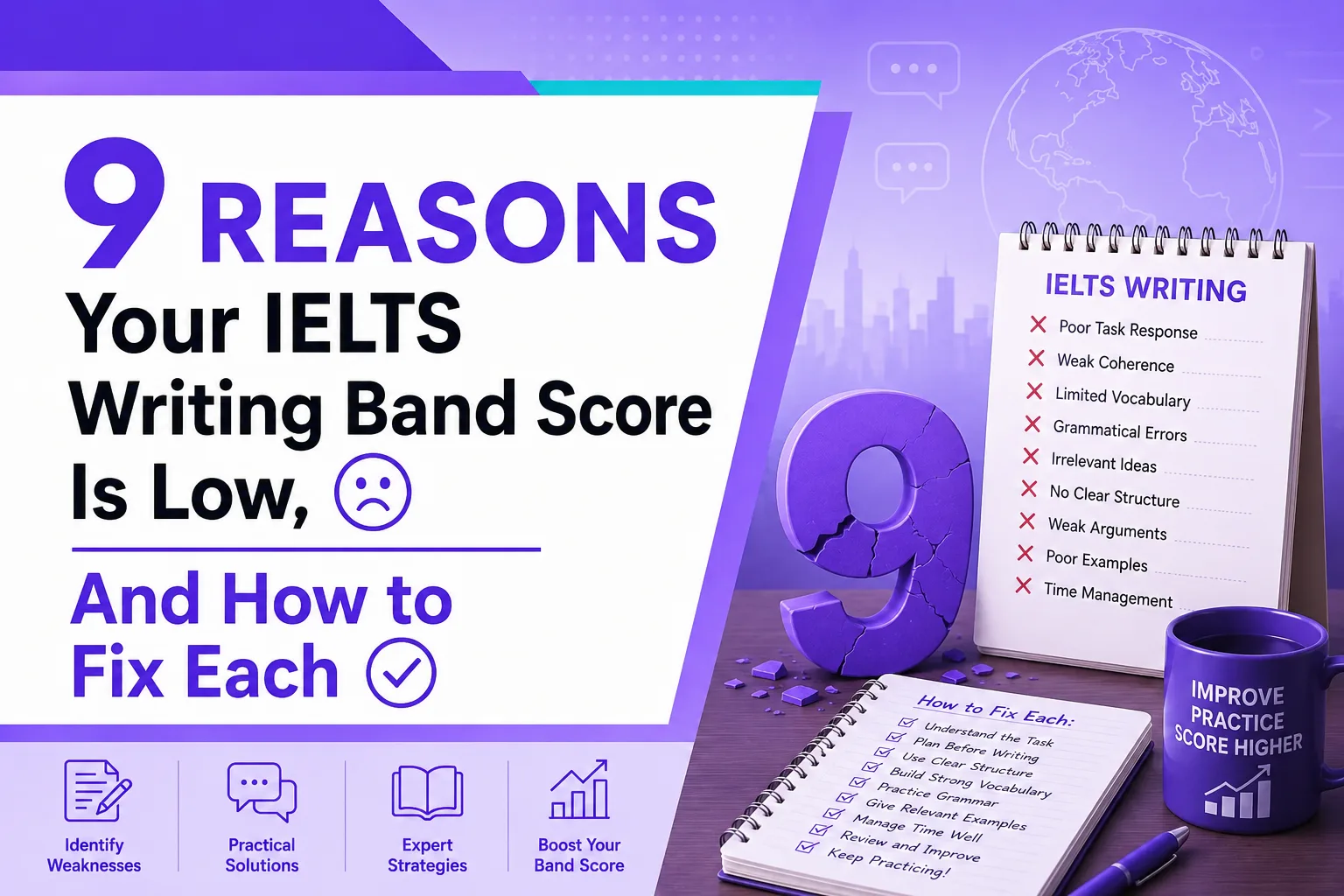
Every year, thousands of IELTS candidates sit their Writing test and walk away disappointed. They studied hard, practised essays, and still ended up with a Band 5.5 or 6 — well below the Band 7 their university or immigration application requires. If that sounds familiar, this guide is for you.
In this article, we break down the 9 most common reasons candidates lose marks in IELTS Writing, explain exactly what examiners are looking for, and give you practical, targeted fixes for each problem. No fluff — just the guidance that actually moves your band score.
How IELTS Writing Is Actually Scored
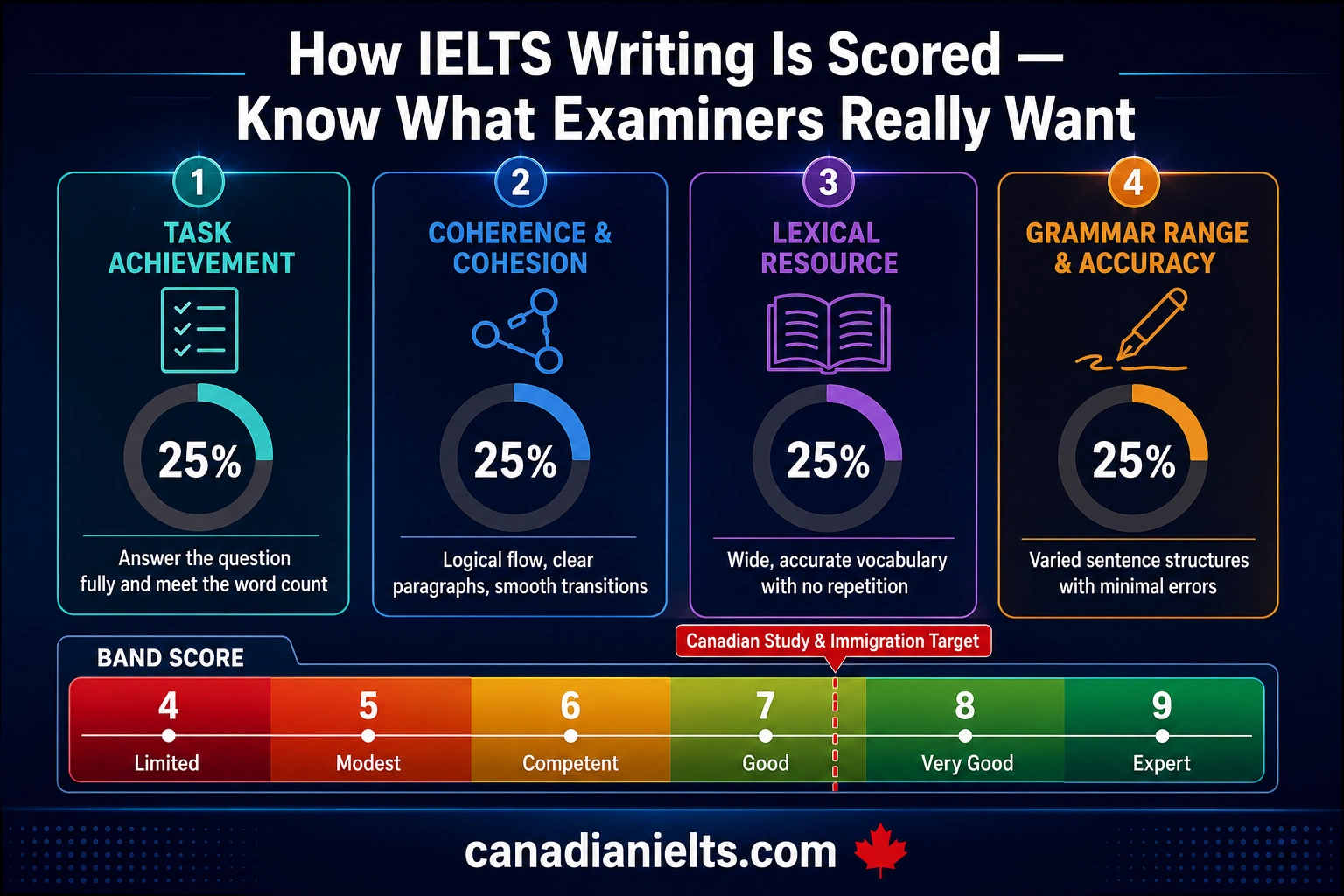
Before diagnosing what is going wrong, you need to understand how your writing is evaluated. IELTS Writing is assessed on four equally weighted criteria — each worth 25% of your final band score:
| Criterion | Weight | What Examiners Look For |
|---|---|---|
| Task Achievement / Response | 25% | Did you fully answer the question and meet the word count? |
| Coherence & Cohesion | 25% | Is your essay logically organized with clear linking and paragraphing? |
| Lexical Resource | 25% | Do you use a wide, accurate vocabulary without repetition? |
| Grammatical Range & Accuracy | 25% | Do you use varied sentence structures with minimal errors? |
Most candidates focus almost entirely on grammar. In reality, a single criterion accounts for only 25% of your score. Neglecting Task Achievement or Coherence and Cohesion is just as damaging as having poor grammar — and far more common.
What the IELTS Writing Band Scores Actually Mean
| Band | Level | What It Means for Writing |
|---|---|---|
| 9 | Expert | Virtually no errors; highly fluent and precise. |
| 8 | Very Good | Only occasional inaccuracies; handles complex writing with ease. |
| 7 | Good | Handles complex writing well; some inaccuracies but meaning is clear. |
| 6 | Competent | Effective in most situations; some errors but ideas are understandable. |
| 5 | Modest | Partial command; coping with overall meaning; frequent errors occur. |
| 4 | Limited | Basic competence; difficulty with complex ideas and structures. |
Most candidates aiming to study or immigrate to Canada need a minimum of Band 6.5 or 7.0. The gap between Band 6 and Band 7 is significant — and almost always traceable to specific, fixable mistakes.
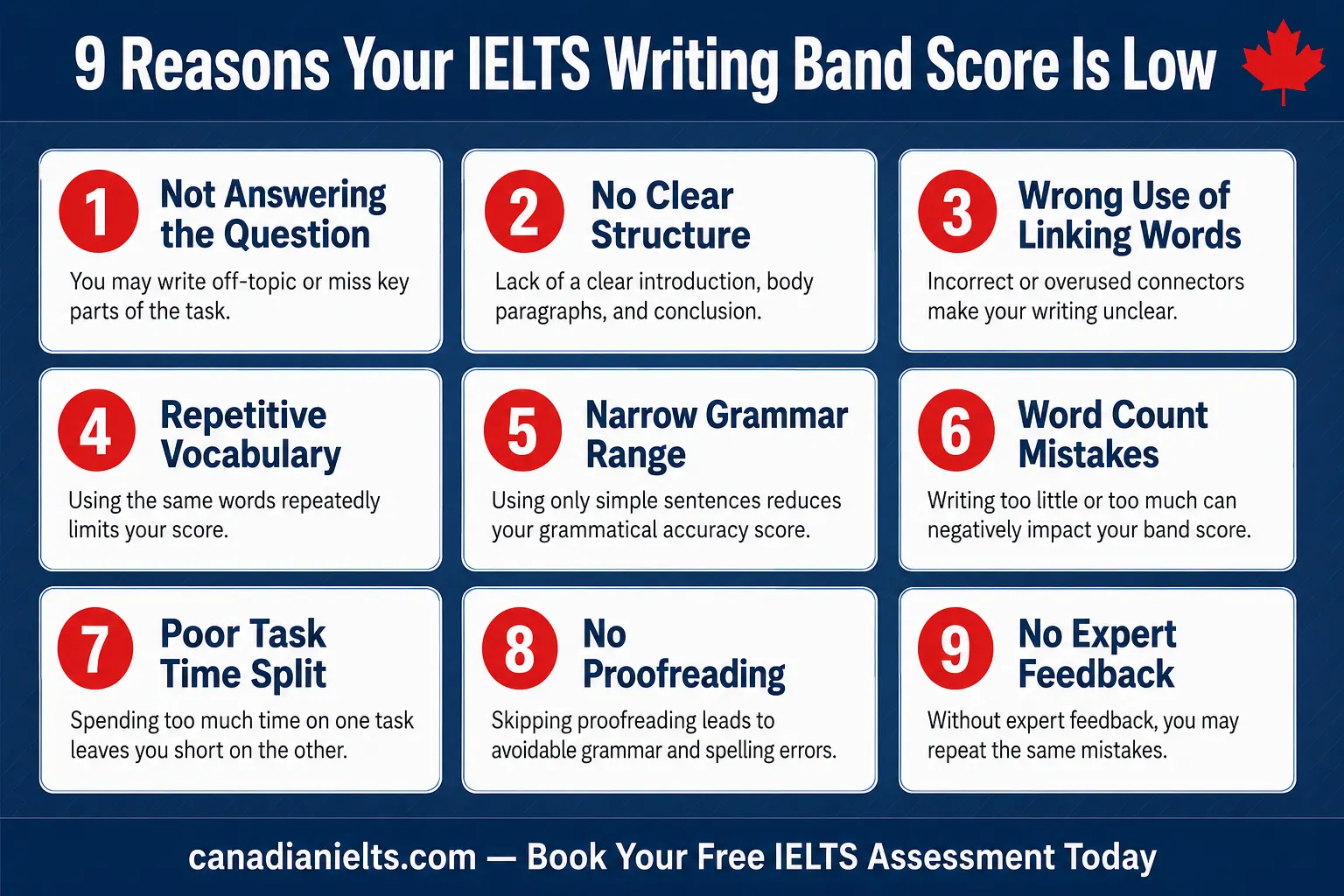
9 Reasons Your IELTS Writing Band Score Is Low
1. You Are Not Answering the Actual Question
The single most common reason for a low Task Achievement score is writing a well-structured essay on the wrong topic. Candidates see a familiar theme, assume they know what is being asked, and write a prepared response rather than reading the prompt carefully.
Weak example: A question asks “To what extent do you agree?” — the candidate writes a balanced discussion without stating a clear personal position.
Fix: Before writing, underline the key instruction words (agree/disagree, discuss both views, advantages/disadvantages). Your opening paragraph must directly address those instruction words, and your conclusion must mirror your stated position.
2. Your Essay Lacks a Clear Structure
Examiners assess Coherence and Cohesion — how logically your ideas are organised and how smoothly they flow. A common mistake is writing a stream of ideas with no clear paragraphing plan.
Every Band 7+ IELTS essay follows a predictable four-paragraph structure: Introduction → Body Paragraph 1 → Body Paragraph 2 → Conclusion. Each body paragraph should have one main idea, a supporting explanation, and an example.
Fix: Spend the first 3–4 minutes planning your essay before writing. Decide on two main arguments and what evidence or examples support each one. A clear plan produces a clearly structured essay.
3. You Are Using Linking Words Incorrectly
Overusing linking words — or using them in the wrong context — is one of the fastest ways to lose marks in Cohesion. Phrases like “firstly”, “moreover”, and “in addition” placed at the start of every sentence make your writing feel mechanical and formulaic.
Weak example: “Moreover, pollution is bad. Furthermore, it harms animals. In addition, it damages oceans.”
Fix: Use a variety of cohesive devices — not just discourse markers, but also pronouns, synonyms, and sentence variety. Linking words should connect ideas logically, not decorate sentences.
4. Your Vocabulary Is Repetitive
Lexical Resource is marked on range, accuracy, and appropriateness — not just difficulty. Many candidates repeat the same words throughout an essay. Others use advanced vocabulary incorrectly, which is penalised more than using simpler words correctly.
Fix: Practise paraphrasing. When you use a word in paragraph one, find a synonym or rephrase the idea in paragraph two. Also avoid copying words directly from the question — paraphrase the prompt in your introduction using your own words.
5. Your Grammar Range Is Too Narrow
Grammatical Range and Accuracy rewards both variety and correctness. Writing only simple sentences (“Pollution is bad. It harms people.”) will cap your score at around Band 5, even if there are no errors.
Fix: Deliberately use a mix of sentence types — complex sentences with relative clauses (“which”, “that”), conditional sentences (“If… then…”), and passive voice where appropriate. Aim for at least one complex and one compound sentence per paragraph.
6. You Are Not Meeting the Word Count — or Going Too Far Over
Task 1 requires a minimum of 150 words; Task 2 requires a minimum of 250 words. Writing below these limits results in an automatic penalty. However, writing far above the limit (e.g. 450+ words for Task 2) is also a trap — it eats into your proofreading time and often introduces more errors.
Fix: Aim for 160–185 words for Task 1 and 260–290 words for Task 2. Practise counting your words during timed exercises so you develop an accurate sense of length without constantly counting during the actual test.
7. You Spend Too Long on Task 1 and Rush Task 2
Task 2 carries more marks than Task 1 — it is double-weighted in the overall Writing band score calculation. Yet many candidates spend 25–30 minutes on Task 1 and only 30 minutes on Task 2, which means their higher-value essay is always rushed.
Fix: Allocate exactly 20 minutes to Task 1 and 40 minutes to Task 2. Practise this timing strictly in every mock test so that it becomes automatic under exam conditions.
8. You Are Not Proofreading Your Work
Most grammatical errors in IELTS Writing are not due to a lack of knowledge — they are careless mistakes that candidates would catch if they re-read their work. Subject-verb agreement errors, missing articles (“a”, “the”), and wrong tense usage are common examples.
Fix: Reserve the last 3–4 minutes of each task for proofreading. Read your essay back slowly, line by line. Focus specifically on verb tenses, singular/plural agreement, and punctuation. Do not try to rewrite sections — only fix errors.
9. You Are Not Practising With Feedback
Practising IELTS Writing without expert feedback is one of the most common reasons candidates plateau at Band 5.5 or 6. You may be repeating the same mistakes in every essay without realising it.
Fix: Write one timed essay per week and have it assessed against the official IELTS marking criteria by a qualified trainer. Reviewing examiner comments on your specific errors will improve your score faster than writing ten unreviewed essays.
Weak vs. Strong Writing: A Quick Comparison
| Weak (Band 5) | Strong (Band 7+) |
|---|---|
| “Pollution is a very bad problem. It is bad for people and animals too. There are many problems because of pollution.” | “Environmental pollution poses one of the most pressing public health challenges of the 21st century, affecting ecosystems and human populations alike.” |
The stronger example uses precise vocabulary (“poses”, “pressing”, “ecosystems”), a complex sentence structure, and avoids repetition — all without using unusually difficult words. Accuracy and range, not complexity, are what examiners reward.
Frequently Asked Questions About IELTS Writing
Q: Why is IELTS Writing harder than IELTS Speaking for most candidates? Writing requires precise grammar, vocabulary control, and logical structure simultaneously — without the benefit of real-time feedback or the ability to self-correct naturally the way you can in conversation. Most candidates also have less practice writing formally in English compared to speaking it.
Q: How long does it typically take to improve your IELTS Writing band score by one band? With targeted, feedback-driven practice, most candidates can improve by half a band in 4–6 weeks and a full band in 8–12 weeks. The key is practising with assessed feedback rather than just writing more essays.
Q: Can I use bullet points in IELTS Writing? No. IELTS Writing Task 1 and Task 2 both require continuous, paragraphed prose. Using bullet points or numbered lists will negatively affect your Coherence and Cohesion score.
Q: What is the difference between IELTS Writing Task 1 Academic and General Training? In the Academic version, Task 1 asks you to describe a graph, chart, diagram, or process in at least 150 words. In the General Training version, Task 1 asks you to write a letter (formal, semi-formal, or informal) of at least 150 words. Task 2 is the same essay question in both versions.
Q: Does writing more words give a higher band score? No. Writing more than the recommended word count does not increase your score and will waste valuable time that you could spend proofreading. Quality, accuracy, and relevance matter far more than length.
Final Thoughts
A low IELTS Writing band score is almost never about intelligence or overall English ability — it is almost always about specific, identifiable mistakes that can be fixed with targeted practice. The nine issues covered in this guide account for the vast majority of lost marks among Band 5 and Band 6 candidates.
At Canadian IELTS, our expert trainers provide assessed feedback on your practice essays, mapped directly to the official IELTS band descriptors. Whether you need to reach Band 6.5 for a Canadian study permit or Band 7.0 for immigration, we give you a clear, personalised path to your target score.
Ready to find out exactly where your writing is losing marks? Book a free assessment with Canadian IELTS today.

Mr. Sanjay Smart has taught IELTS for the last 30 years and has helped more than 15,000 students clear the IELTS and study abroad. He is also the creator of SMART IELTS, an AI-driven IELTS preparation portal, for which he has lent his content creation, UX Design and Prompt Engineering skills.
Leave a Reply