
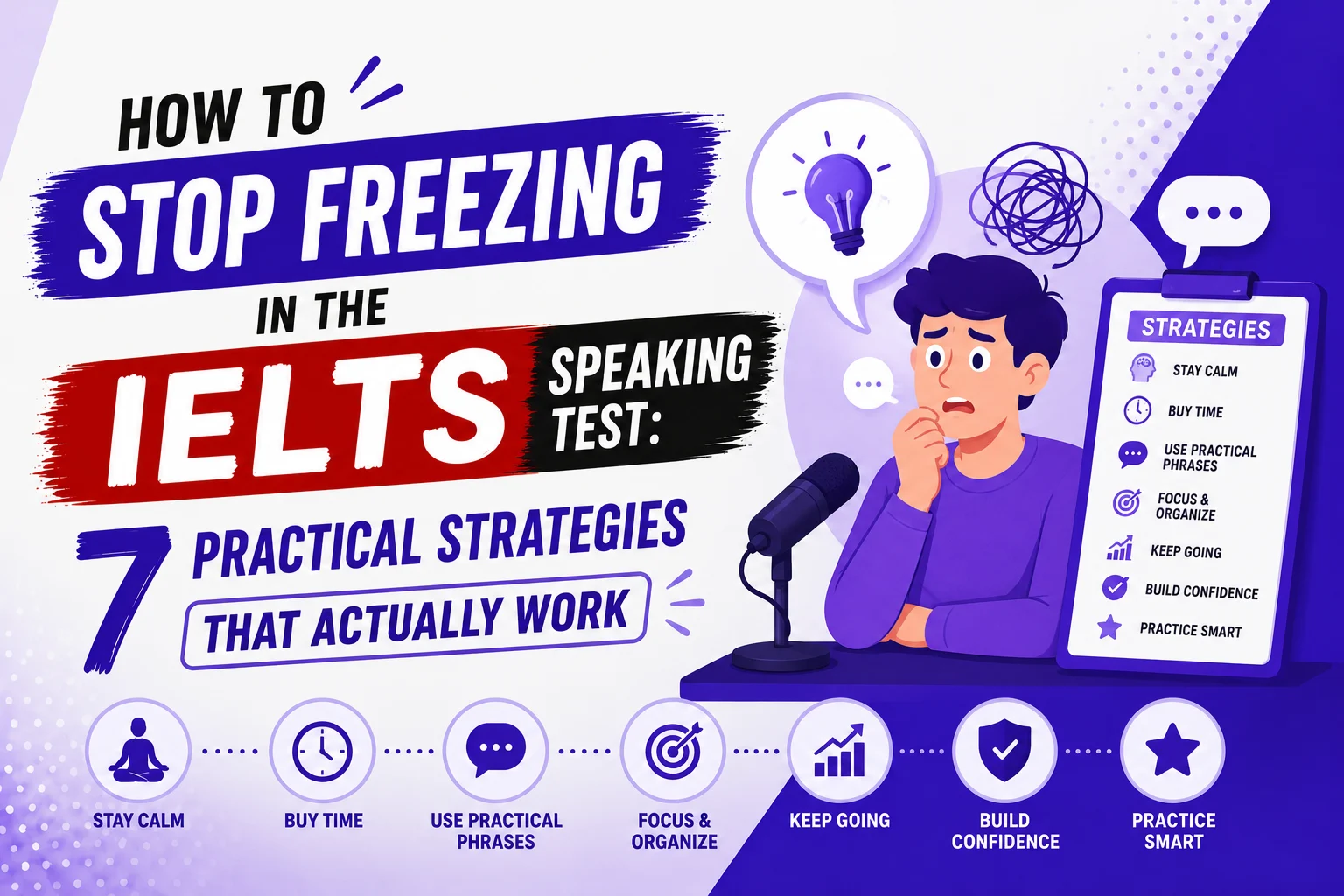
You have studied grammar. You have practised vocabulary. You have read countless sample answers online. Yet the moment the examiner says, “Let’s begin,” your mind goes blank.
If this sounds familiar, you are not alone. Freezing during the IELTS Speaking test is one of the most common and most misunderstood problems that candidates face. The good news? It is almost entirely fixable. Not by memorising more scripts, but by changing how you prepare.
In this article, we will walk through seven strategies that IELTS coaches at Canadian IELTS use with students in Dehradun strategies that have helped hundreds of candidates move from Band 5.5 to Band 7 and above in the Speaking module.
Why Do Candidates Freeze in the First Place?
Before we look at solutions, it helps to understand the cause.
Most candidates freeze because they are trying to do two things at once: think of what to say and think of how to say it correctly. The brain struggles to manage both simultaneously under pressure, especially during the IELTS Speaking test, where you are expected to respond quickly and confidently in a timed, high-stakes environment with a stranger sitting opposite you.
Add to that the fear of making grammar mistakes, the pressure of being recorded, and the anxiety of not knowing what question comes next and it is no surprise that even well-prepared students fall apart.
The solution is not to remove the pressure. That is impossible. The solution is to train your brain so that the how becomes automatic, leaving your mental energy free for the what.
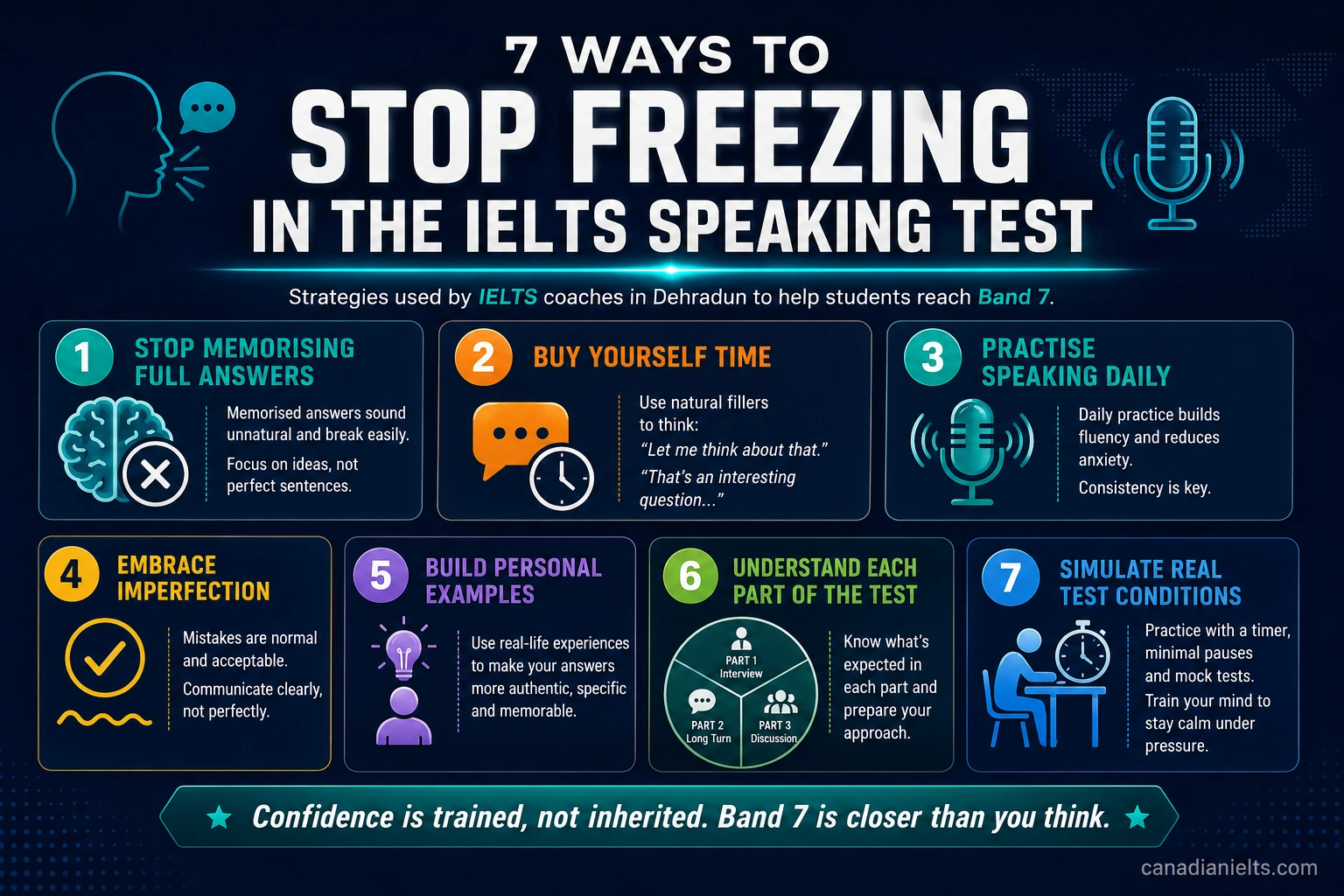
Strategy 1: Stop Memorising Full Answers
This is the most important point in this article, so let us get it out of the way first.
Many candidates prepare by memorising entire answers to common Part 1 and Part 2 questions. This feels productive, but it creates a serious problem: the moment the examiner asks something slightly different or you forget one word the whole answer collapses.
Worse, examiners are trained to spot rehearsed answers. If your response sounds scripted, they will probe deeper with follow-up questions specifically designed to break your prepared script.
Instead of memorising answers, memorise structures. A simple structure like Point → Reason → Example works for almost any question. Practise using this structure with a wide range of topics so it becomes second nature.
Strategy 2: Learn to Buy Yourself Time — Naturally
Silence feels much longer to you than it does to the examiner. A two-second pause while you think is perfectly acceptable. The problem is that most candidates panic during that pause and either rush into a confused answer or simply freeze during the IELTS Speaking test.
Native speakers buy time constantly. They use phrases like:
“That’s an interesting question let me think about that for a moment.”
“I’ve never really considered that before, but I suppose…”
“Off the top of my head, I would say…”
These phrases do two things: they buy you three to five seconds of thinking time, and they sound natural and fluent. Practise using them so that when the pressure hits, they come out automatically rather than feeling forced.
Strategy 3: Practise Speaking Aloud Every Single Day
Reading about speaking is not the same as speaking. This seems obvious, but the majority of IELTS candidates spend most of their preparation time reading, writing, and listening not actually talking.
Aim for at least fifteen minutes of spoken English every day. This does not require a speaking partner. You can:
- Describe what you did that day, as if explaining it to a friend
- Pick a random topic from an IELTS Part 2 card and speak for two minutes without stopping
- Record yourself and listen back (uncomfortable, but enormously useful)
- Comment aloud on a news article or video you have just watched
The goal is to make speaking in English feel normal to your brain, not an event. When speaking feels normal, freezing becomes far less likely.
Strategy 4: Embrace Imperfection
One of the biggest causes of freezing is the fear of making a mistake. Candidates stop mid-sentence because they are not sure whether to say “I have gone” or “I went,” and the whole flow breaks down.
Here is what the IELTS band descriptors actually reward: fluency and coherence are assessed separately from grammatical range and accuracy. A candidate who speaks confidently with occasional errors will often outperform a candidate who speaks slowly and hesitantly but makes fewer mistakes.
The examiner is listening to see whether you can communicate effectively not whether you are a grammar textbook.
Give yourself permission to make mistakes and keep going. In the speaking test, stopping to correct yourself is fine once or twice, but constantly second-guessing your own sentences destroys your fluency score.
Strategy 5: Build a Bank of Real, Personal Examples
Generic answers are easy to spot and hard to develop. When a candidate says, “In my opinion, technology is very useful for people,” there is nowhere to go. When a candidate says, “Last year I was preparing for my IELTS exam and I used an app to practise my listening every evening on the bus that changed how I felt about technology in education,” there is a story, a detail, and a direction.
Personal examples do three things:
- They are easier to remember under pressure (you lived them)
- They sound natural and genuine
- They naturally extend your answer, helping you reach the required length for Part 2
Before your test, jot down five or six memories or experiences across common IELTS topics: travel, education, technology, environment, family, work. You do not need to write full answers just key details you can draw on when needed.
Strategy 6: Understand What Each Part of the Test Requires
Many candidates treat all three parts of the Speaking test the same way. They do not and understanding the difference reduces anxiety considerably.
Part 1 — The Warm-Up
Short, direct answers (two to four sentences) are ideal. Do not over-explain.
Part 2 — The Monologue
You have one minute to prepare and then speak for up to two minutes. Use your preparation time to jot down three or four bullet points, not a full script.
Part 3 — The Discussion
The examiner expects more complex ideas, opinions, and hypothetical thinking. This is where phrases like “It could be argued that…” or “From one perspective…” genuinely improve your score.
Knowing what is expected in each part means you are not wasting mental energy figuring out the rules while the test is happening.
Strategy 7: Simulate Real Test Conditions During Practice
Practising IELTS Speaking at home, comfortably, with no pressure, is not the same as performing under exam conditions. The brain is context-sensitive it behaves differently in high-pressure situations than in relaxed ones.
To bridge this gap, you need to simulate pressure during practice:
- Use a timer strictly during Part 2 practice
- Record yourself (being watched even by a camera creates a real sense of pressure)
- Practise with someone you find slightly intimidating, rather than only with friends
- Do mock tests at the same time of day as your scheduled exam
The more you have experienced the discomfort of timed, observed speaking, the less shocking it will feel on the actual test day.
A Final Word: Confidence Is Trained, Not Inherited
Many students believe that good IELTS speakers were simply born that way that fluency is a gift, not a skill. This is not true. Every confident speaker you admire has gone through an uncomfortable period of stumbling, freezing, and starting again.
The difference between candidates who freeze in the test and those who do not is almost always one thing: the quality and consistency of their spoken practice before the exam.
Start speaking aloud today. Use the strategies above. Give yourself time. Band 7 is not as far away as it feels.
About the Author
Mr. Sanjay Smart is one of the most experienced IELTS trainers in India, with over 30 years of teaching experience and a proven track record of helping more than 15,000 students achieve their IELTS goals and pursue higher education abroad. Throughout his career, he has guided thousands of learners in improving their English proficiency, securing higher band scores, and successfully navigating the study-abroad journey.
He is also the creator of SMART IELTS, an AI-powered IELTS preparation platform designed to make test preparation more effective, accessible, and personalized. Combining his expertise in IELTS training with his skills in content creation, UX design, and prompt engineering, Mr. Smart continues to develop innovative learning solutions that help students prepare with confidence and achieve their target scores.
Leave a Reply