
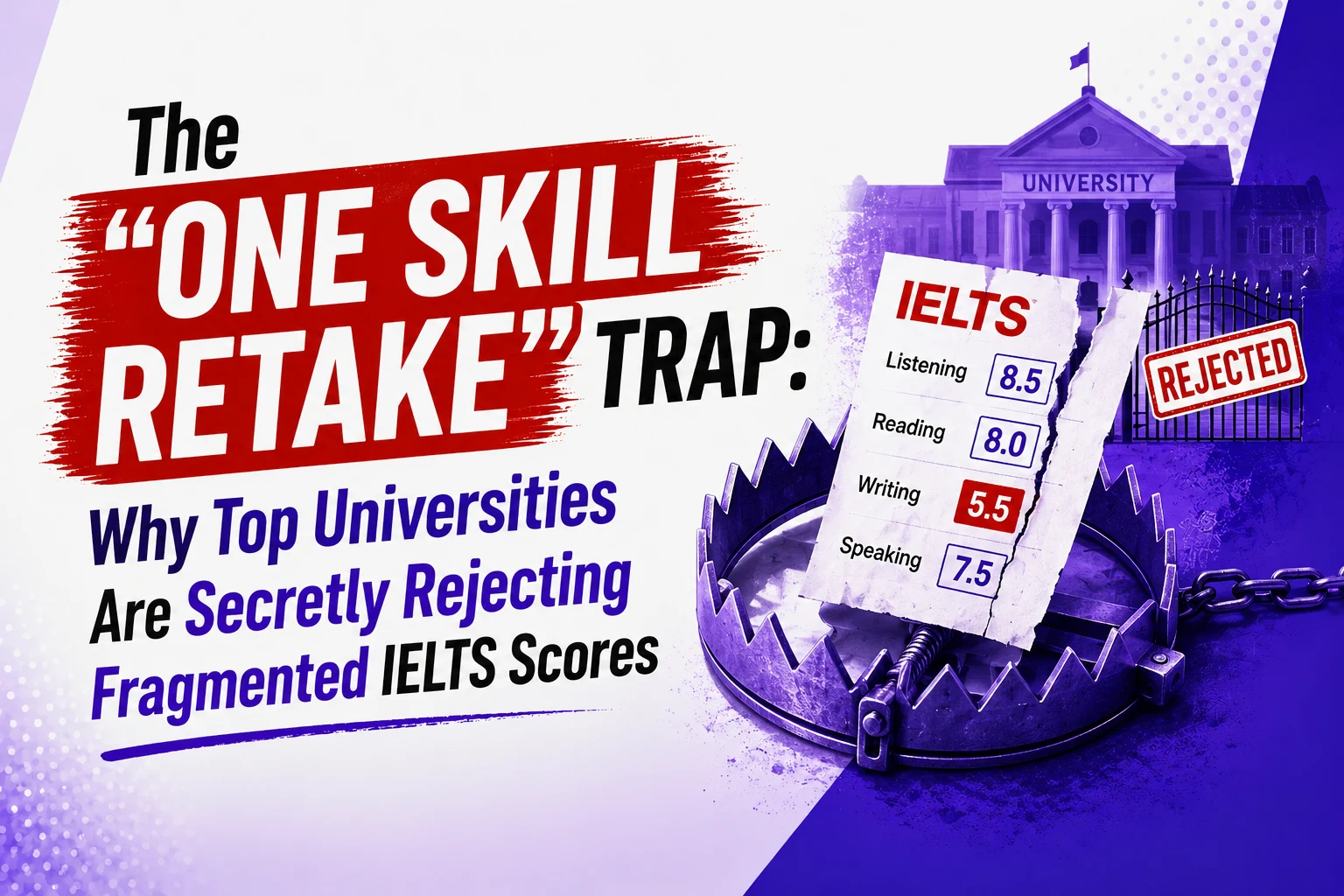
Thousands of students use the one skill retake option every year thinking they’ve found a shortcut to their dream university. Retake just one section, boost a weak band score, combine results done, right?
Not quite. Many top universities have started quietly flagging applications with combined or fragmented IELTS scores. Some reject them outright. Others ask for a fresh full test, costing you both time and money.
This article breaks down exactly what the one skill retake trap is, which universities are suspicious of it, and what you should do instead to protect your application.
What Is the One Skill Retake?
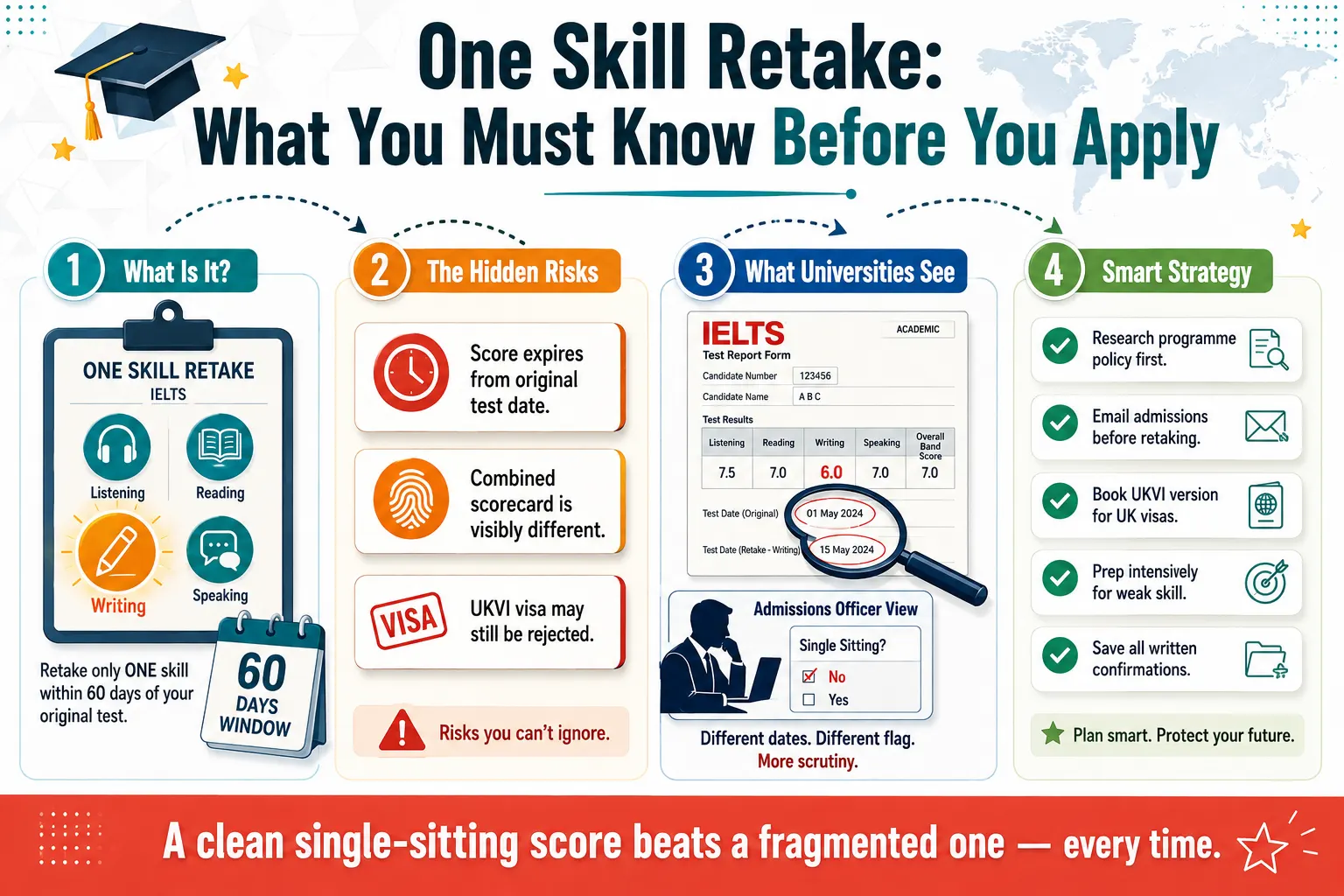
IELTS introduced the One Skill Retake feature in 2023. It lets you retake a single section of the test Listening, Reading, Writing, or Speaking within 60 days of your original test date.
The idea is simple: if your Writing score held you back but the rest was fine, you shouldn’t have to redo everything. You pay a reduced fee, retake only that skill, and your best scores are combined into one final result.
Sounds fair. And for many students, it works exactly as intended.
But here’s what IELTS doesn’t advertise loudly: not every university accepts the combined scorecard.
How the Trap Works
The trap catches students at the very end of the admissions process, when deadlines are close and options are limited.
Here’s the typical sequence:
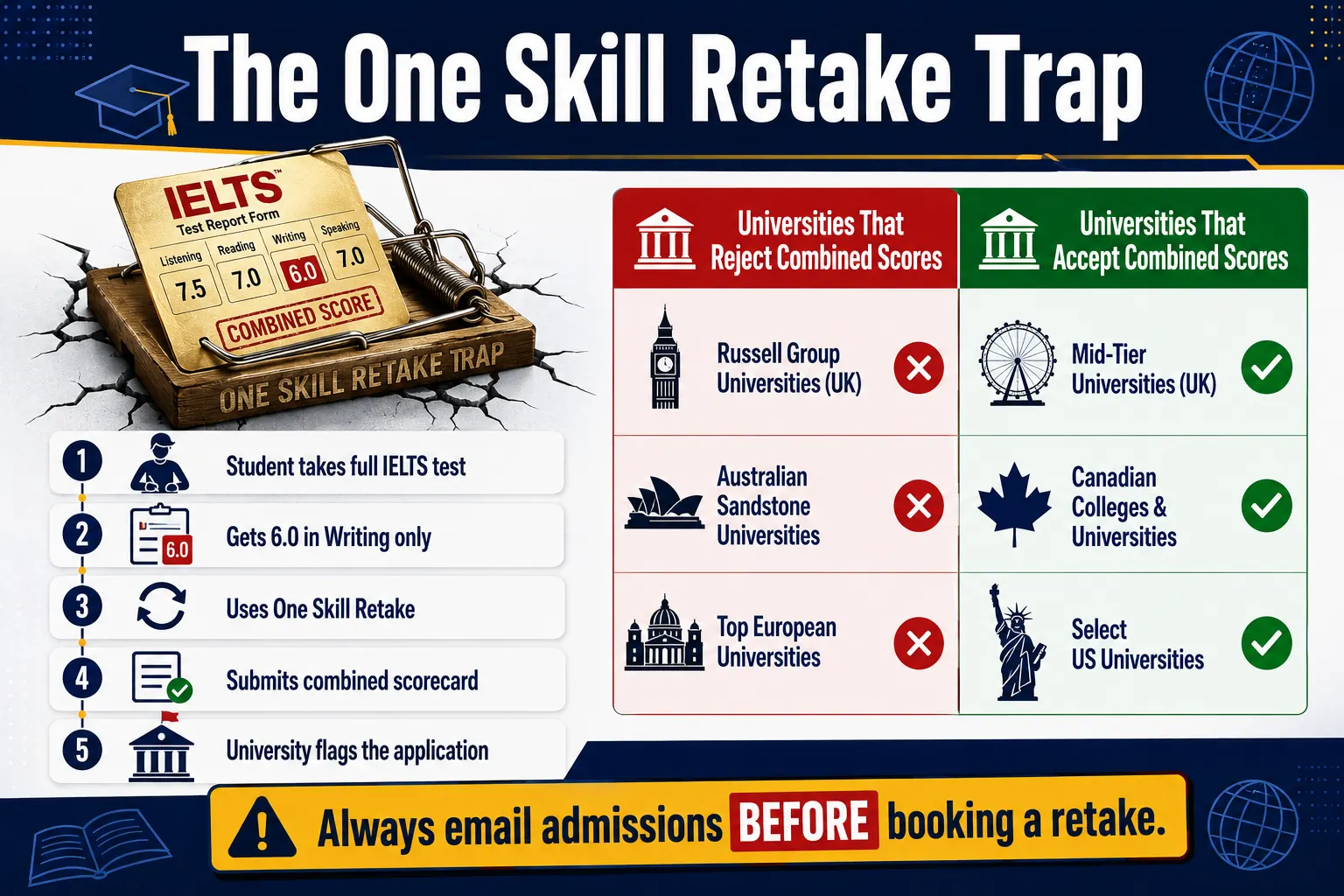
- You sit the full IELTS test and score, say, 6.5 overall but only 6.0 in Writing.
- Your target university requires a minimum 6.5 in every component.
- You use the one skill retake, score 6.5 in Writing, and submit your combined scorecard.
- The admissions office flags it or silently moves your file to a lower priority pile.
The problem is that students assume a valid IELTS result is a valid IELTS result. Many universities don’t think that way.
Why Do Universities Flag Combined Scores?
Universities care about score integrity. A combined scorecard raises a few questions they can’t easily answer:
- Did the candidate perform consistently, or did they prep intensively for just one skill?
- Does the combined score reflect actual language ability, or selective test-taking?
- Did the retake happen under comparable test conditions and proximity in time?
These aren’t paranoid questions. They reflect real concerns about whether a student can function in an academic English environment once enrolled.
What Top Universities Actually Check
Admissions teams at competitive universities typically verify two things: the overall band score and each component score individually.
Many universities state in their admissions requirements that scores must come from a single sitting of the test. That phrase “single sitting” is the key detail students overlook.
For example:
- The University of Edinburgh explicitly states on its admissions pages that it requires all four skills to come from one test date for most programmes.
- Imperial College London has similar language in several department-specific requirements.
- Many Australian Group of Eight universities follow the same policy, especially for health sciences and law programmes.
These policies aren’t always prominently advertised. They’re buried in programme-level entry requirements, not the general admissions FAQ. That’s part of why so many students get surprised.
Which Institutions Accept Combined Scores (and Which Don’t)
Universities That Generally Accept One Skill Retake Scores
- Many mid-tier UK universities and post-92 institutions accept combined IELTS results.
- Several Canadian universities and colleges accept them, particularly for undergraduate entry.
- Some US universities that use IELTS (rather than TOEFL) have more flexible policies.
Universities That Typically Require a Single-Sitting Score
- Russell Group universities in the UK (Oxford, Cambridge, UCL, LSE, and others)
- Top Australian sandstone universities, particularly for medicine, nursing, and law
- Several top-ranked German and Dutch universities that accept IELTS for English-taught programmes
The safest move: Go directly to the programme page on the university website. Search for “IELTS” and look for phrases like “single test date,” “one sitting,” or “original test.” If you can’t find clear language, email the admissions office before you register for a retake.
The Hidden Problem With Fragmented Band Scores
Even when a university technically accepts a one skill retake, there’s another layer to this.
Your combined scorecard shows the dates of both tests. An admissions reader can see that your Listening and Reading were from March and your Writing was from April. This doesn’t automatically disqualify you, but it can create a perception problem.
Competitive programmes receive hundreds of applications. When two candidates have identical overall band scores, the one with a clean, single-sitting scorecard often looks more credible. It signals that the student didn’t need to pick and choose.
The Visa Application Problem
UK and Australian visa applications require IELTS scores from approved tests. Home Office guidance in the UK specifically notes that UKVI-approved IELTS scores must meet certain conditions. If your one skill retake is not from an IELTS UKVI test, your visa application could be rejected even if your university accepted the academic version.
This is a separate but equally serious complication that affects international students applying to the UK in particular.
IELTS Score Validity: The Rule Most Students Forget
IELTS scores are valid for two years from the test date. With a one skill retake, you get a new result letter that reflects the date of the most recent test but the original test’s two-year clock is what universities often use.
If you took your original test in October 2023 and your retake in December 2023, the combined score is valid until October 2025, not December 2025. Some universities interpret this strictly.
If your combined score is approaching the two-year mark when you apply, this becomes a real problem. You may need to retake the full test anyway.
What to Do Instead of Relying on a Skill Retake
Step 1: Research Your Target University’s Policy Before Anything Else
Don’t assume. Go to the programme page, read the entry requirements carefully, and look for any language about test sitting conditions. If you’re unsure, call or email admissions.
Step 2: Target Your Weak Skill With Intensive Preparation
If Writing is your weak skill, spend 4–6 weeks working specifically on Task 1 and Task 2 structures, coherence, and lexical resource. Use official IELTS practice materials and get feedback from a qualified IELTS tutor. Sitting the full test again with better preparation is often faster than navigating the combined score complications.
Step 3: Consider IELTS Academic vs. IELTS UKVI
If you’re applying to UK universities or need a Tier 4 (Student) visa, make sure you’re booking the IELTS UKVI version, not just the Academic version. The one skill retake is available for both, but visa compliance requires the UKVI path.
Step 4: Use the One Skill Retake Only When You’re Sure It Works
If your target institution clearly accepts combined scores, and your visa route allows it, the one skill retake is a legitimate and cost-effective tool. The retake fee is roughly half the full test cost. Use it confidently when you’ve confirmed it’s accepted.
Step 5: Keep Copies of All Communication
If an admissions office tells you verbally or by email that they accept combined scores, save that communication. Policies can change between when you apply and when your file is reviewed.
FAQ
Can I use a one skill retake score for a UK student visa?
Only if you took the IELTS UKVI version and the retake was also UKVI-approved. Standard Academic IELTS scores, including retakes, are not accepted for UK visa applications. Always book the UKVI version if you plan to apply to the UK.
How long does a one skill retake score remain valid?
The overall result validity is tied to the original test date. IELTS scores are valid for two years. Even if you retake one skill six weeks after the original test, the expiry date is calculated from the first test.
Do all IELTS test centres offer the one skill retake?
Not all centres offer it, and availability depends on the test format. Computer-delivered IELTS tests have broader one skill retake availability than paper-based tests. Check with your local test centre directly before planning around this option.
Will my combined scorecard look different from a single-sitting scorecard?
Yes. The combined scorecard will show two separate test dates and will be labelled as a one skill retake result. Admissions officers who know what to look for will see this immediately.
Is a 6.5 on a retake Writing score treated the same as a 6.5 on a first attempt?
Academically, yes IELTS certifies the score regardless. But in practice, some competitive admissions teams do view a retake-achieved score with slightly more scrutiny, particularly for high-stakes programmes like medicine, law, or engineering where academic writing is essential from day one.
The Bottom Line on the One Skill Retake
The one skill retake is not inherently bad. For many students applying to flexible institutions, it works exactly as designed and saves real time and money.
The problem is blind trust. Thousands of students use it without checking whether their specific university, their specific programme, and their specific visa route actually accept it.
Do the research before you book the retake. One email to an admissions office can save you months of confusion, a wasted application fee, and in the worst cases a rejected visa.
If you’re not sure, retake the full test. A clean, single-sitting IELTS Academic score with strong component bands is the safest possible proof of your English ability. No ambiguity. No flag. No problem.

Mr. Sanjay Smart has taught IELTS for the last 30 years and has helped more than 15,000 students clear the IELTS and study abroad. He is also the creator of SMART IELTS, an AI-driven IELTS preparation portal, for which he has lent his content creation, UX Design and Prompt Engineering skills.
Leave a Reply