

You’ve worked hard for 3-5 years. You’re good at what you do. But something feels stuck the leadership roles, the salary jumps, the global exposure they’re not coming fast enough.
That’s exactly why thousands of Indian professionals are choosing an MBA in UK for Indian students as their next big move. And in 2026, there are more reasons than ever to pick the UK over other destinations.
This article breaks it all down for you: costs, salaries, top universities, scholarships, visa rules, and whether the ROI actually makes sense for your situation.
Why the UK Stands Out for Indian MBA Aspirants
The UK does something most countries don’t it delivers a world-class MBA in just 12 months.
That one fact changes the entire financial math. You spend less time out of the workforce, pay tuition for one year instead of two, and re-enter the job market faster. For Indian professionals counting every rupee, this is huge.
Here’s what makes the UK a strong choice in 2026 specifically:
- 1-year MBA format means your total investment is significantly lower than a US 2-year program often by 30-40%.
- QS-ranked universities like LBS, Oxford Saïd, Warwick, and Manchester carry strong brand recognition with Indian employers and MNCs globally.
- The Graduate Route Visa lets you work in the UK for 2 years after graduation but only if you apply before December 31, 2026 (more on this below).
- Indian community networks across London, Manchester, and Edinburgh make the cultural transition much smoother than you’d expect.
- UK business schools have built deep ties with industries like consulting, finance, tech, and FMCG the exact sectors most Indian MBAs want to break into.
Top UK Universities for MBA in 2026
Not all UK MBA programs are the same. Here are the schools that consistently place Indian students well:
| University | Avg. MBA Tuition (GBP) | QS MBA Ranking |
|---|---|---|
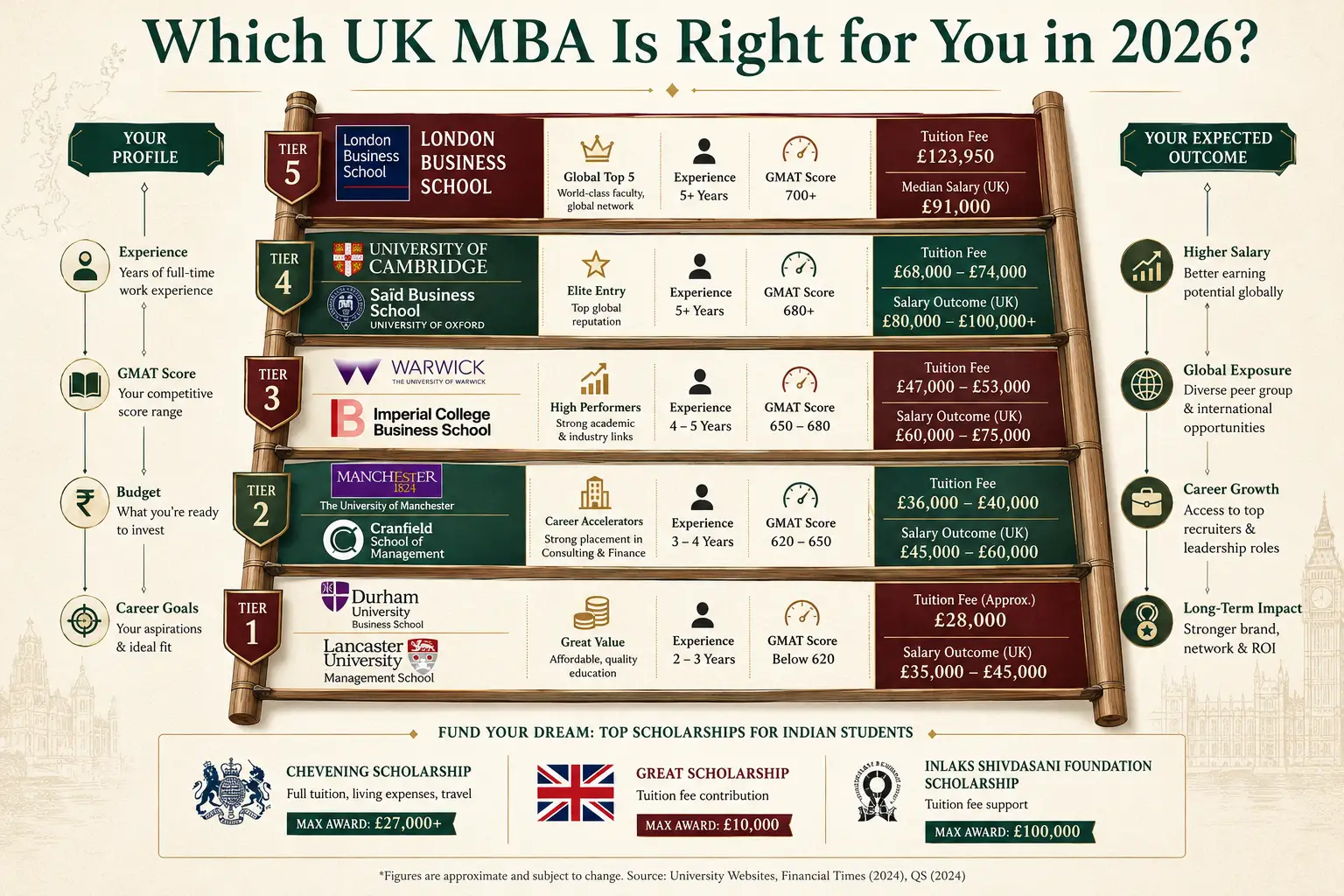
| London Business School (LBS) | £123,950 | Top 5 globally |
| University of Oxford – Saïd | £72,000 | Top 10 globally |
| University of Cambridge – Judge | £67,000 | Top 15 globally |
| Imperial College Business School | £58,000 | Top 20 globally |
| University of Warwick | £43,000 | Top 50 globally |
| University of Manchester | £38,000 | Top 50 globally |
| Durham University Business School | £28,000 | Solid mid-tier |
Practical tip: If your GMAT score is below 620 and you have 3-4 years of experience, Warwick, Manchester, or Durham will offer better value and a realistic acceptance rate than Oxford or LBS.
MBA in UK Cost for Indian Students
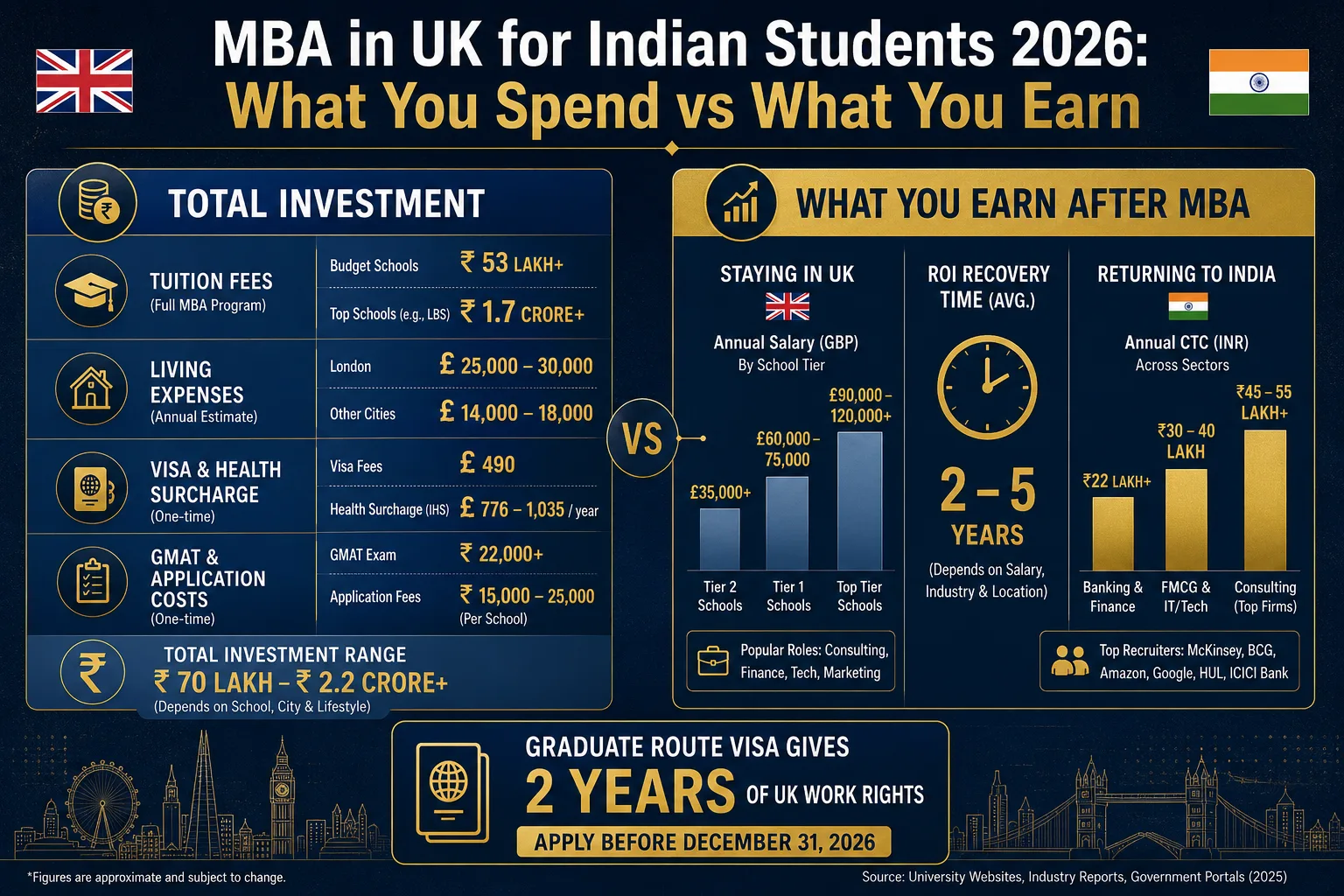
Let’s talk real numbers. The total cost of an MBA in UK for Indian students covers tuition, living expenses, visa fees, and health surcharge.
Tuition Fees:
- Budget universities: £16,000–£28,000 per year
- Mid-tier schools: £38,000–£58,000 per year
- Elite schools (LBS, Oxford): £70,000–£124,000
Living Expenses:
- London: approximately £25,000–£30,000 per year
- Manchester, Warwick, Durham: approximately £14,000–£18,000 per year
So the total investment for a 1-year UK MBA ranges from roughly ₹53 lakh at the lower end to ₹1.7 crore at LBS with London living costs (at the May 2026 exchange rate of ₹129.51 per GBP).
One cost most students forget: the Immigration Health Surcharge (IHS), which is £776 per year and must be paid upfront when you apply for your visa.
If you’re choosing between London and a city like Manchester or Durham, factor in that London adds roughly ₹5–7 lakh more per year in living costs alone.
Average Salary After MBA in UK
This is what everyone really wants to know. Here’s the honest picture.
If you stay in the UK:
- Entry-level post-MBA roles: £35,000–£55,000 annually
- Consulting and finance (mid-tier schools): £60,000–£75,000 annually
- LBS / Oxford graduates: £91,000–£120,000 median weighted salary
If you return to India:
- McKinsey/BCG India consulting roles (LBS/Oxford MBAs): ₹35–55 lakh CTC
- FMCG leadership at companies like HUL or Nestlé: ₹22–38 lakh CTC
- Indian banking VP-level roles (Kotak, HDFC, Axis): ₹25–40 lakh CTC
- Startup CXO/VP roles at funded Indian startups: ₹20–35 lakh + ESOPs
Most students recover their UK MBA investment within 2 to 5 years depending on the school they attend and the salary they land.
The ROI gets even better when you factor in placement rates Edinburgh Business School places up to 90% of graduates, and London-based schools report employment success rates as high as 95% within 3 months of graduation.
Scholarships for Indian Students
Funding is available. You just need to know where to look and apply early.
Chevening Scholarship The most prestigious option for Indian students. Fully funded covers tuition, living expenses, and airfare. You need at least 2 years of work experience and must commit to returning to India for 2 years after graduation.
GREAT Scholarships 2026-27 Jointly funded by the UK government and participating universities. Each award covers a minimum of £10,000 (approximately ₹12.95 lakh) toward tuition. Multiple UK universities offer these specifically for Indian students.
Commonwealth Scholarship Covers full tuition up to £22,000, monthly stipend, and visa fees. You apply through the Indian Ministry of Education’s SAKSHAT portal. It’s competitive but open to MBA applicants aligned with development-focused themes.
Inlaks Scholarship Covers up to USD 100,000 (around £79,000) for Indian citizens under 30. This covers tuition, living, and travel at select top UK universities including Cambridge and Imperial.
University-specific awards:
- Oxford Pershing Square Scholarship: Fully funded for exceptional leaders
- Warwick Chancellor’s International Scholarship: Full funding plus stipend
- Manchester Global Futures Scholarship: Up to £6,000
Start your scholarship search 8–10 months before your intended intake. Most universities auto-consider you for merit scholarships no separate application needed at schools like LBS or Warwick.
UK Graduate Route Visa: What You Need to Know
This is a time-sensitive point that every Indian MBA applicant must understand in 2026.
The Graduate Route Visa gives you the right to live and work anywhere in the UK for 2 years after you complete your degree without needing employer sponsorship.
The critical deadline: If you apply for this visa before December 31, 2026, you get the full 2-year entitlement. Applications submitted from January 2027 onward will only receive 18 months under the new UK immigration rules.
This means students starting an MBA in September 2026 and graduating around September 2027 will still fall under the 2-year rule giving you two years to find a job, build experience, and potentially transition to a Skilled Worker Visa.
For Indian professionals, those 2 years are gold. You can build a UK work history, earn in pounds, and return to India with global credentials or continue building your career in Europe.
MBA in UK vs MBA in USA: Which Is Better for Indians?
Both have strengths. But for most Indian students, the UK wins on ROI especially if you plan to return to India within 5 years.
Here’s why:
- Time: UK MBA takes 1 year. US MBA takes 2 years. That’s a full extra year of salary foregone in the US.
- Cost: Total investment for a strong UK MBA (Warwick, Manchester) sits around ₹70–90 lakh. A comparable US school can push ₹1.5–2 crore.
- Work visa risk: The US H-1B lottery sits at roughly 35% approval odds in 2026, with a new $100,000 supplemental fee for certain petitions. The UK Graduate Route Visa is guaranteed upon graduation no lottery.
- India employer perception: LBS and Oxford carry equal or stronger brand recognition in India compared to most mid-tier US business schools.
The US still wins if you’re targeting Big Tech, bulge-bracket banking, or have a confirmed employer willing to sponsor H-1B. Otherwise, the UK offers more certainty and a faster payback period.
How to Get Admission to UK MBA Programs
Most UK MBA programs require the following:
- Work experience: 2–5 years of full-time post-graduate experience (some top schools prefer 5+)
- GMAT/GRE score: Most schools ask for 600+ on the GMAT Focus Edition; LBS and Oxford expect 680–710+
- English proficiency: IELTS 7.0 or above (some schools accept PTE or TOEFL)
- Statement of Purpose: A well-crafted SOP that clearly links your past experience, MBA goals, and future plans
- References: Two professional references, ideally from senior managers who can speak to leadership potential
GMAT waiver schools: If your GMAT score is below 600, Durham, Cranfield, and Lancaster offer GMAT waivers for candidates with strong work experience and academics.
Applications for September 2026 intake typically open between October 2025 and March 2026, with multiple rounds. Scholarship pools shrink in later rounds, so applying in Round 1 is always the smarter call.
Is an MBA in UK Worth It for Indian Students?
Here’s the honest answer: yes but only if you make the right choices.
The MBA in UK for Indian students makes strong financial sense when:
- You pick a school that matches your GMAT score and experience level (don’t stretch for LBS on a 610 GMAT)
- You apply for and use the 2-year Graduate Route Visa to build real UK work experience
- You target high-ROI sectors like consulting, finance, or tech not just any available role
- You factor in scholarships early and plan your finances before you apply
The unique angle most articles miss: the ROI calculation changes dramatically based on where you plan to live after graduation. If you return to India in 2-3 years, a mid-tier UK MBA from Warwick or Manchester often beats LBS on net ROI because the lower investment recovers faster against Indian salaries, while the brand still opens the right doors.
FAQ
Q1: What is the total cost of an MBA in the UK for Indian students in 2026? The total cost ranges from approximately ₹53 lakh (tuition + living at mid-tier schools) to ₹1.7 crore at London Business School with London living expenses. The current GBP to INR exchange rate is approximately ₹129.51 per pound (May 2026).
Q2: How long does it take to recover the cost of a UK MBA? Most graduates recover the investment in 2–5 years depending on the school they attend and the salary they land. Graduates staying in the UK at consulting or finance firms typically break even faster than those returning to India immediately.
Q3: Can I work in the UK after completing my MBA? Yes. The Graduate Route Visa allows you to work in the UK for 2 years after graduation with no employer sponsorship needed. Apply before December 31, 2026 to get the full 2-year entitlement.
Q4: Which scholarships are available for Indian students pursuing MBA in the UK? Key options include the Chevening Scholarship (fully funded), GREAT Scholarships (£10,000+ toward tuition), Commonwealth Scholarship, and university-specific awards from LBS, Oxford, Warwick, and others. The Inlaks Scholarship also covers up to USD 100,000 for students under 30.
Q5: Is GMAT mandatory for MBA in the UK? Most top schools require GMAT, with scores between 620–710 for strong candidacy. However, several schools like Durham, Cranfield, and Lancaster offer GMAT waivers for candidates with strong work experience and academic records.
Your Next Step Starts Here
An MBA in UK for Indian students is not a leap of faith it’s a calculated decision. You now have the numbers, the school options, the scholarship paths, and the visa rules. The only thing left is deciding whether this is the right move for you, at this point in your career. If you have 2-5 years of experience, a clear sense of where you want to go, and the drive to make one focused year count, the UK gives you everything you need to get there. The 1-year format is fast, the global network is real, and the doors it opens in London, Mumbai, or anywhere in between are worth every rupee of the investment.

Mr. Sanjay Smart has taught IELTS for the last 30 years and has helped more than 15,000 students clear the IELTS and study abroad. He is also the creator of SMART IELTS, an AI-driven IELTS preparation portal, for which he has lent his content creation, UX Design and Prompt Engineering skills.
Leave a Reply