
ieltsMost IELTS test-takers spend months perfecting their vocabulary and essay structure. Then they sit the exam, write a well-argued response and still score a 5.5 or 6.0 in Writing. Why? Often, a string of tiny punctuation errors quietly drag the score down.
This guide breaks down exactly how IELTS punctuation mistakes affect your band score, which errors examiners notice most, and how to fix them before test day.
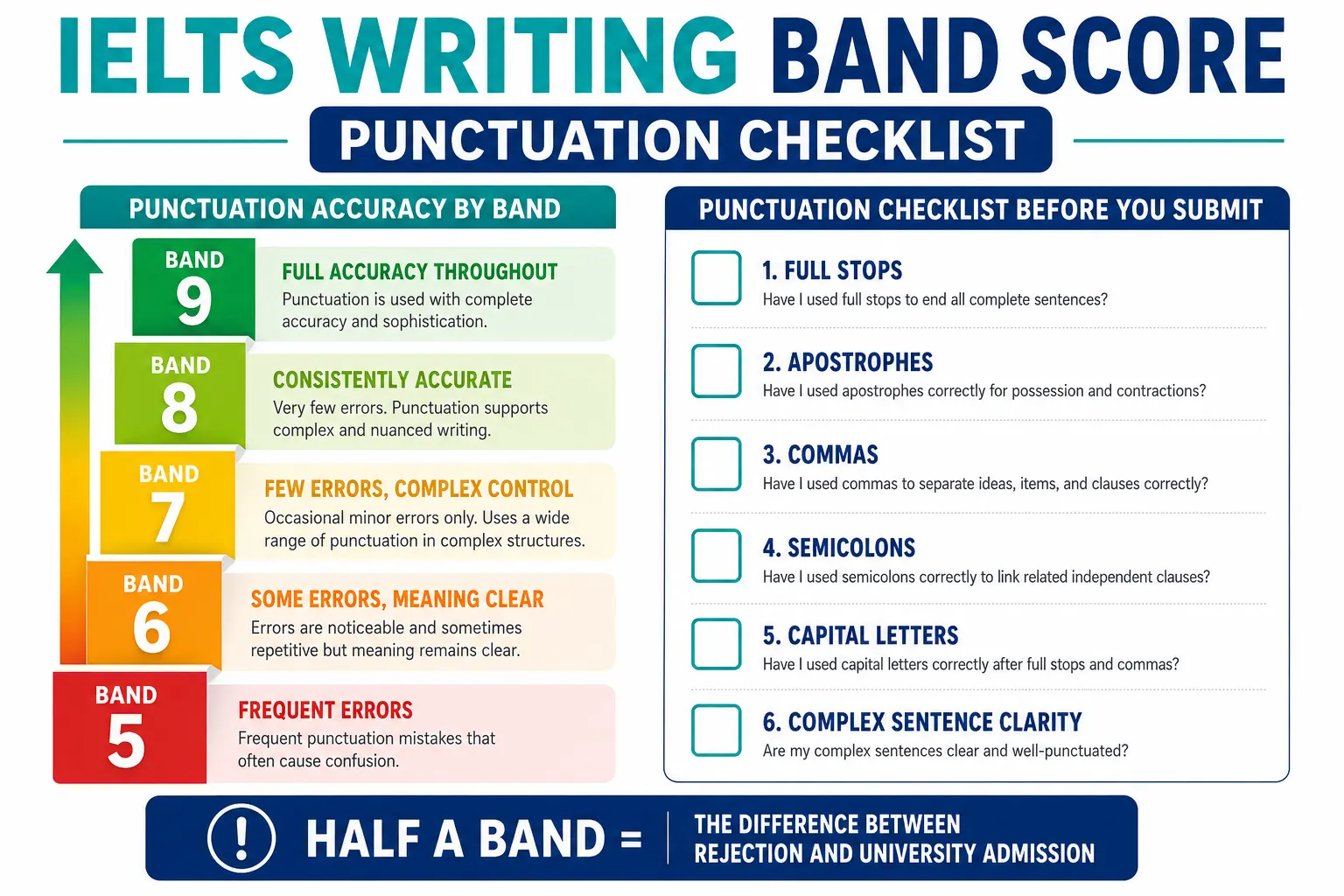
Table of Contents
- Why Punctuation Matters for Your IELTS Writing Score
- How Examiners Actually Mark Punctuation
- The 6 Most Common IELTS Punctuation Mistakes
- Comma Splice: The Silent Score Killer
- How to Improve Your IELTS Punctuation Fast
- Does One Mistake Really Make a Difference?
- Quick Punctuation Checklist for IELTS Writing
- FAQ
Why Punctuation Matters for Your IELTS Writing Score
The IELTS Writing band score uses four marking criteria. One of them is Grammatical Range and Accuracy. This criterion covers 25% of your total Writing score and punctuation falls directly under it.
The official IELTS band descriptors state that a Band 7 writer uses “a variety of complex structures with frequent error-free sentences.” At Band 6, “errors in grammar and punctuation occur but rarely impede communication.”
So even at Band 6, you are expected to keep punctuation errors low. Push into Band 7 or above, and you need near-clean punctuation throughout.
The problem? Many candidates don’t treat punctuation as grammar. They see a comma as just a pause, or a full stop as obvious. Examiners see it differently. To them, a misplaced comma or a missing apostrophe signals weak language control.
How Examiners Actually Mark Punctuation
IELTS examiners do not circle every error and count them. Instead, they form an overall impression of your grammatical control. Punctuation errors contribute to this impression in two key ways:
- Frequency: One or two errors across 250 words look like slips. Five or six errors look like a pattern. Patterns pull your band score down.
- Effect on meaning: A punctuation error that confuses the reader is more damaging than one that merely looks sloppy. Errors that create ambiguity are the most costly.
Examiners are also trained to notice certain high-frequency mistakes. Comma splices, missing apostrophes in contractions, and run-on sentences appear so often that examiners spot them almost automatically.
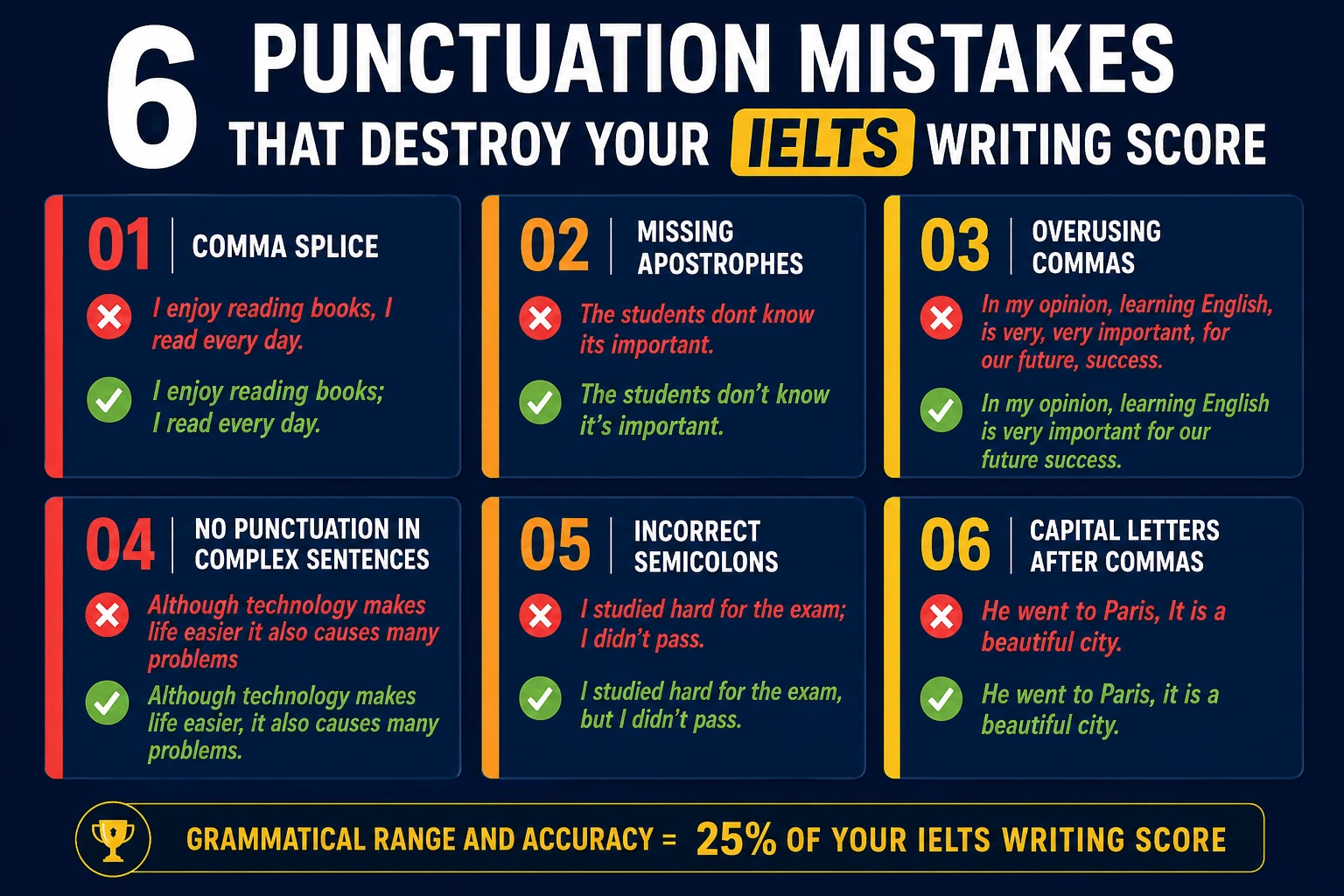
The 6 Most Common IELTS Punctuation Mistakes
1. Comma Splice
A comma splice joins two complete sentences with only a comma. Example: “The population is rising, governments must act now.” This is one sentence crashing into another. Use a full stop, a semicolon, or a conjunction instead.
2. Missing or Wrong Apostrophes
Many candidates write “its” when they mean “it’s” and vice versa. Others write “the governments policy” instead of “the government’s policy.” Apostrophes show possession and contraction. Getting them wrong signals weak grammar control, not just careless typing.
3. Overusing Commas
Some writers place a comma after almost every clause, whether it is needed or not. This creates choppy, breathless writing that reads as low control over sentence structure. Commas should serve a purpose not simply mark where a reader might pause.
4. No Punctuation at All in Complex Sentences
A long sentence with multiple clauses needs punctuation to stay clear. Without commas around relative clauses or after introductory phrases, the sentence becomes a wall of text. The reader has to re-read to understand which is exactly what examiners penalise.
5. Incorrect Use of Semicolons
Semicolons are powerful, but many candidates misuse them. A semicolon should join two closely related independent clauses. Writing “There are many factors; such as education and income” is wrong. “Such as education and income” is not an independent clause. A comma works here instead.
6. Capital Letters After Commas
This happens when a writer types quickly. “The report shows, That urban areas are growing.” The word “That” should not be capitalised because a comma does not end the sentence. Examiners read this as a basic error in sentence awareness.
Comma Splice: The Silent Score Killer
The comma splice deserves its own section because it appears so frequently in IELTS scripts and because many candidates have no idea they are making this mistake. In fact, it is one of the most common punctuation errors that can reduce your IELTS writing score.
Here is why it happens. In many languages, joining two ideas with a comma is perfectly normal. When writers translate this habit into English, comma splices appear throughout their writing.
Wrong: “Technology has changed education, students can now learn from anywhere.”
Right (option 1): “Technology has changed education. Students can now learn from anywhere.”
Right (option 2): “Technology has changed education, so students can now learn from anywhere.”
Right (option 3): “Technology has changed education; students can now learn from anywhere.”
All three corrections work. The key is recognising that two complete thoughts need more than a comma to stay grammatically connected.
If you review your practice essays and spot comma splices, count how many appear. More than two in a single essay will almost certainly cap your Grammatical Range and Accuracy score below Band 7.
How to Improve Your IELTS Punctuation Fast
Improvement does not take months. Most candidates fix their core punctuation issues within two to three weeks of focused practice. Here is a practical approach:
Step 1: Audit your past essays. Take your last three practice essays and read them aloud, slowly. Every place where you pause naturally ask yourself whether a punctuation mark is there and whether it is the right one.
Step 2: Focus on one rule per day. Trying to fix everything at once leads to confusion. Spend one day on comma splices, the next on apostrophes, the next on complex sentences. Targeted practice builds faster habits.
Step 3: Read Band 8 and Band 9 sample essays. The British Council and Cambridge publish official sample scripts with examiner comments. Read them not just for vocabulary and structure read them for punctuation. Notice how sentences are separated, where commas appear, and how complex clauses are handled.
Step 4: Type your practice essays. Handwriting can make punctuation errors harder to spot because the eye reads the intended meaning rather than what is actually on the page. Typing forces you to see each character.
Step 5: Use a grammar checker as a learning tool not a crutch. Tools like Grammarly or LanguageTool can flag many punctuation errors. Use them after you finish writing to see what you missed, then study why the suggestion was made.
Does One Mistake Really Make a Difference?
Yes, but context matters.
A single comma splice in 250 words, surrounded by otherwise accurate grammar, probably will not drop your score from Band 7 to Band 6. Examiners look at overall control, not a single slip.
However, one mistake rarely travels alone. Candidates who write comma splices tend to write several. Candidates who miss apostrophes tend to miss them repeatedly. This is because these errors usually reflect a habit or a gap in understanding, not a one-off accident.
The honest answer is this: one isolated mistake is unlikely to change your band. But if you are making that mistake once, you are probably making it three or four times across your full response. Four recurring errors of the same type are enough to drop a score by half a band.
Half a band in IELTS Writing score can be the difference between a 6.5 and a 7.0 which, for university admission requirements, is often the line between acceptance and rejection.
Quick Punctuation Checklist for IELTS Writing
Before you submit your IELTS Writing response, run through these checks:
- Full stops: Every sentence ends with one. No sentence ends with a comma where a full stop is needed.
- Apostrophes: Every contraction and possessive noun uses one correctly. (“it’s” = “it is”; “its” = belonging to it)
- Commas: Used after introductory phrases, around non-essential clauses, and before coordinating conjunctions in compound sentences. Not used to join two complete sentences on their own.
- Semicolons: Only used between two independent clauses. Not used before a list item or a dependent clause.
- Capital letters: Only at the start of a new sentence or for proper nouns. Never after a comma mid-sentence.
- Complex sentences: Long sentences with multiple clauses have commas in the right places to keep meaning clear.
FAQ
Does punctuation affect all four IELTS Writing criteria?
Punctuation directly affects the Grammatical Range and Accuracy criterion, which is 25% of your score. However, very poor punctuation can also reduce the clarity of your writing, which may indirectly affect Coherence and Cohesion another 25% criterion. So in theory, serious punctuation problems could impact up to half your score.
Can I lose marks for using a comma instead of a full stop?
Yes. A comma used where a full stop is needed creates a comma splice or a run-on sentence. Examiners classify this as a grammatical error, not just a stylistic choice. Repeated use of this pattern signals low control over sentence boundaries.
Is punctuation for IELTS different from everyday English writing?
The rules are the same. However, IELTS Writing Tasks expect a semi-formal to formal register, which means contractions (like “don’t” or “can’t”) are best avoided in Task 2 essays. This makes apostrophe-related errors less likely, but the other rules commas, full stops, semicolons all apply in full.
How many punctuation errors are acceptable in IELTS Writing?
There is no fixed number. Band 7 descriptors require “frequent error-free sentences” and only “a few errors.” As a rough guide, aim for no more than one or two minor punctuation errors per 250 words. More than that starts to form a pattern that examiners notice and can negatively affect your IELTS writing score.
How do I improve my IELTS writing grammar and punctuation at the same time?
The most efficient method is sentence-level editing practice. Take complex sentences from sample essays, strip out all punctuation, and try to re-punctuate them correctly. Then compare your version to the original. This builds awareness of how punctuation relates to sentence structure — which improves both grammar and punctuation together.
Leave a Reply