
Most IELTS candidates spend hours practising grammar and vocabulary. Yet on test day, their essay still feels choppy, disconnected, or hard to follow. The examiner marks it down for “Coherence and Cohesion” and the student has no idea why.
This guide explains exactly what flow means in an IELTS essay, why yours might be missing it, and what you can do to fix it before your next attempt.
What Does “Flow” Actually Mean in an IELTS Essay?
“Flow” is not a formal IELTS term. But it perfectly describes what the examiner calls Coherence and Cohesion one of the four marking criteria, worth 25% of your Writing band score.
Coherence means your ideas are organised logically. Each paragraph has one clear purpose. The argument moves forward in a sensible direction.
Cohesion means the sentences and paragraphs connect smoothly. The reader never has to stop and re-read a sentence to understand where you are going.
When both work together, your essay has flow. When one is broken, the examiner notices even if your grammar is perfect.
Why Your IELTS Essay Might Lack Cohesion
Here are the most common reasons IELTS essays feel disconnected:
- You jump between ideas without a bridge. One sentence discusses education policy; the next talks about parental responsibility. No linking phrase connects them.
- You overuse the same connector. Writing “Furthermore” at the start of every paragraph is not cohesion it is repetition. Examiners at Band 6 and below often rely on only two or three connectors.
- You add linking words but ignore sentence structure. Slapping “However” in front of a sentence does not automatically create contrast if the idea is not actually contrasting.
- Your paragraphs have no internal logic. A strong paragraph follows this pattern: topic sentence → explanation → example → link to the thesis. Without this structure, even well-connected sentences feel random.
- You copy connectors without understanding them. Many students memorise phrases like “In spite of the fact that” without knowing how to use them correctly, which creates grammatically broken sentences.
The Four Main Cohesive Devices for IELTS
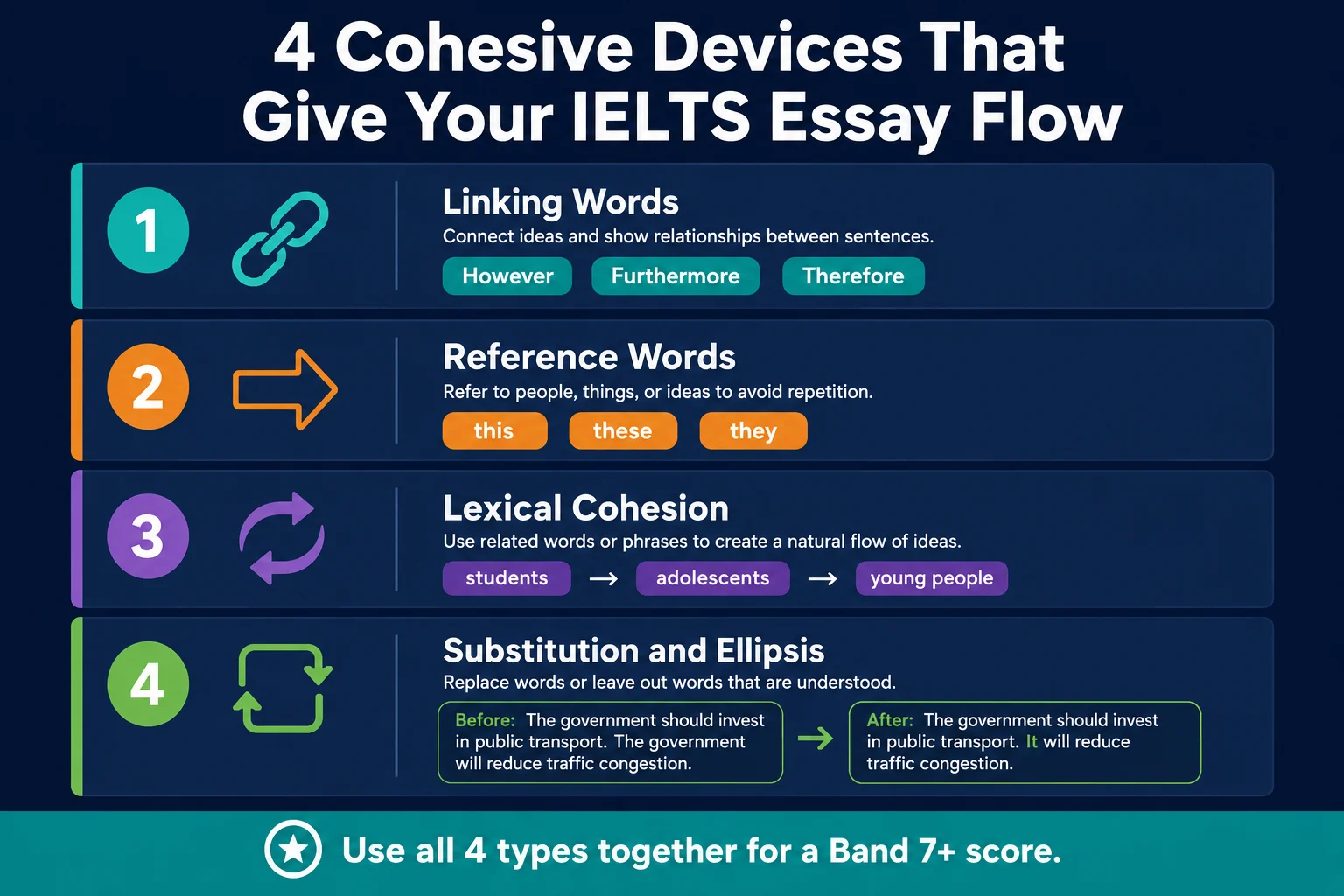
A cohesive device is any language tool that links ideas. There are four main types in academic writing, and your IELTS essay needs all of them.
1. Linking Words and Phrases (Conjunctions and Adverbials)
These are the connectors most students know. They signal the relationship between two ideas.
| Function | Examples |
|---|---|
| Adding information | Furthermore, In addition, Moreover |
| Showing contrast | However, On the other hand, Nevertheless |
| Showing cause/result | Therefore, As a result, Consequently |
| Giving examples | For instance, For example, Such as |
| Conceding a point | Admittedly, Although, Even though |
Use these sparingly. One or two per paragraph is enough. More than that, and they start to feel mechanical.
2. Reference Words (Pronouns and Demonstratives)
Reference words point back to something already mentioned. They reduce repetition and create a thread between sentences.
- “Many students struggle with writing. They often lack feedback on their essays.”
- “The government launched a new policy. This decision received criticism from educators.”
Using “this,” “these,” “it,” “they,” and “such” correctly shows a high level of linguistic control something Band 7+ candidates do naturally.
3. Lexical Cohesion (Synonyms and Word Families)
Instead of repeating the same noun five times, skilled writers use synonyms, related words, or broader terms.
- “young people” → “adolescents” → “the younger generation” → “students”
- “government” → “authorities” → “policymakers” → “officials”
This technique improves both cohesion and your Lexical Resource score simultaneously.
4. Substitution and Ellipsis
These are advanced devices. Substitution replaces a word or phrase to avoid repetition:
- “Some people prefer online learning. Others prefer the traditional approach.” (substituting “classroom learning”)
Ellipsis leaves out words that are clearly understood:
- “Some students study alone; others [study] in groups.”
You do not need to use these constantly. But using them correctly once or twice signals Band 7+ writing.
Common Mistakes with Linking Words in IELTS Writing
Using connectors at the start of every sentence
Beginning every single sentence with a linker makes the writing feel forced. Good flow often comes from sentence structure itself, not just signal words.
Choosing the wrong connector for the relationship
Students often write “However” when they mean “Therefore,” or “Furthermore” when they mean “In contrast.” Each connector has a precise job. Using the wrong one confuses the reader and damages coherence.
Using formal connectors in informal positions
“Notwithstanding” and “Thus” are very formal. Using them in a casual explanation sounds unnatural and suggests the writer does not fully understand the phrase.
Connecting ideas that have no logical relationship
No linking word can rescue two ideas that simply do not belong together. Before adding a connector, ask: Is there actually a logical relationship between these sentences?
How to Improve Cohesion in Your IELTS Essay
Follow these practical steps to improve cohesion in your IELTS writing immediately.
Step 1: Plan before you write
A five-minute plan stops illogical jumps between ideas. Write down your main points in order. Check that each one follows naturally from the last.
Step 2: Give every paragraph one job
Each body paragraph should have one central idea. State it in the first sentence. Support it. Do not mix two arguments in the same paragraph.
Step 3: Use a variety of cohesive devices — not just connectors
Most students fix “However” at the start of a paragraph and call it cohesion. Real cohesion also includes reference words, synonyms, and well-structured sentences. Aim to use at least two different device types per paragraph.
Step 4: Read your essay like a stranger
After writing, read each sentence and ask: If I had no context, would the next sentence feel like a natural continuation? If the answer is no, add a bridge whether that is a connector, a reference word, or a rewritten sentence.
Step 5: Practise “sentence chaining”
Take any paragraph you have written. Highlight the first and last word of each sentence. Check that consecutive sentences share a word, a reference, or a clear logical link. This exercise reveals gaps in cohesion instantly.
Sentence-Level Flow: The Secret Most Students Miss
Most IELTS guides talk about paragraph-level cohesion. But flow at the sentence level is where Band 7 and Band 8 candidates truly separate themselves.
The principle is called given-new structure. Each sentence should begin with information the reader already knows (“given”) and end with new information.
Poor flow: “Education funding has declined sharply. Many governments face budget pressures. Private investment is increasing as a result.”
Better flow: “Education funding has declined sharply, largely because many governments face budget pressures. These pressures have driven a steady rise in private investment.”
Notice that “budget pressures” appears at the end of the first sentence, then reappears at the start of the next as “these pressures.” The reader is never lost.
Before and After: A Real Example
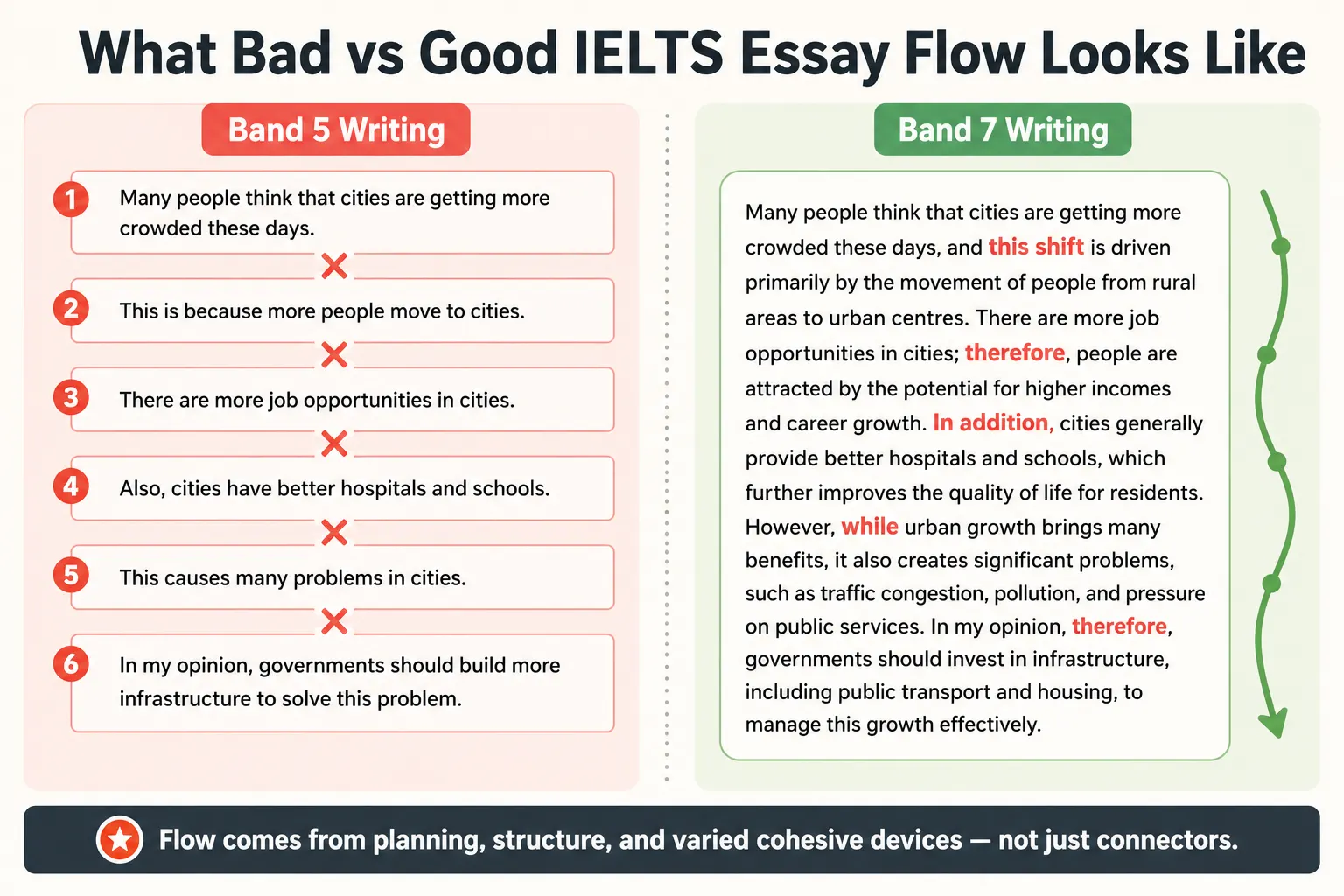
Before (Band 5-6 level): “Technology is changing education. Students use computers a lot. Teachers also use technology. Some people think it is bad. Children spend too much time on screens. The government should make rules.”
After (Band 7 level): “Technology is rapidly transforming the way students learn. Many now rely on computers for research, communication, and even assessments. While this shift offers clear advantages, it has also raised concerns about excessive screen time. Policymakers, therefore, face growing pressure to establish clear guidelines around digital use in schools.”
The second version uses reference words (“this shift”), a concession connector (“While”), a cause-result link (“therefore”), and synonym variation (“students” → “policymakers”) — all working together to create natural IELTS essay flow.
FAQ
What is the difference between coherence and cohesion in IELTS?
Coherence refers to how logically your ideas are organised — whether the overall argument makes sense and follows a clear structure. Cohesion refers to the language tools you use to connect sentences and paragraphs. Both are assessed under the same marking criterion, worth 25% of your total IELTS Writing band score.
How many linking words should I use in an IELTS essay?
There is no fixed number, but quality matters more than quantity. Using four or five different types of cohesive devices across your essay — with each one used correctly — is far more effective than repeating “Furthermore” and “However” ten times.
Can I start a sentence with “And” or “But” in an IELTS essay?
Technically yes, but it is not recommended for IELTS Writing Task 2. Academic writing prefers connectors like “Moreover” or “However” at the start of a sentence. Starting with “And” or “But” may lower your formal register score.
Do cohesive devices help in both IELTS Writing Task 1 and Task 2?
Yes, both tasks assess Coherence and Cohesion. In Task 1 (describing a graph or chart), cohesion helps the reader follow your comparison of data trends. In Task 2 (argumentative or discussion essay), it holds your argument together across multiple paragraphs.
Why does my essay still feel choppy even when I use lots of connectors?
Using connectors without logical organisation is the most common cause. If your ideas do not follow a clear sequence, no amount of “Furthermore” or “In addition” will fix the problem. Focus first on planning your argument clearly, then add cohesive devices to reinforce the connections that already exist.
Putting It All Together
Flow in an IELTS essay is not magic. It comes from a clear plan, well-organised paragraphs, a variety of cohesive devices, and sentences that pass ideas smoothly from one to the next.
Most students focus only on linking words and miss the bigger picture. Work on all four types of cohesive devices, practise the given-new sentence structure, and read your essays back with fresh eyes.
Do this consistently, and your IELTS essay will read the way examiners reward: clear, logical, and genuinely easy to follow.
About the Author – Mr. Sanjay Smart
Mr. Sanjay Smart is one of the most experienced IELTS trainers in the industry, with over 30 years of teaching experience and a proven track record of helping more than 15,000 students successfully clear the IELTS exam and pursue their study-abroad goals. He is the creator of SMART IELTS, an AI-driven IELTS preparation platform that combines expert teaching methods with modern technology to make IELTS preparation more effective and accessible. Drawing on his expertise in IELTS training, content creation, UX design, and prompt engineering, Sanjay continues to develop innovative learning solutions that help students achieve higher band scores with confidence.

Mr. Sanjay Smart has taught IELTS for the last 30 years and has helped more than 15,000 students clear the IELTS and study abroad. He is also the creator of SMART IELTS, an AI-driven IELTS preparation portal, for which he has lent his content creation, UX Design and Prompt Engineering skills.
Leave a Reply