
Jumping from IELTS Band 5.5 to Band 7 feels like a huge leap. It isn’t. With the right plan, the right resources, and 60 focused days, this is one of the most achievable score jumps in test prep.
Most students fail not because they lack ability. They fail because they study randomly doing a practice test here, watching a YouTube video there, with no structure. This guide gives you a clear, day-by-day strategy that targets every weak point between Band 5.5 and Band 7. Follow it consistently, and you will hit your target.
What Separates Band 5.5 from Band 7?
Understanding the gap is step one of any IELTS Band 7 preparation strategy.
At Band 5.5, you can communicate in English but make frequent errors. Your vocabulary is limited. Your answers are sometimes unclear. The IELTS examiner notices these gaps immediately.
At Band 7, you handle complex language with accuracy. Errors still happen, but they don’t stop communication. You use a wider range of vocabulary and grammar structures without forcing them.
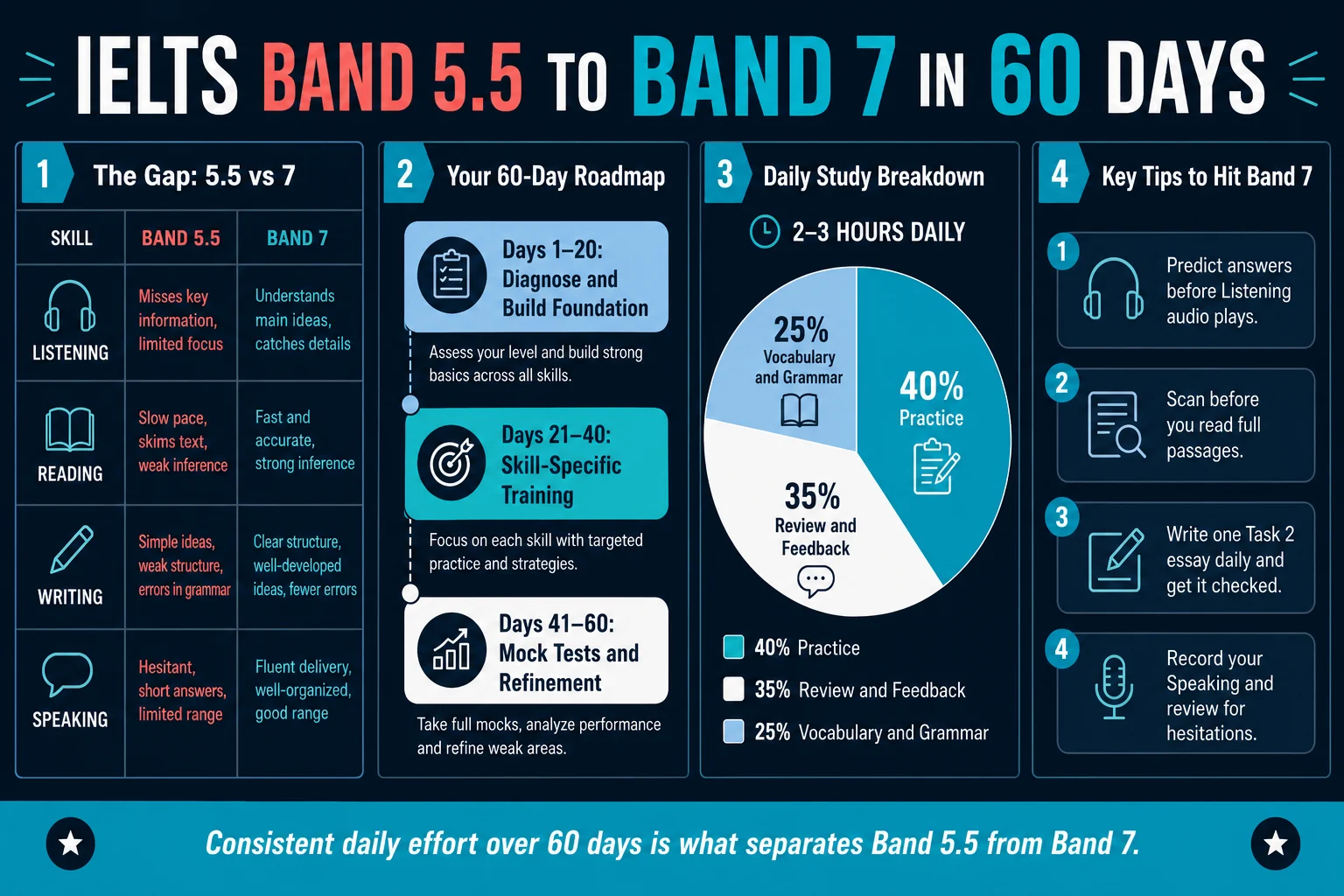
Here’s the exact difference by skill:
| Skill | Band 5.5 | Band 7 |
|---|---|---|
| Listening | Misses details, struggles with accents | Catches main ideas and most details accurately |
| Reading | Slow, often picks wrong answers | Skims and scans efficiently, manages time well |
| Writing | Limited range, unclear structure | Clear argument, varied sentence structures, accurate vocabulary |
| Speaking | Hesitates often, uses simple phrases | Speaks fluently with minimal hesitation, uses idiomatic language |
The gap is real, but it’s learnable. Research from the British Council shows that most students who improve by 1–1.5 bands do so within 6–12 weeks of structured study. Sixty days puts you right in that window.
Your 60-Day IELTS Study Plan: The Big Picture
This IELTS 60-day study plan divides into three phases:
- Phase 1 (Days 1–20): Diagnose your weaknesses and build solid foundations in grammar, vocabulary, and test format.
- Phase 2 (Days 21–40): Focus intensively on each skill with targeted practice and feedback loops.
- Phase 3 (Days 41–60): Run full mock tests, simulate exam conditions, and refine what’s still not working.
Commit to 2–3 hours daily. You don’t need 8-hour study marathons. Consistent, focused sessions beat occasional long ones every time.
Week-by-Week Breakdown
Phase 1: Days 1–20 – Diagnosis and Foundation
Days 1–3: Take a Full Diagnostic Mock Test
Use an official Cambridge IELTS practice test (Cambridge IELTS 14 or 15 are ideal). Take it under strict exam conditions. Score yourself honestly.
This gives you a baseline. You’ll know whether Listening or Reading loses you more marks. You’ll see if Writing Task 1 or Task 2 is weaker. Without this data, you’re guessing.
Days 4–10: Grammar and Vocabulary Foundation
Band 7 Writing and Speaking require accurate grammar. Focus on:
- Complex sentence structures (relative clauses, conditionals)
- Articles (a, an, the) one of the top error sources for South Asian and East Asian test-takers
- Subject-verb agreement in longer sentences
- Academic vocabulary: aim to learn 10–15 new words daily using spaced repetition apps like Anki
Days 11–20: Learn Every IELTS Task Format
Spend two days on each task type. Read the official band descriptors from the British Council website. Knowing exactly what examiners look for changes how you answer.
- Listening: 4 sections, 40 questions, increasing difficulty
- Reading: 3 passages, 40 questions, 60 minutes (Academic) or varied text types (General)
- Writing Task 1 and Task 2 (covered in detail below)
- Speaking: 3 parts, 11–14 minutes total
Phase 2: Days 21–40 Skill-Specific Training
This is the hardest and most rewarding phase. Each week targets one skill deeply while maintaining the others.
Days 21–25: Listening Focus
- Listen to 2 IELTS Listening sections daily.
- Use BBC 6 Minute English for accent variety.
- After each practice, re-listen to the sections you got wrong. Don’t just check answers understand why you missed them.
- Common Band 5.5 error: writing what you hear instead of what the question asks. Train yourself to read ahead in the question paper before the audio starts.
Days 26–30: Reading Focus
- Practice one full Reading passage daily with a 20-minute time limit.
- For True/False/Not Given questions (a major stumbling block), always locate the relevant paragraph first, then compare the statement word-by-word.
- Learn skimming (reading for main ideas) and scanning (reading for specific details). These are learnable skills, not natural gifts.
Days 31–35: Writing Focus
For IELTS Writing Task 2, your band score depends on four criteria: Task Achievement, Coherence and Cohesion, Lexical Resource, and Grammatical Range and Accuracy each worth 25%.
Write one Task 2 essay every day during this block. Use a clear 4-paragraph structure:
- Introduction (paraphrase the question, give your position)
- Body Paragraph 1 (main argument + example)
- Body Paragraph 2 (secondary argument or counterargument)
- Conclusion (summarize without introducing new ideas)
Get your essays checked use a teacher, a qualified tutor, or a feedback tool. Self-checking works only when you already know what Band 7 looks like.
Days 36–40: Speaking Focus
Record yourself answering Part 2 (the long turn) topics every single day. Listen back and note where you hesitate, repeat yourself, or use the same basic words repeatedly.
Fluency comes from practice, not from memorizing scripts. Examiners are trained to detect memorized answers and will mark you down for them.
Phase 3: Days 41–60 Mock Tests and Refinement
Days 41–50: Full Mock Tests Every Other Day
Take a full 4-skill mock test every second day. On the off days, review your mistakes in depth.
Track your scores in a simple spreadsheet. You should see your weak areas narrowing. If Listening is stuck at Band 6, go back to Phase 2 Listening strategies for two focused days before resuming mocks.
Days 51–58: Targeted Weakness Drilling
By Day 51, you know exactly what’s holding you back. Spend this block drilling only those areas. Don’t waste time practicing what you’re already strong at.
Days 59–60: Light Review and Rest
Stop heavy practice two days before your exam. Review your notes. Re-read the band descriptors. Sleep well. A rested brain scores higher than an exhausted one.
How to Improve Each IELTS Skill from IELTS Band 5.5 to Band 7
Listening: Predict Before You Hear
Before each section plays, read the questions and predict what kind of answer is needed. A number? A name? A place? This habit alone can lift Listening scores by 0.5 bands.
Reading: Stop Reading Every Word
Reading every word at IELTS pace is a guaranteed way to run out of time. Scan for keywords first, then read the relevant section carefully. Practice this until it’s automatic.
Writing: Task 2 Is Worth More Prioritize It
IELTS Writing Task 2 carries double the marks of Task 1. A Band 7 Task 2 response is at least 250 words, has a clear central argument, and uses topic-specific vocabulary accurately. Aim for 270–290 words for safety.
Speaking: Extend Your Answers Naturally
Band 5.5 speakers give short answers. Band 7 speakers extend with reasons, examples, and comparisons. When you answer a Part 1 question like “Do you like cooking?”, don’t just say “yes.” Add why, when, and a brief example. This signals fluency without sounding rehearsed.
The One Mistake Band 5.5 Students Always Make
They practice quantity without feedback. Doing 50 practice tests without understanding your errors is like driving in circles and wondering why you haven’t arrived.
Every practice session needs a review phase. Every wrong answer needs an explanation. Every essay needs a score and a reason for that score. Build the feedback loop and your improvement accelerates dramatically.
Recommended Resources for IELTS Exam Preparation 2026
For anyone starting IELTS Exam Preparation 2026, these are the most reliable resources:
- Cambridge IELTS Official Practice Tests (Books 14–19): The gold standard for authentic practice material
- IELTS.org: Free sample questions and official band descriptor information
- British Council LearnEnglish: Grammar and vocabulary tools aligned with IELTS requirements
- E2 IELTS (YouTube): Clear, structured video lessons on every task type
- Magoosh IELTS Blog: Detailed strategy guides with sample answers
Avoid buying expensive courses until you’ve exhausted free official resources. Most Band 7 achievers get there with Cambridge practice books and consistent daily effort.
Related Questions People Also Ask
Can I improve from IELTS Band 5.5 to Band 7 in 60 days?
Yes many test-takers achieve this. The British Council notes that a 1-band improvement typically requires 150–200 hours of study. Sixty days at 2–3 hours daily puts you at 120–180 hours, which is within that range, especially if your weak areas are specific rather than widespread.
How many hours a day should I study for IELTS Band 7?
Two to three focused hours per day is more effective than longer unfocused sessions. Quality beats quantity when your study is structured around your actual weak points.
Which IELTS skill is hardest to improve quickly?
Speaking is the hardest to improve quickly because it requires real-time language production. Writing is actually the fastest to improve because you can study model answers, learn the marking criteria, and practice at your own pace. Most students see Writing gains within 2–3 weeks of consistent practice.
Is Band 7 in IELTS difficult for non-native speakers?
Band 7 is achievable for non-native speakers at an upper-intermediate level. According to IELTS data, approximately 17% of all test-takers globally achieve Band 7 or above. With a structured IELTS preparation strategy, this is a realistic target.
FAQ
Q1: How do I know if my IELTS study plan is working? Track your mock test scores weekly. If you’re not seeing improvement after 2–3 weeks, the issue is usually feedback quality you’re practicing but not identifying why you get things wrong.
Q2: Should I take Academic or General Training IELTS? Academic is required for university admissions. General Training is for immigration and work visas. The Listening and Speaking modules are identical; Reading and Writing differ significantly. Confirm your requirement before you start your IELTS score improvement journey.
Q3: What band do I need in each skill to get an overall Band 7? Overall Band 7 requires an average of 7.0 across all four skills. You can score 6.5 in one skill if you score 7.5 in another to balance it out. Aim for Band 7 in at least three skills.
Q4: Can I use ChatGPT to check my IELTS Writing essays? You can use AI tools for a rough check, but they don’t score to the official IELTS rubric reliably. A certified IELTS teacher or a platform like IELTS Advantage’s marking service gives more accurate and actionable feedback.
Q5: What vocabulary score do I need for Band 7 in IELTS Writing? Band 7 Lexical Resource means you use a wide range of vocabulary with flexibility and precision. You should use less common vocabulary accurately, attempt paraphrasing, and make only rare spelling errors. Aim for varied word choices rather than repeating the same terms throughout your essay.
Conclusion
Going from IELTS Band 5.5 to Band 7 is not a mystery. It’s a process. Diagnose your gaps, follow a structured IELTS study plan, get consistent feedback, and simulate exam conditions in the final weeks. Sixty days is enough time if you use every one of them with intention.
Start Day 1 today.

Mr. Sanjay Smart has taught IELTS for the last 30 years and has helped more than 15,000 students clear the IELTS and study abroad. He is also the creator of SMART IELTS, an AI-driven IELTS preparation portal, for which he has lent his content creation, UX Design and Prompt Engineering skills.
Leave a Reply