
📌 Key Facts
| Question Type | True / False / Not Given (TFNG) |
| Also Known As | Yes / No / Not Given (for opinions) |
| Appears In | IELTS Academic & General Training — Reading |
| Typical Count | 5–7 questions per set |
| Recommended Time | 2–2.5 minutes per question |
| Hardest Pair | False vs Not Given |
| Difficulty Level | High — most commonly failed question type |
| Band Impact | Cracking TFNG = significant Band score jump |
Most IELTS candidates stare at a “Not Given” option and feel the same thing a cold, creeping panic.
You have read the passage. You have read the statement. You cannot tell if the information is missing or if you are just missing it. So you guess. And more often than not, you guess wrong.
Here is the truth no one tells you early enough: True / False / Not Given is not a reading task. It is a logic task. The moment you understand that distinction, the entire question type suddenly clicks into place.
Over 60% of IELTS test-takers consistently confuse “False” and “Not Given” and that confusion alone pulls their Reading Band score down by an average of half a Band. That is the difference between a 6.5 and a 7. The difference between a university offer and rejection.
If you are planning to study abroad after IELTS, Study Unifees offers expert counselling from test preparation to university placement — all in one place.
This guide gives you the exact, step-by-step method the same one that takes students from Band 5.5 to Band 7 on the reading section
What is IELTS True / False / Not Given in IELTS?
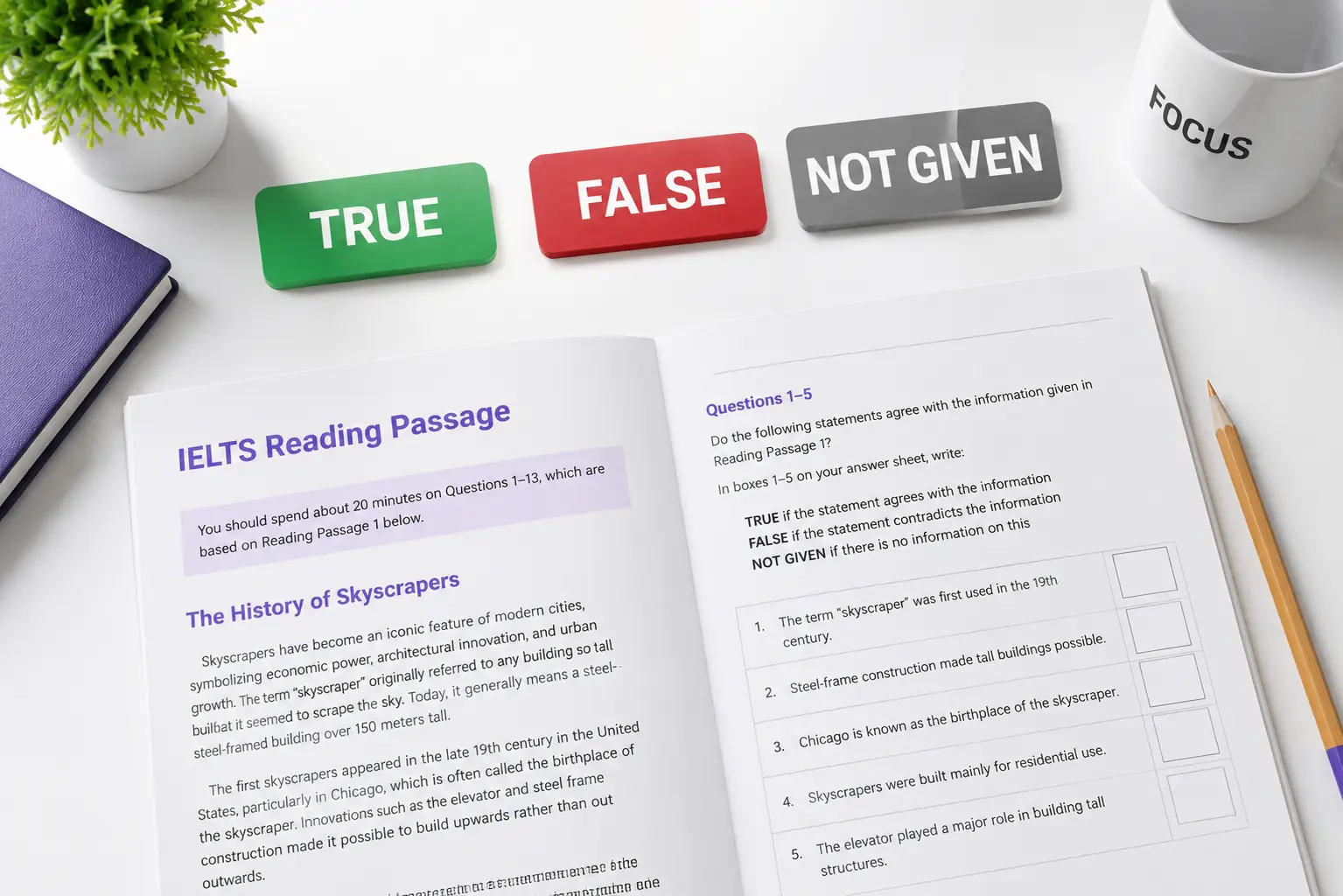
True / False / Not Given (TFNG) is a question type in the IELTS Reading section. You are given a written statement and must decide whether that statement is:
- TRUE — the passage confirms the statement
- FALSE — the passage contradicts the statement
- NOT GIVEN — the passage says nothing about this
The statements always follow the order of the passage. Statement 1 relates to the beginning of the text, Statement 2 follows it, and so on until the end.
One-sentence summary: TFNG tests whether you can separate what the passage actually says from what you assume it says, what feels logical, or what you already know.
This is what makes it hard. And this is also exactly what makes it beatable with the right method.
Why Is This the Hardest Question Type?
Ask any experienced IELTS teacher and they will say the same thing: “Not Given” is where the Band points disappear.
Here is why. The human brain hates uncertainty. When a statement sounds plausible even if the passage never mentions it your brain wants to call it “True.” When a statement sounds unlikely even if the passage never directly contradicts it your brain wants to call it “False.”
Both instincts are wrong. Both cost you points.
Think about it this way. Imagine the passage is a witness giving testimony in a courtroom. The witness says exactly what they saw. Your job is not to decide what probably happened your job is to report only what the witness actually said.
If the witness said it TRUE. If the witness said the opposite FALSE. If the witness never mentioned it NOT GIVEN.
You are not a judge deciding what is likely. You are a court reporter writing down exactly what was said. That mental shift changes everything.
The Exact 5-Step Method
Follow these five steps for every TFNG question. Do not skip steps. Do not reorder them.
Step 1: Read the Statement Carefully Before Touching the Passage
Before you look at the passage, read the statement in full. Underline or mentally note the specific claim being tested. Ask yourself: What exact thing is this statement asserting?
Example statement: “The researcher spent over ten years working on the project.” Key claim: Duration = “over ten years”
You now know exactly what to look for. You are not reading generally you are hunting one specific piece of information.
Step 2: Find the Right Section of the Passage
Since TFNG statements follow the passage’s order, use the location of the previous question as your starting point. Scan for the name, number, place, or concept from the statement.
Do not re-read the full passage. Locate the relevant paragraph. Read only that section carefully.
Step 3: Find the Exact Piece of Information
Once you are in the right area, look for the specific data that matches the claim in the statement. In the example above look for how long the researcher worked on the project.
Step 4: Apply the Three-Question Test
Ask these three questions in order:
- Does the passage say the same thing as the statement? → TRUE
- Does the passage say something that directly fights the statement? → FALSE
- Does the passage say nothing about this specific point? → NOT GIVEN
Step 5: Never Add Your Own Knowledge
This is the step where most students lose points. The IELTS Reading section tests only what the passage says not what you know from real life, not what seems logical, not what you read elsewhere.
If the passage does not say it, the answer is NOT GIVEN. Full stop.
True vs False vs Not Given The One Rule That Ends All Confusion
Memorise this before your test:
FALSE = the passage says the OPPOSITE. NOT GIVEN = the passage says NOTHING.
That is the entire distinction. Let us make it completely concrete.
The passage says: “The study involved 200 participants.”
| Statement | Answer | Reason |
|---|---|---|
| “The study involved 200 participants.” | TRUE | Passage confirms the exact number |
| “The study involved fewer than 150 participants.” | FALSE | Passage says 200; statement says under 150 — direct contradiction |
| “The participants were all university students.” | NOT GIVEN | Passage says nothing about who the participants were |
| “The results of the study were published.” | NOT GIVEN | Passage mentions the study but not its publication |
Notice that the last two are both NOT GIVEN but for different reasons. One is about participant type, one is about publication. Neither appears in the passage. Both are NOT GIVEN.
The test to use when stuck: “Is there a sentence in the passage that directly fights this statement?”
- If YES → FALSE
- If NO and the information is absent → NOT GIVEN
- If the passage agrees → TRUE
Common Traps and How to Avoid Each One
Trap 1: The “Feels True” Trap
The statement sounds completely reasonable and likely so you mark TRUE. But the passage never actually says it. This is NOT GIVEN, not TRUE.
Example: Statement says “The festival attracts international tourists.” The passage describes how popular and large the festival is but never mentions where visitors come from. The answer is NOT GIVEN — no matter how logical it seems that international tourists would attend a large festival.
Fix: Ask yourself, “Did the passage actually say this or did I assume it?”
Trap 2: The “Almost Contradiction” Trap
The statement is partially wrong but not completely opposite — and you freeze between FALSE and NOT GIVEN.
Rule: If any specific detail in the statement directly contradicts a specific detail in the passage — it is FALSE. The contradiction does not need to be total.
Example: Passage says the building was constructed in 1987. Statement says the building was constructed before 1980. This is FALSE — not because everything is opposite, but because one key fact (the year) directly contradicts.
Trap 3: The “Same Topic, Different Point” Trap
The passage mentions the same topic as the statement but makes a completely different point. Students assume the topic mention confirms the statement — it does not.
Example: Statement says “Researchers found the treatment to be effective.” Passage says researchers conducted a study on the treatment but never reports findings or effectiveness. The passage mentions the same topic (treatment study) but says nothing about effectiveness. Answer: NOT GIVEN.
Trap 4: The “General Knowledge” Trap
You already know from the outside world that something is true so you write TRUE. The IELTS Reading section does not care what is true in the world. It only cares what is true in the passage.
Fix: Pretend you are an alien reading the passage. You know nothing except what is written in front of you. What does this passage — and only this passage — tell you?
Worked Practice Example
Read this passage carefully:
Dr. Sarah Chen began her research on ocean plastics in 2015. Her team, consisting of twelve scientists from four different countries, published their first report in 2017. The report focused on microplastic distribution in the Pacific Ocean. Funding for the project came from three private environmental foundations.
Now answer these four TFNG statements:
Statement 1: Dr. Chen started her ocean plastics research before 2020. → The passage says she began in 2015. That is before 2020. ✅ TRUE
Statement 2: The research team included scientists from more than five countries. → The passage says four countries. “More than five” directly contradicts “four.” ❌ FALSE
Statement 3: The team’s first report was well received by the scientific community. → The passage says the report was published. It says nothing about how it was received. 🔲 NOT GIVEN
Statement 4: Government agencies provided funding for the research. → The passage says funding came from private environmental foundations. “Government agencies” directly contradicts “private foundations.” ❌ FALSE
Notice how Statements 3 and 4 look similar — both seem like “no information” — but only Statement 3 is NOT GIVEN. Statement 4 has a clear contradiction in the passage. This is exactly the kind of trap you must watch for.
Quick Reference Cheat Sheet
Cut this out and keep it on your desk while practising.
| Situation | Answer |
|---|---|
| Passage confirms the statement | TRUE |
| Passage directly contradicts the statement | FALSE |
| Passage doesn’t mention the point at all | NOT GIVEN |
| You cannot find the information after careful search | NOT GIVEN |
| Statement is “true in real life” but not in the passage | Likely NOT GIVEN |
| Two options both feel like NOT GIVEN | Re-read — one may be FALSE |
| You feel the contradiction is partial, not total | Still FALSE |
The one question to always ask: “Does the passage fight this statement, or does it stay silent?”
- Fights it → FALSE
- Stays silent → NOT GIVEN
- Agrees with it → TRUE
FAQ: Everything You Wanted to Know About IELTS TFNG
What is the difference between False and Not Given in IELTS Reading?
FALSE means the passage contains a statement that directly contradicts the given claim. NOT GIVEN means the passage never addresses the point at all. This is the most important distinction in TFNG and the one most students get wrong.
How many True False Not Given questions are in IELTS Reading?
A typical IELTS Reading section includes 5 to 7 TFNG questions per set. A single test may contain one or two sets of TFNG questions. You will almost always encounter this question type in both Academic and General Training Reading papers.
Should I write “True” or just “T” on the answer sheet?
Both are acceptable. You may write TRUE / FALSE / NOT GIVEN in full, or abbreviate to T / F / NG. Either is accepted by IELTS markers. Write clearly so there is no ambiguity.
What is the difference between True/False/Not Given and Yes/No/Not Given?
These are two distinct question types. True / False / Not Given tests factual claims made in the passage. Yes / No / Not Given tests the writer’s opinions, views, or arguments — not facts. The answering method is identical, but the focus shifts: for YNNG, you are checking whether the passage reflects the writer’s stance, not a verifiable fact.
Is NOT GIVEN the most common answer in IELTS TFNG?
Over time across many tests, the three answers appear in roughly equal numbers. However, NOT GIVEN feels disproportionately difficult because students are reluctant to commit to it. When you genuinely cannot find any contradicting information in the passage, commit to NOT GIVEN with confidence.
Can I score full marks on TFNG without being a strong reader?
Yes with practice. TFNG rewards logical thinking and method-following more than raw reading speed. Students who follow a consistent method often outperform faster readers who rely on instinct alone.
How much time should I spend per TFNG question?
Target 2 to 2.5 minutes per question. If you are spending more than 3 minutes and still cannot locate the information, mark NOT GIVEN and move forward. Return later if time allows.
Do TFNG statements always follow the order of the passage?
Yes — this is confirmed by official IELTS guidance from the British Council and IDP. Statement 1 relates to the early part of the passage, and statements progress sequentially. Always use this to your advantage when scanning for information.
How do I improve at TFNG fast without doing full mock tests?
The fastest improvement comes from focused daily drills. Take 5 TFNG statements, apply the 5-step method to each one, check your answers, and critically understand every single mistake. Do this for 15 minutes daily for two weeks. This produces more improvement than occasional full-test practice.
What if the passage partly confirms and partly contradicts the statement?
Focus on the specific element the statement is testing. If the specific claim in the statement is contradicted by the specific corresponding detail in the passage even if other parts match the answer is FALSE.
Conclusion
True / False / Not Given stops being hard the moment you stop treating it as a reading task and start treating it as a logic task. Your job is not to decide what is true in the world. Your job is to decide what this one passage confirms, contradicts, or ignores.
Apply the 5-step method. Use the three-question test. Remember the golden rule: FALSE requires a direct fight. NOT GIVEN requires silence.
Practice with that mindset for two weeks, and something surprising happens the “Not Given” option stops feeling like a trap and starts feeling like a clear, confident answer.
You are not guessing anymore. You are deciding.
📚 Read Next:
- IELTS Reading: How to Improve Speed Without Losing Accuracy
- IELTS Writing Task 2: The Band 7+ Essay Structure
- How to Practice IELTS at Home: A 30-Day Preparation Plan

Mr. Sanjay Smart has taught IELTS for the last 30 years and has helped more than 15,000 students clear the IELTS and study abroad. He is also the creator of SMART IELTS, an AI-driven IELTS preparation portal, for which he has lent his content creation, UX Design and Prompt Engineering skills.
Leave a Reply