Whether you want to study, work, or get permanent residency in Canada, your IELTS for Canada score is one of the first things you need to sort out. One wrong band score can delay your application by months or get it rejected altogether.
This guide breaks down every score requirement by program, explains the CLB system, and tells you what score you actually need to stay competitive not just meet the minimum.
What Is IELTS and Why Does Canada Care About It?
IELTS stands for International English Language Testing System. It tests four skills: Listening, Reading, Writing, and Speaking. Each section gets a band score from 0 to 9.
Canada uses IELTS to check if you can communicate in English well enough to live, work, or study there. The country’s immigration department Immigration, Refugees and Citizenship Canada (IRCC) accepts IELTS as one of the two approved English tests for almost every immigration program.
Over 400 Canadian universities and colleges accept IELTS Academic, and the Express Entry immigration system awards up to 136 CRS points for strong IELTS scores. That’s a massive number of points that can make or break your application.
IELTS General Training vs Academic: Which One Do You Need?
This is where many beginners make their first mistake. There are two versions of IELTS, and picking the wrong one wastes your time and money.
IELTS General Training is for:
- Canada immigration through Express Entry
- Provincial Nominee Programs (PNPs)
- Work permits
IELTS Academic is for:
- University and college admissions in Canada
- Professional registration (nursing, medicine, engineering)
- The Student Direct Stream (SDS) visa
IELTS General Training is for immigration, while IELTS Academic is required for university admissions. CELPIP-General is only for immigration and citizenship, not university admissions.
So if you plan to study at a Canadian university AND later apply for PR, you may need to take both versions at different stages.
Understanding the CLB System
Canada does not directly use IELTS band scores for immigration. It converts them into Canadian Language Benchmark (CLB) levels. You need to understand this system before you apply.
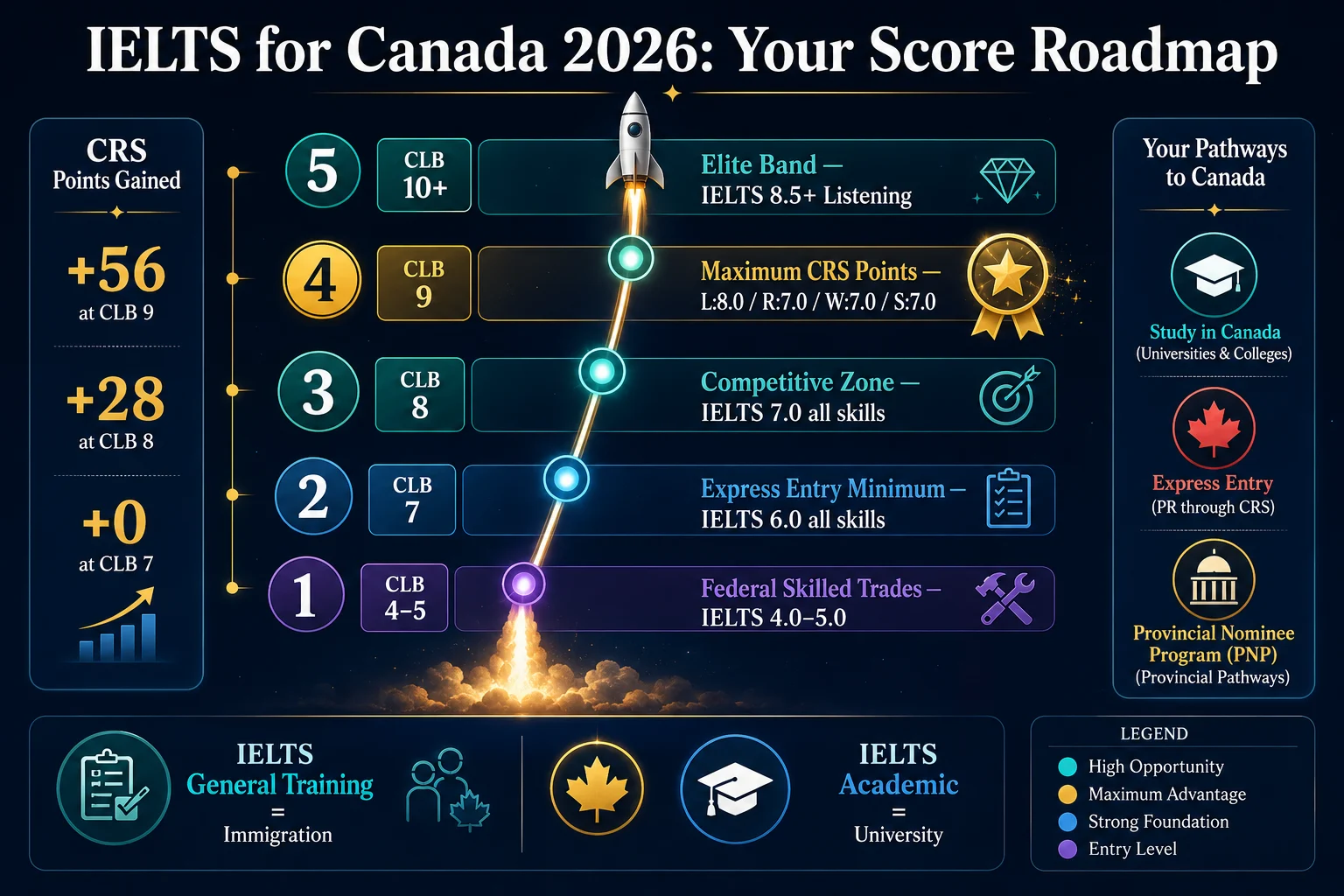
Here is how IELTS General Training bands convert to CLB:
| IELTS Band (Each Skill) | CLB Level |
|---|---|
| 4.0 | CLB 4 |
| 5.0 | CLB 6 |
| 6.0 | CLB 7 |
| 7.0 | CLB 8 |
| 8.0 (Listening) / 7.0 (Reading, Writing, Speaking) | CLB 9 |
| 8.5 (Listening) / 8.0 (Reading, Writing, Speaking) | CLB 10 |
A CLB 9 is equivalent to an IELTS General Training result of 8.0 in Listening, 7.0 in Reading, 7.0 in Writing, and 7.0 in Speaking, according to the language equivalency table from IRCC.
Note that the Listening requirement for CLB 9 is slightly higher than the other skills. Many applicants miss this detail.
IELTS Score Requirements for Canada Immigration (Express Entry)
Express Entry is Canada’s main pathway for skilled workers to get permanent residency. It covers three programs, each with its own language floor.
Federal Skilled Worker Program (FSWP)
The minimum IELTS score required for Canada PR through the Federal Skilled Worker Program is 6.0 in each module, which equals CLB 7. You need CLB 7 in all four skills Listening, Reading, Writing, and Speaking.
Scoring just 5.5 in Writing, for example, drops you below the threshold. You cannot average out your scores.
Canadian Experience Class (CEC)
The Canadian Experience Class requires CLB 7 for NOC TEER 0 and 1 occupations (managerial and professional roles), and CLB 5 for TEER 2 and 3 (technical and trades roles).
Federal Skilled Trades Program (FSTP)
This program asks for CLB 5 in Listening and Speaking, and CLB 4 in Reading and Writing. It has the lowest English bar among federal programs.
What Score Makes You Competitive?
Meeting the minimum gets you into the pool. But getting an invitation to apply (ITA) is a different story.
For most Express Entry applicants, the actual goal is to achieve CLB 9, because it is the level at which the Canadian immigration system rewards you exponentially.
Moving from CLB 7 to CLB 9 across all four skills adds 56 CRS points more than a full year of Canadian work experience (40 points) or having a Canadian degree (15 extra points). In Q1 2026, CEC draw cut-offs held between 507 and 511.
Those 56 extra CRS points can be the difference between getting invited in the next draw and waiting another year.
IELTS Score Requirements for Canadian Universities
If you want to study in Canada, you need IELTS Academic not General Training.
For undergraduate programs, you need a minimum of 6.0 overall with no less than 6.0 in each module. For graduate programs, you require a minimum 6.5 overall with no less than 6.0 in each module.
Here are the typical requirements for top Canadian universities:
| University | Minimum IELTS Score |
|---|---|
| University of Toronto | 6.5 overall (no band below 6.0) |
| University of British Columbia (UBC) | 6.5 overall |
| McGill University | 6.5 overall |
| University of Waterloo | 6.5 overall |
| Most other universities | 6.0–6.5 overall |
Always aim for 7.0 or above if applying to competitive programs like medicine, law, or engineering. Meeting the minimum does not guarantee admission.
Student Direct Stream (SDS) Requirements
The Student Direct Stream requires IELTS Academic 6.0 in each component — no exceptions. SDS offers faster visa processing (20 calendar days) but only accepts IELTS, PTE, or TOEFL iBT.
SDS is worth aiming for if you want faster processing. Just note that every single skill must hit 6.0 there is no flexibility here.
IELTS Requirements by Province (PNP Programs)
Provincial Nominee Programs let individual provinces nominate workers or graduates for permanent residency. Each province sets its own score requirements.
Most PNPs accept CLB 4 to CLB 7 depending on the stream. Some key ones:
- Ontario Immigrant Nominee Program (OINP): CLB 7 for most skilled worker streams
- British Columbia PNP: CLB 4 for some entry-level streams; CLB 7 for skills immigration
- Alberta Advantage Immigration Program: CLB 5 to 7 depending on occupation
- Saskatchewan Immigrant Nominee Program (SINP): CLB 4 minimum for some categories
Always check the specific stream on the provincial government website before applying. Requirements change frequently.
IELTS for Skilled Trades and Professional Registration
Some professions in Canada have higher IELTS bar than immigration programs.
Canadian nursing regulators require IELTS Academic 7.0 in Speaking and Writing, and 6.5 in Listening and Reading under NCAS/NNAS standards.
For engineers, doctors, and pharmacists, individual provincial regulatory bodies set their own requirements. These are often stricter than immigration minimums. Check with the relevant licensing body in your target province before sitting the exam.
IELTS vs CELPIP: Which Should You Choose?
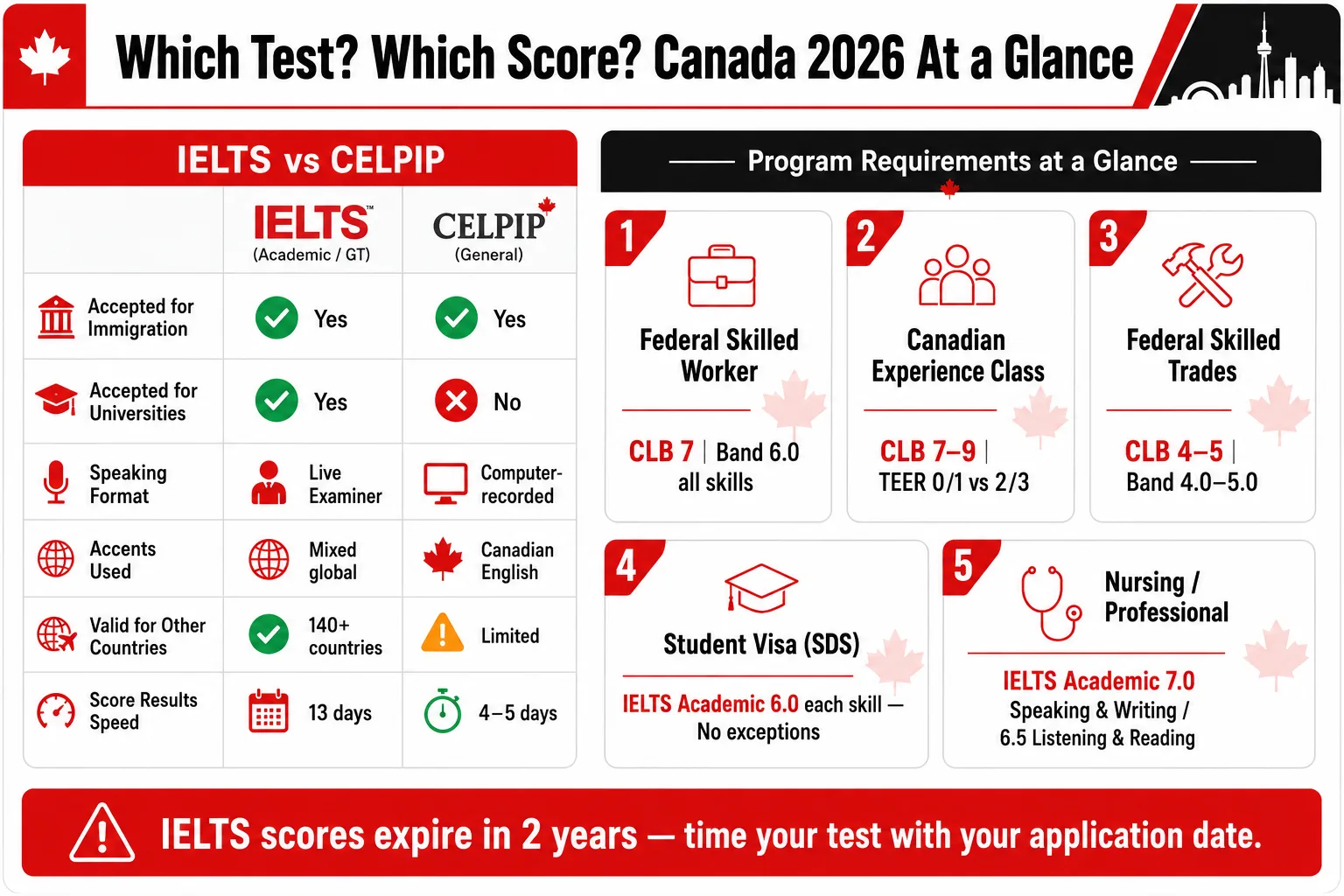
Canada accepts two English tests for immigration: IELTS and CELPIP. Both give the same CRS points at the same CLB level, so neither is objectively “better” for immigration.
Both IELTS General Training and CELPIP General are fully accepted by IRCC and give identical CRS points at the same CLB level. Neither test is universally easier.
Here is when to pick each one:
Choose IELTS if you:
- Plan to apply to a Canadian university (CELPIP is not accepted for university admissions)
- Want to use the score outside Canada- IELTS is recognised in over 140 countries
- Prefer a face-to-face speaking test with a real examiner
- Need it for professional registration (nursing, engineering, etc.)
Choose CELPIP if you:
- Are only applying for immigration or Canadian citizenship
- Prefer a fully computer-based test (speaking is recorded, not face-to-face)
- Are more comfortable with Canadian English accents in the Listening section
CELPIP uses Canadian English accents, making it more familiar for Canada PR applicants, and many find the computer-based speaking section less stressful than talking to a live examiner.
How Long Is Your IELTS Score Valid for Canada?
IELTS scores are valid for two years from your test date. This applies to both immigration and university applications.
IELTS scores are valid for two years from the test date. If your Express Entry profile might sit in the pool for 6 to 12 months, factor that into when you sit the exam so your scores do not expire mid-process.
This is a detail most first-time applicants overlook. If you take the test early and your Express Entry profile sits in the pool for a year, your score could expire before you get your invitation to apply.
Plan your test date based on when you expect to submit your final application not when you first create your profile.
Tips to Hit Your Target Band Score
Getting the score you need is not just about studying English. It is about knowing the test format inside out.
- Practice with official IELTS materials from the British Council or IDP not random practice papers from unverified sources.
- Focus on your weakest skill first. A low Writing or Speaking score kills most applications.
- Take at least one full mock test under real exam conditions before your actual test day.
- For Writing Task 2, practice structuring arguments clearly not just using complex vocabulary.
- For Listening, practice with different English accents (British, Australian, Canadian, American) since the test uses all of them.
- Retake as many times as needed. There is no waiting period between IELTS attempts. Most test takers reach their target CLB score within 2 to 4 weeks of focused daily practice.
FAQ
What is the minimum IELTS score for Canada PR in 2026?
The minimum IELTS score for Express Entry is 6.0 overall, which equals CLB 7. The Federal Skilled Worker Program needs CLB 7 in all four skills. However, this minimum just gets you into the pool. To receive an invitation in competitive draws, you typically need CLB 9 or higher.
Can I use IELTS Academic for Canada immigration?
No. You must use IELTS General Training for immigration purposes. For immigration, you must take the IELTS General Training test — not the Academic version. IELTS Academic is for university admissions and professional licensing only.
Does IELTS score affect CRS points in Express Entry?
Yes, significantly. Language proficiency accounts for up to 136 points in the Comprehensive Ranking System (CRS), and higher language scores significantly boost your Express Entry profile. Even a half-band increase in one skill can add several CRS points.
Is IELTS or CELPIP better for Canada immigration?
Neither is universally better. Both IELTS General Training and CELPIP General give identical CRS points at the same CLB level. Choose based on your comfort with the test format, where you plan to use the score, and whether you need it for university admissions (where only IELTS works).
How many times can I retake IELTS for Canada?
There is no limit on how many times you can take IELTS. IRCC uses your most recent valid score. You can retake the test as often as you like without any mandatory waiting period between attempts.
Final Word on IELTS for Canada
Getting your IELTS for Canada score right is not optional — it is the foundation of your entire application. Whether you are targeting Express Entry, a top university, or a Provincial Nominee Program, each pathway has its own specific band requirements.
Do not aim for the minimum. Aim for the score that makes your application competitive. In a system where 56 extra CRS points can change your timeline by years, every band point counts.
Start with the right version of the test (General Training for immigration, Academic for university), understand the CLB conversion, and practise smart — not just hard.

Mr. Sanjay Smart has taught IELTS for the last 30 years and has helped more than 15,000 students clear the IELTS and study abroad. He is also the creator of SMART IELTS, an AI-driven IELTS preparation portal, for which he has lent his content creation, UX Design and Prompt Engineering skills.
Leave a Reply