
If you are preparing for the IELTS exam for study abroad, one of the first questions you probably have is: what will they ask me to talk about? IELTS Speaking can feel unpredictable, but the good news is that the topics follow clear, repeating patterns. Once you know what those patterns are, you can prepare smarter, not harder.
Whether your goal is to study abroad in countries like Canada, the UK, Australia, or New Zealand, understanding the most common IELTS Speaking topics can help you build confidence and improve your fluency before test day.
This guide breaks down every common IELTS Speaking topic, covers all three parts of the test, and gives you real examples so you know exactly what to expect on exam day.
How IELTS Speaking Works
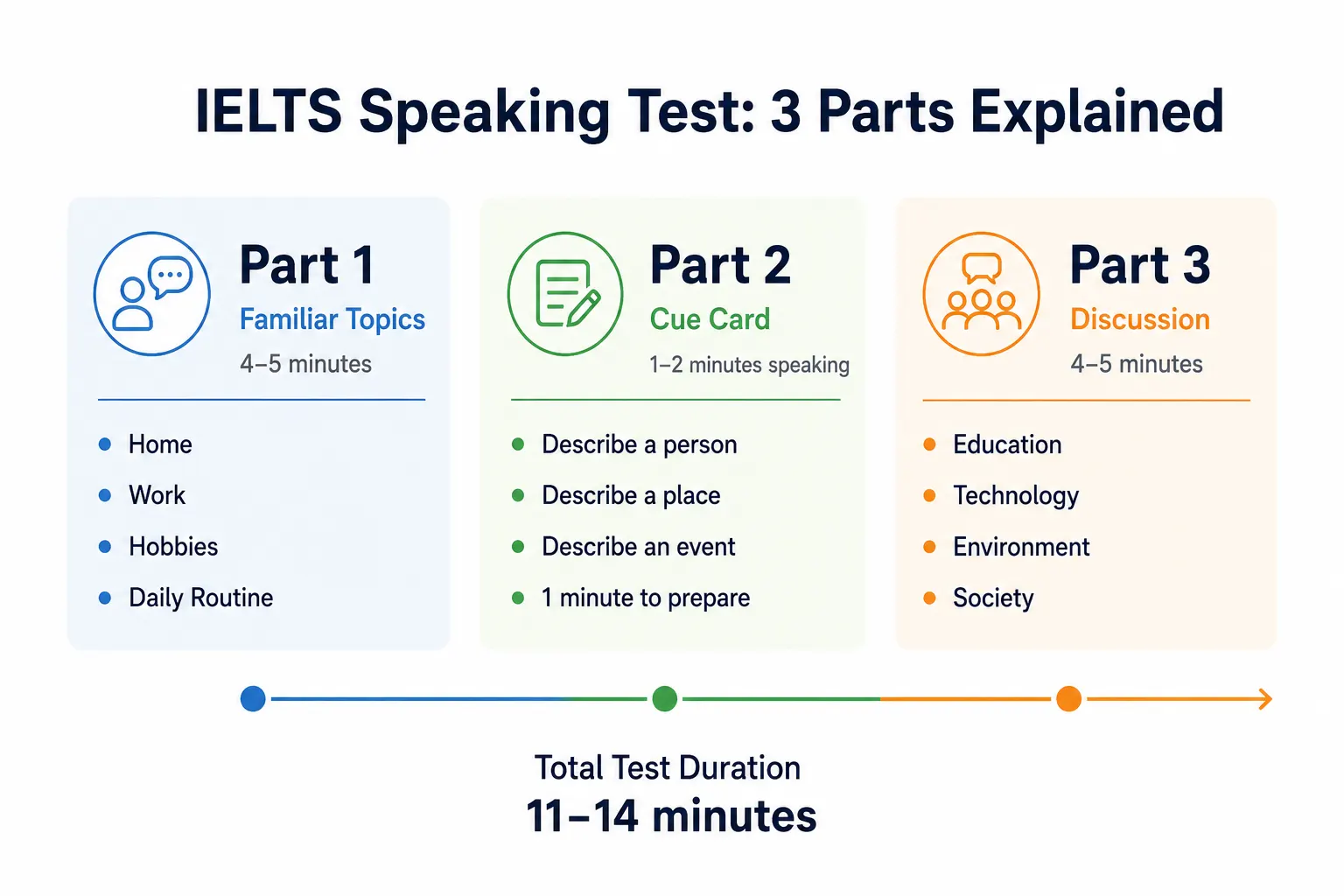
The IELTS Speaking test lasts 11–14 minutes and has three distinct parts. Each part tests different speaking skills.
Part 1 is a short conversation lasting 4–5 minutes. The examiner asks about familiar topics like your home, family, work, or hobbies.
Part 2 gives you a cue card with a topic and bullet points. You get one minute to prepare and then speak for 1–2 minutes without interruption.
Part 3 is a two-way discussion lasting 4–5 minutes. The examiner asks deeper, more abstract questions that connect to your Part 2 topic.
Understanding this structure helps you prepare the right kind of answers for each stage.
Common IELTS Speaking Topics in Part 1
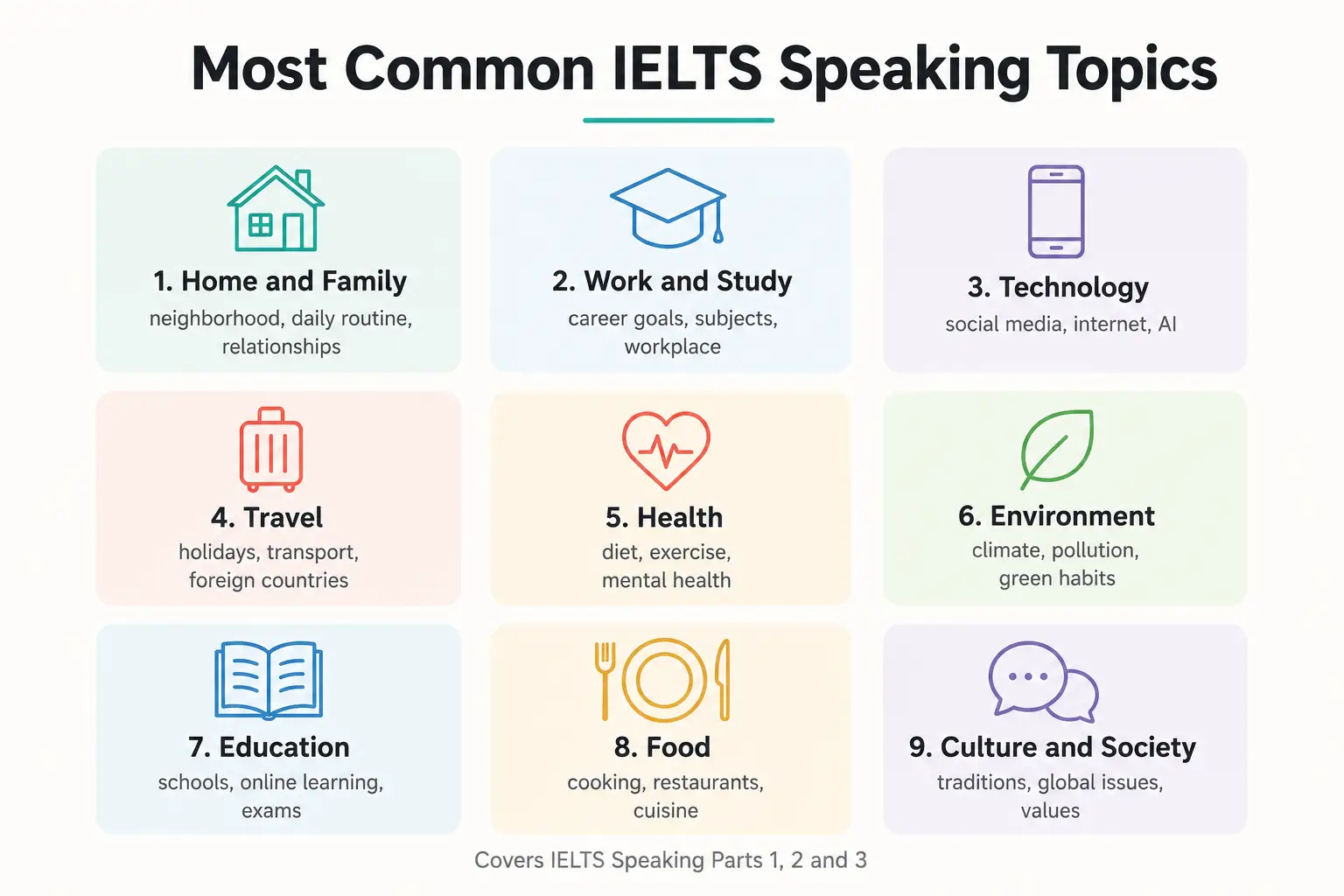
Part 1 focuses on personal, everyday topics. The examiner wants to see if you can speak naturally about your own life. These are the topics that come up most often:
Your Home and Living Area
Questions here include where you live, what your home looks like, and how long you have lived there. You might also get questions about your neighborhood or whether you prefer living in a city or the countryside.
Example question: Do you live in a house or an apartment? What do you like most about it?
Work and Studies
Expect questions about your job, your field of study, and why you chose it. The examiner may also ask whether you enjoy your work or what you plan to study in the future.
Family and Friends
These questions ask about your relationship with family members, how often you spend time with friends, and what activities you enjoy together.
Hobbies and Free Time
Reading, cooking, sports, gaming, watching films any hobby is fair game. The examiner wants to hear specific details, not just one-word answers.
Daily Routines
You may be asked about your morning routine, how you commute, or what a typical day looks like for you. These questions test your ability to describe regular activities.
Food and Cooking
Questions here include your favourite foods, whether you cook at home, and what kinds of restaurants you enjoy.
Travel and Holidays
The examiner might ask where you have travelled, how you prefer to travel, or what your ideal holiday looks like.
Technology and the Internet
Questions about social media use, how often you use your phone, or whether technology has changed your daily life are very common in recent tests.
Weather and Seasons
This comes up more often than most students expect. You might be asked which season you prefer or how weather affects your mood.
Sports and Exercise
Whether or not you are active, expect questions about what sports you watch or play and whether physical fitness matters to you.
Common IELTS Speaking Topics in Part 2 (Cue Cards)
Part 2 cue cards ask you to describe a person, place, object, event, or experience. Here are the categories that appear most frequently in IELTS Speaking Part 2:
Describing a Person
- Describe a person who has had a positive influence on you.
- Describe a person you admire.
- Describe an interesting person you recently met.
For these cue cards, talk about who the person is, how you know them, and why they matter to you. Give specific qualities and real examples from your experience.
Describing a Place
- Describe a place you like to visit in your free time.
- Describe a foreign country you would like to live in.
- Describe a city or town that impressed you.
Name the place clearly, describe what it looks and feels like, and explain what makes it special to you personally.
Describing an Object
- Describe something you own that is important to you.
- Describe a gift you gave or received.
- Describe a piece of technology you find useful.
These cards reward specific, sensory details what it looks like, how you use it, why it matters.
Describing an Event or Experience
- Describe a memorable event from your childhood.
- Describe a time you helped someone.
- Describe a challenge you successfully overcame.
Structure your answer around what happened, when, who was involved, and how you felt.
Describing an Achievement
- Describe something you worked hard to achieve.
- Describe a skill you have recently learned.
- Describe a goal you set and met.
Describing a Book, Film, or Song
- Describe a book that changed the way you think.
- Describe a film you recently watched and enjoyed.
- Describe a song that is meaningful to you.
Common IELTS Speaking Topics in Part 3
Part 3 moves away from personal experience and into broader social, cultural, and global issues. The questions are more abstract and require you to give opinions, compare perspectives, and think critically.
These are the themes that appear most frequently:
Education
Questions about the purpose of education, whether exams are a fair way to assess students, online learning, or the role of teachers in modern classrooms.
Technology and Society
How social media affects relationships, whether people rely too much on technology, or how artificial intelligence is changing the job market.
Environment and Climate
Questions about individual responsibility versus government action, whether people care enough about the environment, or what countries should do about pollution.
Health and Lifestyle
Whether governments should control unhealthy habits, how modern life affects physical and mental health, or the impact of fast food culture.
Work and Employment
Questions about work-life balance, remote working, gender equality in the workplace, and whether job satisfaction matters more than salary.
Cities and Urban Life
Whether cities are becoming too crowded, how urban planning affects quality of life, or what makes a city a good place to live.
Culture and Tradition
Whether cultural traditions should be preserved, how globalization affects local customs, or the role of art and music in society.
Family and Society
Changing family structures, the role of grandparents in raising children, or whether young people spend enough time with family.
Topics That Appear Across All Three Parts
Some themes thread through all three parts of the test. If you prepare these well, you cover multiple parts at once:
- Technology – personal use (Part 1), an experience with technology (Part 2), societal impact (Part 3)
- Travel – your travel habits (Part 1), a memorable trip (Part 2), tourism and culture (Part 3)
- Education – your studies (Part 1), a teacher or learning experience (Part 2), education systems (Part 3)
- Environment – daily habits (Part 1), a place in nature (Part 2), climate policy (Part 3)
Knowing that these themes link across parts helps you build a connected set of ideas rather than memorizing separate answers.
How to Prepare for Any IELTS Speaking Topic
You do not need to memorize scripts. Instead, build a flexible preparation system:
- Read the topic list above and brainstorm ideas for each category. Write down 5–6 key ideas per topic, not full sentences.
- Practice speaking out loud for 1–2 minutes on each Part 2 cue card category. Use a timer.
- Record yourself and listen back. Most students are surprised by their filler words and repetition when they hear themselves.
- Learn topic-specific vocabulary for the themes most likely to appear technology, environment, education, and health.
- Practice giving opinions. Part 3 requires you to discuss issues from multiple angles. Practice phrases like: Some people argue that… however, I think… or On one hand… but on the other hand…
The One Thing Most Students Miss
Most IELTS Speaking guides focus only on what to say. But examiners also assess how you say it.
The IELTS Speaking band descriptors score you on four criteria: fluency and coherence, lexical resource (vocabulary), grammatical range and accuracy, and pronunciation. A Band 7 speaker uses a wide range of vocabulary and grammar, not just correct vocabulary and grammar.
That means you should not just aim to answer the question aim to extend your answer naturally, use varied sentence structures, and show range. A short, accurate answer scores lower than a longer, naturally flowing answer with a few minor errors.
FAQ
What are the most common topics in IELTS Speaking Part 1?
The most common topics in IELTS Speaking Part 1 are home and neighborhood, work or studies, hobbies and free time, family, food, technology, travel, daily routines, and weather. These topics repeat across test sessions worldwide because they test natural conversational ability.
How many topics can appear in one IELTS Speaking test?
In a single test, you will answer questions from 2–3 topics in Part 1, one cue card topic in Part 2, and 3–5 questions on a related theme in Part 3. So you may cover 4–6 different topic areas in one test.
Do IELTS Speaking topics change every year?
The pool of IELTS Speaking topics rotates every few months. However, the broad categories education, technology, health, environment, travel — stay the same. What changes are the specific questions and cue card prompts within those categories.
Can you ask the examiner to repeat a question in IELTS Speaking?
Yes, you can politely ask the examiner to repeat a question. Saying “Could you repeat the question, please?” will not affect your score. However, asking for repetition very frequently may suggest a listening or comprehension issue.
Is it okay to talk about personal opinions in IELTS Speaking?
Not only is it okay it is expected, especially in Part 3. The examiner wants to see whether you can express and defend a point of view using appropriate language and reasoning. Avoid one-sided answers; discuss more than one perspective where possible.
Start Speaking with Confidence
IELTS Speaking is not a test of perfect English it is a test of how well you communicate. Now that you know the topics, you are already ahead of most candidates who walk in unprepared. Pick three topics from this guide today, set a two-minute timer, and just talk. Do it again tomorrow. Do it the day after. That small daily habit builds the fluency and confidence that no vocabulary list can give you. The examiner wants to hear your voice, your ideas, and your personality so give them exactly that.

Mr. Sanjay Smart has taught IELTS for the last 30 years and has helped more than 15,000 students clear the IELTS and study abroad. He is also the creator of SMART IELTS, an AI-driven IELTS preparation portal, for which he has lent his content creation, UX Design and Prompt Engineering skills.
Leave a Reply