
If you just got a 4.5 on your IELTS test, your first question is probably this: did I fail? You’re not alone. Thousands of students search this exact question every month. The short answer is it depends on what you need the score for. But the full answer is much more useful.
This article breaks down exactly what a 4.5 band score means, when it’s considered a pass or fail, and what practical steps you can take to improve. No vague advice just clear, honest information.
What Does the IELTS Band Score System Actually Mean?
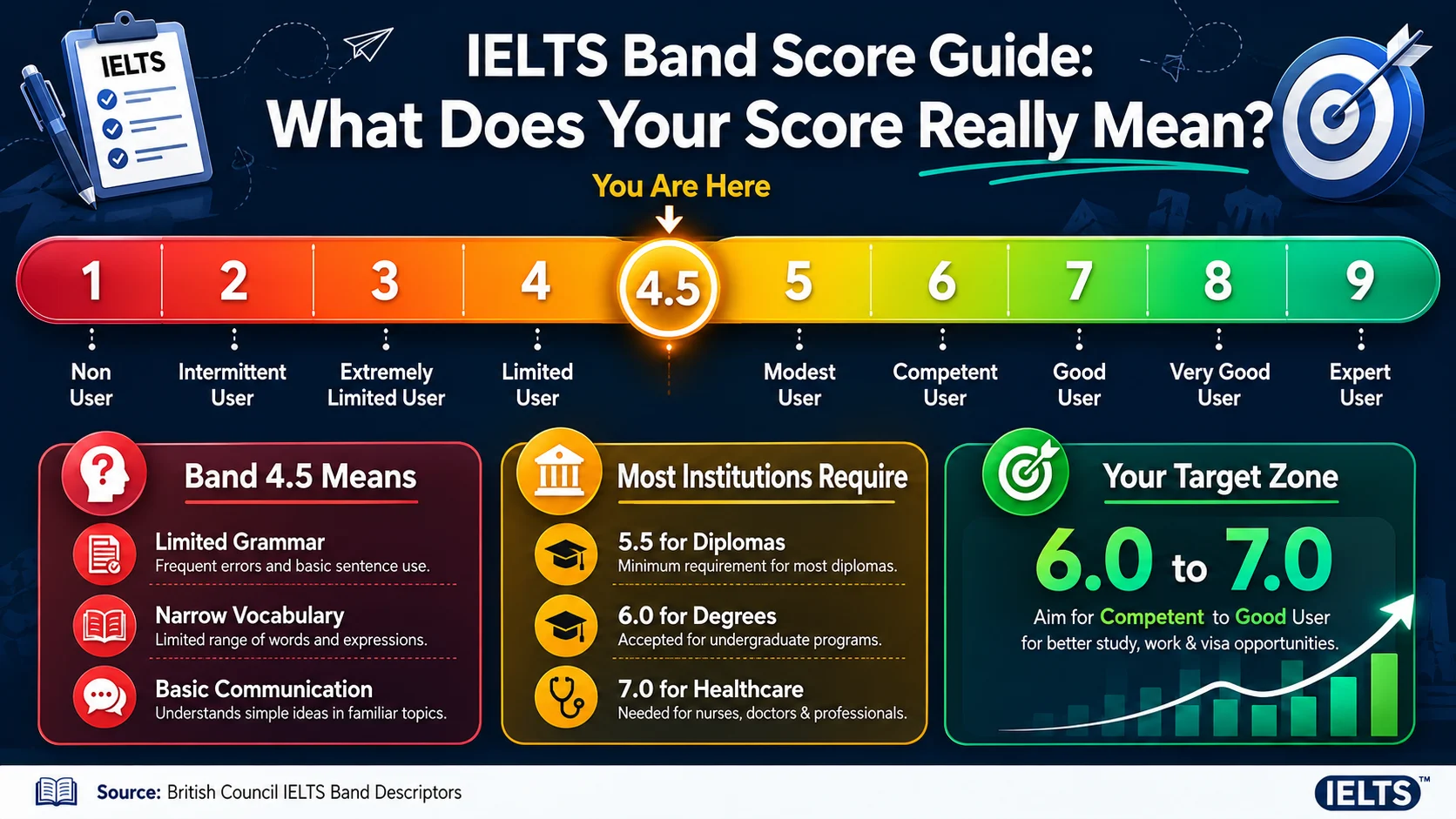
IELTS scores run from 0 to 9, reported in whole and half bands (so 4.0, 4.5, 5.0, and so on). There is no universal “pass” or “fail” on the IELTS. The test simply measures your English ability on a scale.
Here’s a quick reference for the full band range:
| Band Score | Level Description |
|---|---|
| 9 | Expert user |
| 8 | Very good user |
| 7 | Good user |
| 6 | Competent user |
| 5 | Modest user |
| 4 | Limited user |
| 3 | Extremely limited user |
A 4.5 sits between “limited user” and “modest user.” That tells you something important, the test sees 4.5 as a real, measurable level of English, not a failure of the test itself.
Is 4.5 Fail in IELTS (Direct Answer)
Yes, a 4.5 is effectively a fail for most university admissions, visa applications, and professional registrations. Most institutions that require IELTS set a minimum of 5.5, 6.0, or 6.5. If your target requires 6.0 and you scored 4.5, you did not meet the requirement.
However, is 4.5 fail in IELTS in an absolute sense? No. There is no official “fail” grade on IELTS. You will always receive a score and a certificate. The question is whether your score meets the specific requirement you’re applying for.
Think of it this way: a student who needs a 6.0 for a UK university and scores 4.5 has effectively failed that application not the test itself. The test just reported where they stand.
What Score Do You Need? Requirements by Purpose
This is where most students get confused. IELTS score requirements vary widely depending on your goal. Here’s a realistic breakdown:
For UK Universities:
- Undergraduate programs typically require 6.0 to 6.5 overall, with no band below 5.5.
- Postgraduate programs often ask for 6.5 to 7.0.
For Australian Student Visa (Subclass 500):
- The minimum is usually 5.5 overall with no band below 5.0.
For Canada Immigration (Express Entry):
- A CLB 7 (equivalent to roughly IELTS 6.0) is needed for most skilled worker pathways.
For UK Skilled Worker Visa:
- Applicants need at least IELTS 4.0 overall for some roles, but most employers want 6.0+.
For Nursing Council Registration (NMC, UK):
- Minimum 7.0 in all four skills -Speaking, Listening, Reading, and Writing.
A 4.5 falls short of almost every major institutional requirement. That’s why so many students perceive it as a fail for their specific goal, it is.
Why Do So Many Students Score 4.5 in IELTS?
This is a question competitors barely answer, but it’s really what students need to know. Here are the real reasons:
1. Weak academic writing skills. Writing is the hardest skill for most test-takers. Many students write informally, repeat ideas, and never learn how to structure a Task 2 essay properly. Writing alone can drag the overall band down fast.
2. Limited vocabulary range. At band 4.5, students often use the same words repeatedly or choose incorrect words. IELTS examiners score vocabulary (called Lexical Resource) separately, and repetition hurts this score badly.
3. Test anxiety pulling down Speaking scores. Speaking is marked live by an examiner. Students who know English in daily life often freeze or speak too simply under pressure, which limits fluency and coherence scores.
4. Misunderstanding Reading task types. Students spend all their prep time reading passively. They don’t practise skimming, scanning, or matching headings all skills IELTS Reading specifically tests.
5. No structured preparation. Many students sit the test with general English knowledge but without IELTS-specific training. The test has a very specific format, and familiarity with that format makes a huge difference.
How Is the IELTS Score Calculated?
Your overall IELTS band score is the average of your four individual skill scores:
Each skill is scored from 0 to 9. The four scores are added and divided by four, then rounded to the nearest half band.
Example: If you score Listening 5.5, Reading 5.0, Writing 4.0, Speaking 4.5, your average is 4.75, which rounds to 5.0 overall.
This rounding rule matters. A 4.75 rounds up to 5.0, not down to 4.5. So a student with those four scores would report an overall band of 5.0, even though Writing was 4.0.
This also means one low skill can drag your overall score significantly. A 4.0 in Writing is a common reason students end up with a 4.5 or 5.0 overall even if their other skills are stronger.
What Skills Does a 4.5 Band Score Reflect?
According to the official IELTS band descriptors published by the British Council and IDP, a band 4 to 5 user:
- Handles basic communication in familiar situations but struggles with complex language.
- Makes frequent errors in grammar and word choice that sometimes cause misunderstanding.
- Can understand general meaning in simple texts but struggles with detailed arguments.
- Speaks with limited fluency and often pauses to search for words.
A 4.5 means you’re right in this range. You’re communicating, but not with the accuracy or range that academic or professional settings require.
How to Improve From 4.5 to 6.0 or Higher
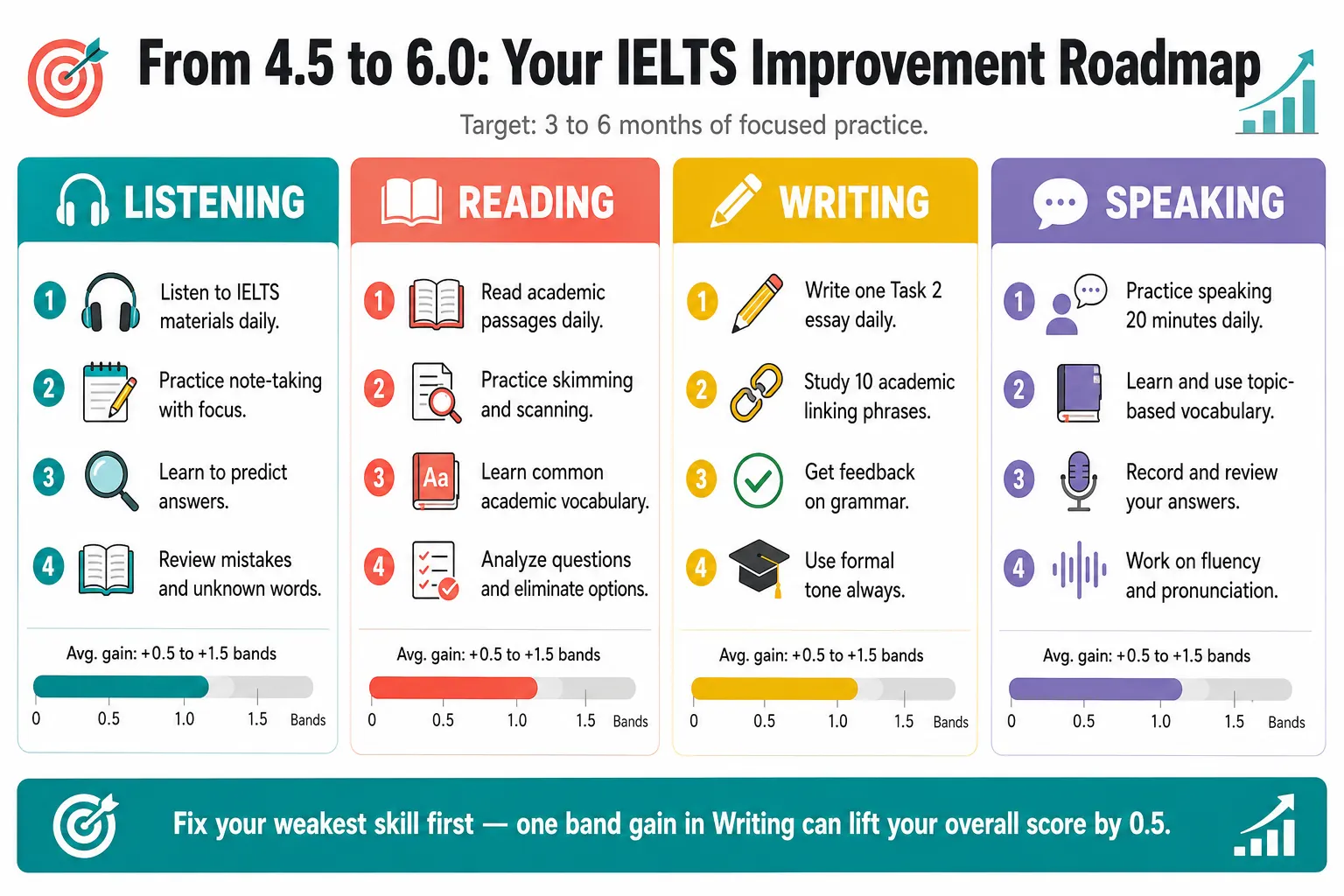
Getting from IELTS 4.5 to 6.0 is absolutely achievable most students can do it in 3 to 6 months with the right approach. Here’s a skill-by-skill plan:
Improve Your IELTS Writing Score
Writing is usually where 4.5 students lose the most points. Fix it first.
- Practice Task 2 essays every day. Write one complete essay, then compare it to a band 7 sample answer.
- Learn 10 academic linking phrases (such as “Furthermore,” “In contrast,” “As a result”) and use them naturally.
- Stop writing the way you text or talk. Academic writing needs formal tone and structured paragraphs.
- Ask a teacher or use an AI tool to give you feedback on grammar, coherence, and vocabulary.
Boost Your IELTS Reading Speed and Accuracy
- Practice timed reading every day 60 minutes for 40 questions is the real test limit.
- Learn to scan for keywords rather than reading every word. Most answers are found by locating a keyword and reading the surrounding text.
- Work through every task type: True/False/Not Given, Matching Headings, and Short Answer questions all need different strategies.
Raise Your IELTS Speaking Score
- Record yourself answering Part 2 speaking topics. Listen back and notice where you pause, repeat, or use simple vocabulary.
- Learn topic-specific vocabulary for common IELTS themes: environment, technology, education, health, and cities.
- Speaking with a language partner for 20 minutes a day is one of the fastest ways to improve fluency.
Strengthen Your IELTS Listening Score
- Watch English TV shows and podcasts without subtitles, then with subtitles to check what you missed.
- Practice predicting what type of word goes in a gap before you hear the audio number, name, place, or adjective.
- Do at least two IELTS practice listening tests per week using official Cambridge IELTS books (books 14-18 are the most recent).
Common Mistakes That Keep Students at 4.5
Many students prepare hard but stay stuck at 4.5 because they repeat the same mistakes. Watch out for these:
- Translating from your native language in your head. This slows you down and produces unnatural English. Try to think directly in English, even imperfectly.
- Only practising with old IELTS materials. The test format has evolved. Use Cambridge IELTS books from 2019 onwards and take official IELTS practice tests from the British Council website.
- Ignoring individual skill scores. If your Writing is 4.0 but your Listening is 6.0, focus 80% of your prep on Writing. Fix your weakest link first.
- Not reading the question carefully in Reading and Listening. Many marks are lost simply because students answer a slightly different question than what was asked.
- Avoiding complex sentences in Speaking and Writing. Examiners reward grammatical range. Simple sentences kept perfectly correct will cap your Grammar score at around 5.0.
FAQ: Is 4.5 Fail in IELTS?
Q1: Is 4.5 a passing score in IELTS? There is no official pass or fail on IELTS. But a 4.5 falls below the minimum requirement of most universities, visa programs, and professional bodies, which typically ask for 5.5 to 7.0. For most real-world purposes, 4.5 will not meet the requirement.
Q2: Can I get a UK student visa with an IELTS score of 4.5? No. UK student visa (Tier 4/Student Route) requires a minimum IELTS score that varies by course level, but it is typically 5.5 to 6.0 overall. A 4.5 will not satisfy this requirement and your visa application will be refused.
Q3: How long does it take to go from 4.5 to 6.0 in IELTS? Most students who study consistently for 3 to 6 months can raise their score by 1.0 to 1.5 bands. The timeline depends on how much time you study each day and whether you get feedback on your writing and speaking. Targeted prep focusing on your weakest skills produces faster results than general English study.
Q4: Should I retake IELTS immediately after getting 4.5? Not immediately. Retaking within 1 to 2 months without changing your preparation strategy rarely produces a significantly different result. Take at least 2 to 3 months to specifically improve your weak skills, then retest. IELTS Academic and General Training can each be taken as many times as needed there is no restriction on retakes.
Q5: Does 4.5 in one skill fail the whole test? No. You receive an overall band score AND individual skill scores. Some institutions accept a low score in one skill if the overall band meets the requirement. For example, a university might accept overall 6.5 with no individual band below 6.0. Always check the exact requirements of your target institution, as band requirements vary widely.
Final Thoughts: Is 4.5 Fail in IELTS?
Here’s the honest bottom line: is 4.5 fail in IELTS? For most study, visa, and professional goals yes, it falls short. But it’s not the end. It’s a data point that tells you where you are and how far you need to go.
The students who reach 6.0 and above are not necessarily smarter. They practise strategically, target their weakest skills, and learn how the test actually works. With the right plan, 4.5 is a starting point, not a ceiling.
Start with your weakest skill. Build a daily practice habit. Use official Cambridge materials. Get feedback on your writing. Six months from now, your score can look completely different.

Mr. Sanjay Smart has taught IELTS for the last 30 years and has helped more than 15,000 students clear the IELTS and study abroad. He is also the creator of SMART IELTS, an AI-driven IELTS preparation portal, for which he has lent his content creation, UX Design and Prompt Engineering skills.
Leave a Reply