
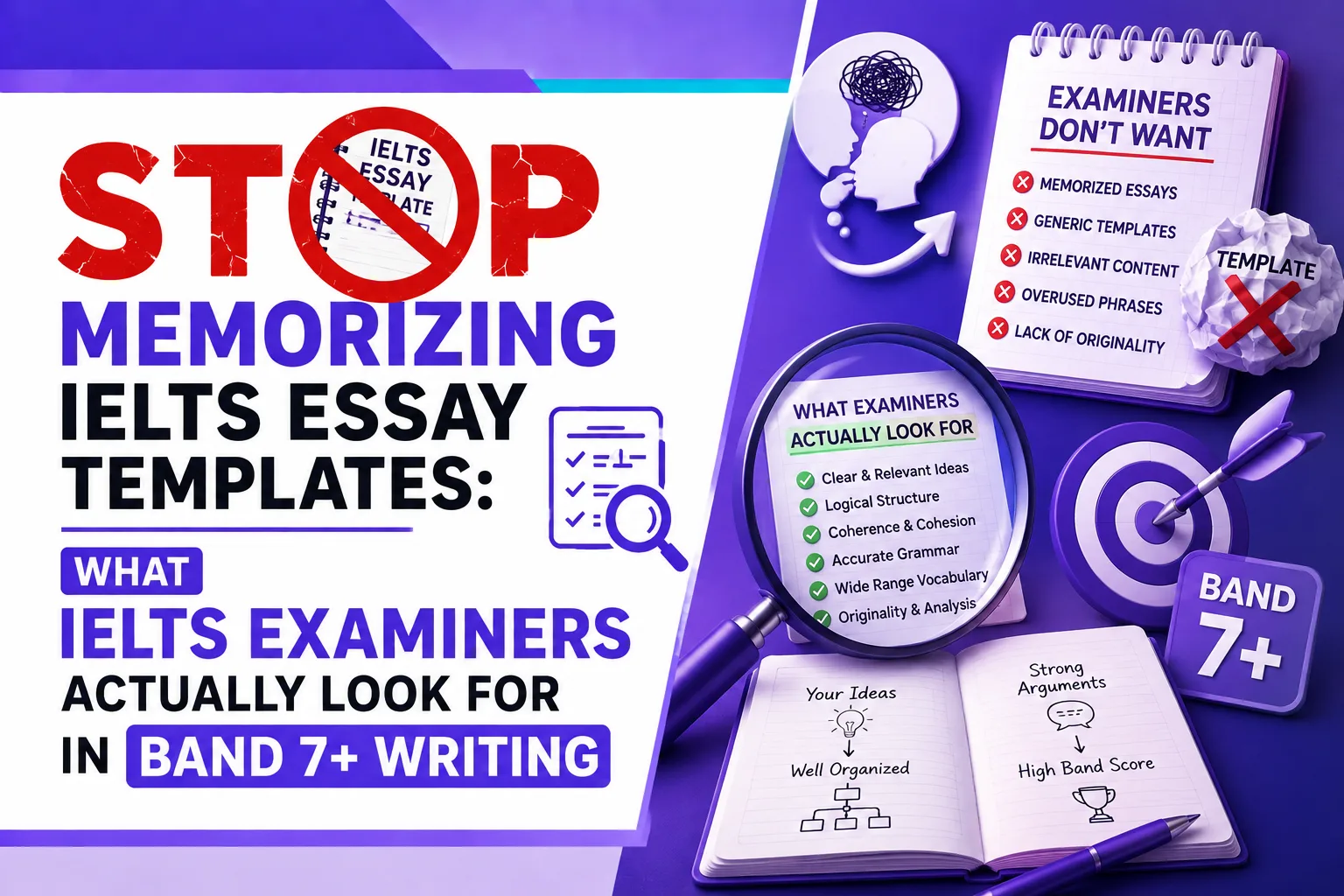
Most IELTS test-takers spend weeks memorizing IELTS essay templates. They drill phrases like “In this essay, I will discuss both sides before giving my opinion” until they can write them in their sleep. Then they sit the exam, use those exact phrases — and get a Band 6.
Here is the hard truth: IELTS examiners are trained to spot templates. And when they do, it costs you marks.
This article breaks down exactly what examiners look for, why templates backfire, and what you should do instead to reach Band 7 or higher.
Table of Contents
- Why IELTS Essay Templates Hurt Your Score
- What IELTS Examiners Actually Assess
- The Four Marking Criteria Explained
- Examiner Insight: What Band 7 Writing Really Looks Like
- What to Do Instead of Memorizing Templates
- Common Template Phrases That Red-Flag Your Essay
- How to Build Flexible Writing Skills That Score Higher
- FAQ
Why IELTS Essay Templates Hurt Your Score
IELTS essay templates feel safe. They promise structure and save you from staring at a blank page. The problem is that they do something far more damaging: they make your writing sound mechanical.
Examiners read hundreds of essays per week. They have seen the same template openings thousands of times. When an essay starts with “Nowadays, there are many people who believe that…”, the examiner knows immediately that the writer is filling in blanks, not thinking.
The Memorized Language Problem
The IELTS marking scheme specifically rewards natural, flexible use of language. When you memorize a fixed phrase, you are doing the opposite. You are forcing pre-packaged language onto a topic it may not fit perfectly.
For example, a template phrase like “There are advantages and disadvantages to this issue” might make no sense for a question asking you to agree or disagree with a statement. Using it anyway signals poor task understanding and that hits your Task Achievement score directly.
Templates Lower Your Lexical Flexibility Score
One of the four IELTS marking criteria is Lexical Resource, which measures how well you use vocabulary. Examiners want to see you choosing words that fit the specific topic. A memorized phrase that works for any topic, by definition, is not specific to your topic. That is not impressive vocabulary use. That is substitution.
What IELTS Examiners Actually Assess
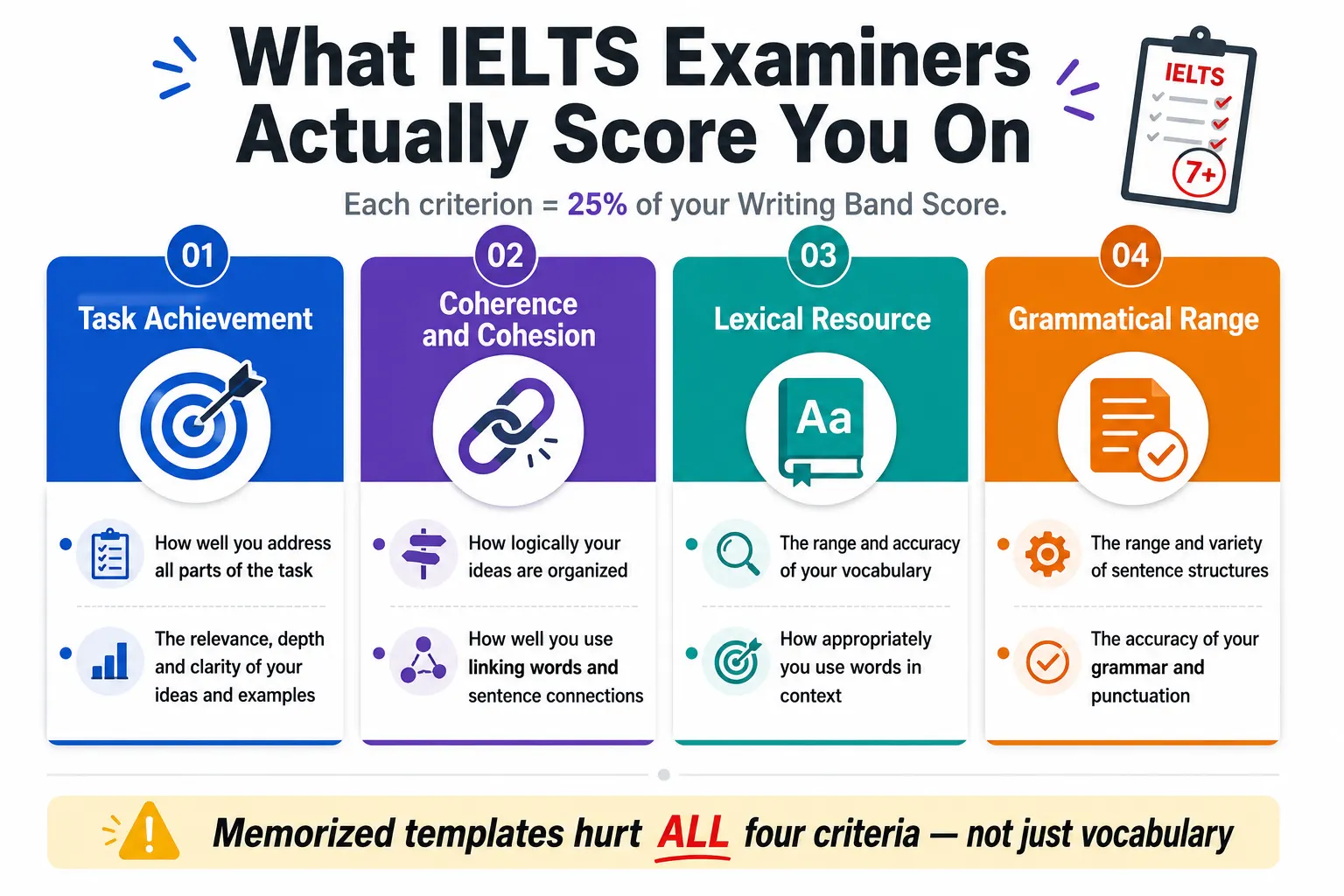
IELTS examiners do not reward effort or length. They assess four specific things, each worth 25% of your Writing score.
This is the most important examiner insight most test-takers never get: the examiner is not looking for a “correct” essay. They are measuring observable writing skills.
Every word you write is evidence. The examiner asks: does this evidence show the skills required for Band 7?
The Four Marking Criteria Explained
1. Task Achievement (Task 2) / Task Response
This measures whether you answered the question asked not a question you prepared for. You need to:
- Address all parts of the question directly.
- Give a clear position when asked for an opinion.
- Support your points with relevant, specific ideas.
A template like “I will discuss both sides and then give my opinion” often leads writers to sit on the fence when the question actually demands a clear stance. That costs marks here.
2. Coherence and Cohesion
This measures how logically your ideas flow and how well you link them. Examiners look for:
- A clear progression of ideas throughout the essay.
- Effective use of cohesive devices (linking words and pronouns) without over-using them.
- Paragraphs that each have a clear central topic.
Many template-trained writers insert linking words mechanically: “Firstly… Secondly… Furthermore… In conclusion…” That is not sophisticated cohesion. Examiners see it as formulaic, and Band 7 requires language that goes beyond mechanical connectors.
3. Lexical Resource
This measures your range and accuracy of vocabulary. To score Band 7:
- Use less common vocabulary naturally, not forced.
- Show awareness that some words carry specific connotations.
- Avoid spelling errors on key words.
Memorized phrases cannot help you here. They are common phrases by design. The examiner needs to see you generating topic-specific vocabulary on the spot.
4. Grammatical Range and Accuracy
This measures the variety of sentence structures you use and how accurately you use them. Band 7 requires:
- A mix of simple and complex sentences that are mostly accurate.
- Use of structures like relative clauses, conditionals, and passive voice where they fit naturally.
- Minimal errors that do not impede communication.
Templates teach fixed sentence patterns. Real grammatical range means choosing the right structure for what you want to say.
Examiner Insight: What Band 7 Writing Really Looks Like
Based on publicly available IELTS examiner reports and band descriptors from Cambridge Assessment English, Band 7 writers share several clear traits.
They Write with a Clear Voice
Band 7 writers have a consistent viewpoint throughout the essay. The examiner can tell what the writer actually thinks. This is not about having controversial opinions it is about committing to a position and supporting it coherently.
They Use Vocabulary Precisely
A Band 7 writer does not just use more words. They use the right words. For example, instead of writing “many bad effects on society”, a Band 7 writer might write “significant social consequences” or “widespread harm to community wellbeing” whichever fits the specific point being made.
They Connect Ideas, Not Just Paragraphs
Lower-band writers use linking words at the start of sentences: “Moreover, this causes pollution.” Band 7 writers integrate ideas within and across sentences in a way that feels natural: “This rise in emissions, driven largely by industrial growth, has pushed air quality in urban areas to dangerous levels.”
They Respond to the Specific Question
Here is an examiner insight that rarely appears in prep materials: examiners are trained to re-read the question after reading the essay. They check whether the essay genuinely responds to this question. A templated response that could fit any similar question fails this check.
What to Do Instead of Memorizing Templates
The goal is not to have no structure. Structure matters. The goal is to build flexible structure from genuine understanding, not memorized phrases.
Learn the Question Types, Not the Templates
There are five main IELTS Task 2 question types: Opinion (Agree/Disagree), Discussion (Both Views), Problem/Solution, Advantages/Disadvantages, and Two-Part Questions. Each type needs a different approach.
For each type, understand what the examiner needs to see, not what words to write. For an Opinion essay, the examiner needs a clear position stated early and maintained throughout. That understanding helps you write any introduction — without a template.
Practice “Prompted Planning”
Instead of recalling a memorized structure, spend 5 minutes on a real plan for each practice essay. Write down:
- Your position (for opinion tasks).
- Two or three main ideas with one specific supporting point each.
- Any relevant vocabulary that fits this specific topic.
This takes the same time as filling in a template — and it produces writing that scores much higher.
Build a Vocabulary Bank by Topic
IELTS essays come from predictable topic areas: education, environment, technology, health, urbanization, crime, and media. Study vocabulary in those areas, not in isolation. Know that “urban sprawl” relates to cities, or that “preventive healthcare” is different from “curative treatment.” Topic-linked vocabulary sounds natural in your essay because you understand the meaning, not just the spelling.
Write Varied Sentence Openings
One practical skill that immediately lifts Grammatical Range scores: avoid starting every sentence with a noun or pronoun. Practice sentences that open with:
- A participle phrase: “Driven by economic pressure, many families…”
- A conditional: “If governments invest in renewable energy…”
- A time clause: “As automation continues to expand…”
This is not a template. It is a set of real grammatical options you can mix freely.
Common Template Phrases That Red-Flag Your Essay
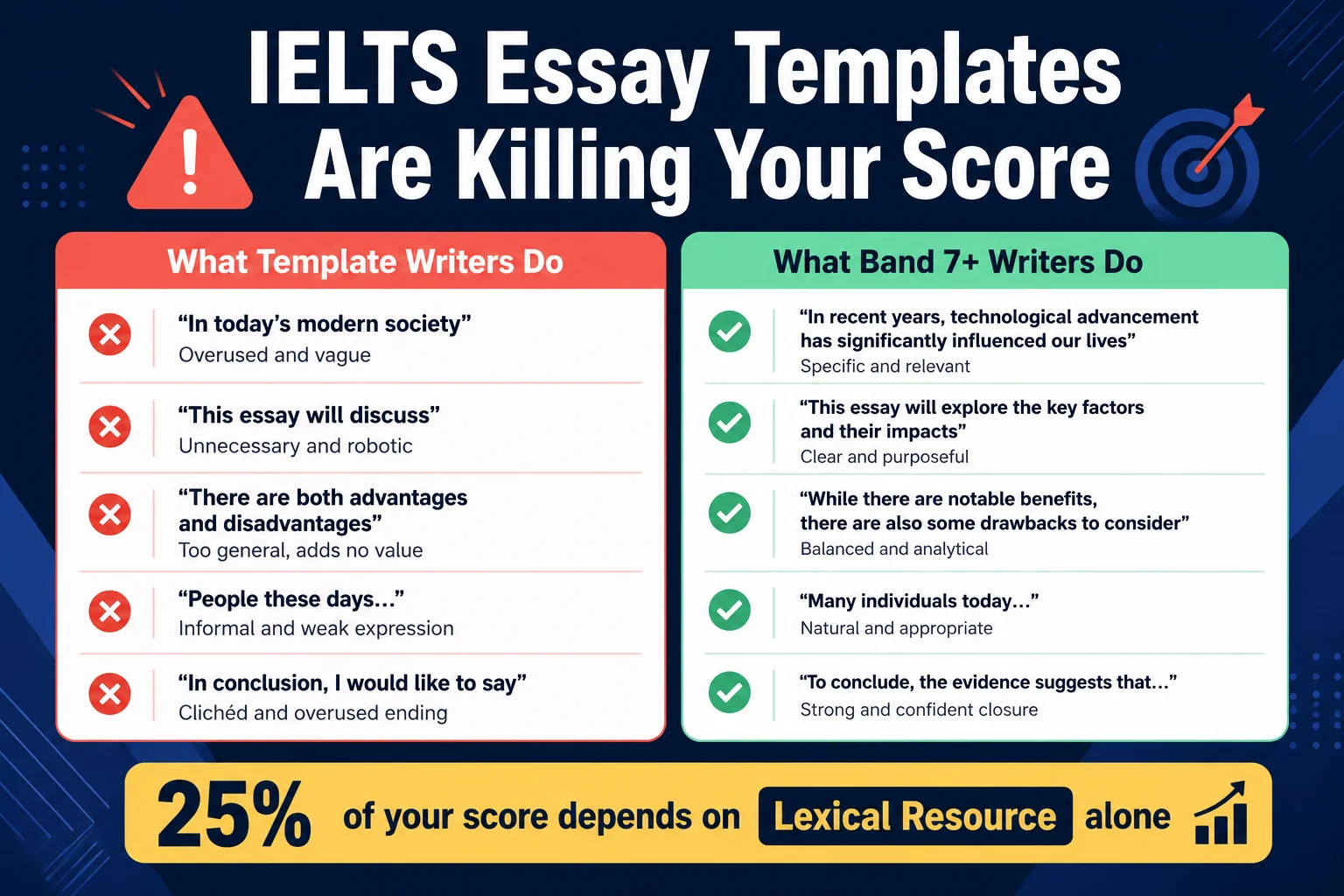
These phrases appear in nearly every IELTS template book. Examiners recognize all of them. If you use them, they signal memorized language rather than genuine ability.
- “In today’s modern society…” — Vague, overused, adds nothing to your argument.
- “It is a controversial topic that has been debated for many years…” — Empty opener that delays your actual response.
- “I strongly agree/disagree with this statement…” — The word “strongly” here is nearly always a template filler rather than a genuine expression of degree.
- “In conclusion, to summarize the above points…” — Redundant. A conclusion is already a summary.
- “There are many advantages and disadvantages…” — If the question asks for your opinion, this signals you are avoiding it.
- “This essay will discuss…” — Academic writing does not typically announce itself this way. It just does.
None of these phrases are grammatically wrong. The problem is that they demonstrate zero topic-specific thinking. Replacing them with your own direct engagement with the question immediately makes your essay stronger.
How to Build Flexible Writing Skills That Score Higher
Read Model Band 7-8 Essays — But Analyze Them
Do not just read high-scoring sample essays and absorb the “vibe.” Instead, annotate them. Ask:
- Why did the writer make this vocabulary choice here?
- How did the writer connect this sentence to the previous one without using a linking word?
- What exactly makes the argument in this paragraph convincing?
This analytical reading builds real skill. Passive reading just builds familiarity.
Time Yourself Differently
Most test-takers practice writing full 40-minute essays. That is useful — but also practice writing just introductions in 5 minutes. Write just one body paragraph in 10 minutes. Isolating sub-tasks builds speed and confidence in each component.
Get Feedback on Criteria, Not Just Errors
If you use a tutor or a writing correction service, ask for feedback against the four IELTS criteria specifically. “This sentence is grammatically wrong” is less useful than “This paragraph lacks a clear central idea, which affects your Coherence score.” Criterion-specific feedback teaches you what the examiner is actually measuring.
Track Your Progress by Band Descriptor
The official IELTS band descriptors are publicly available on the British Council and IDP websites. Print the Band 6, Band 7, and Band 8 descriptors for each criterion. After writing a practice essay, honestly rate your own work against each descriptor. This self-assessment habit develops your understanding of exactly what gap you need to close.
FAQ
Is it completely wrong to use any set phrases in IELTS essays?
No. Some common phrases are fine when they fit naturally. The issue is phrases that are so generic they could apply to any essay topic. If a phrase does not come from genuine engagement with this question and this topic, reconsider whether it adds value.
What is the minimum vocabulary level needed for IELTS Band 7?
You do not need rare or highly academic words. Band 7 Lexical Resource requires that you use a sufficient range of vocabulary with flexibility and precision. Using a word like “prevalent” correctly in context scores better than using “ubiquitous” incorrectly. Precision beats rarity every time.
How many words should an IELTS Task 2 essay have?
The minimum is 250 words, and most Band 7+ essays fall between 270 and 320 words. Writing significantly more than 320 words increases your risk of grammatical errors and does not, by itself, raise your score. Quality over quantity.
Do IELTS examiners penalize non-native English speakers more?
No. The IELTS marking criteria do not reference a writer’s background. An examiner marking your essay does not know your nationality. What they see is the evidence of skill in the writing and the criteria are designed to reward that skill regardless of where you learned English.
How long does it take to go from Band 6 to Band 7 in IELTS Writing?
There is no single answer, but research from test-prep educators suggests that most Band 6 writers need 8 to 16 weeks of focused practice to reach Band 7, assuming regular feedback and deliberate practice not just volume of essays written. The key variable is whether your practice targets the specific gaps in each marking criterion.
The Bottom Line on IELTS Essay Templates
IELTS essay templates give you the feeling of preparation without the substance of it. They create the illusion of structure while actually limiting your ability to respond flexibly to the specific question in front of you.
What IELTS band 7 really demands is a writer who thinks clearly, expresses ideas precisely, and controls language rather than borrowing it. That is a skill and skills are built through practice, feedback, and genuine understanding of what the examiner is measuring.
Stop memorizing IELTS essay templates. Start building the four skills that the marking criteria actually reward. That is the shortest path to Band 7+.

Mr. Sanjay Smart has taught IELTS for the last 30 years and has helped more than 15,000 students clear the IELTS and study abroad. He is also the creator of SMART IELTS, an AI-driven IELTS preparation portal, for which he has lent his content creation, UX Design and Prompt Engineering skills.
Leave a Reply